
Short Answer
Quick Snapshot
In 1955, Michigan was the engine room of American prosperity. The state’s automobile industry produced a record 7,942,893 passenger cars, an increase of more than a million over 1954, cementing its role as the nation’s industrial heartland. The year was defined by two landmark stories: the United Auto Workers (UAW) secured historic guaranteed annual wage agreements with major automakers, and the Salk polio vaccine was declared safe and effective at a press conference in Ann Arbor on April 12. Yet the year also carried darker notes—the unsolved sex slayings of three children gripped the public, and political reforms reshaped the state’s governance.
Michigan’s 1955 was a time of optimism and anxiety, of booming factories and suburban expansion, of scientific triumph and lingering social tensions. The state’s newspapers and broadcasters ranked the UAW agreements and the vaccine as the top stories of the year, reflecting a public eager for security and progress.
Michigan in 1955
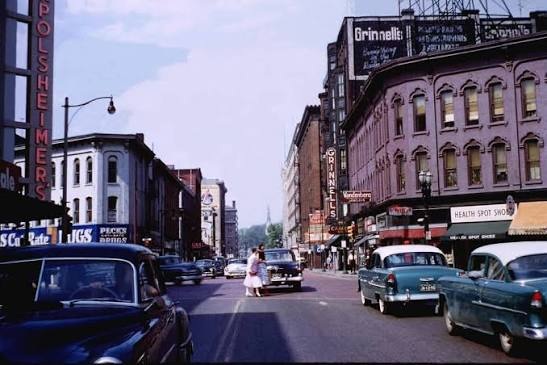
Michigan in 1955 was a state of stark contrasts: vast forests and freshwater shores in the Upper Peninsula, dense industrial cities in the south, and sprawling farmland in between. The Great Lakes—Superior, Michigan, Huron, and Erie—bordered the state, moderating its climate and shaping its commerce. The winter of 1954–55 had been harsh, but by spring the thaw brought a sense of renewal. The atmosphere was one of confident expansion: new highways were being carved, suburbs were sprouting around Detroit, and the automobile reigned supreme.
The state’s identity was inseparable from the car. Detroit, the Motor City, hummed with assembly lines, while Flint, Lansing, and Pontiac echoed with the clang of machinery. Yet beyond the industrial belt, small towns and rural communities maintained a quieter rhythm. The state’s natural beauty—the dunes of Lake Michigan, the forests of the north—drew vacationers, while the growing middle class sought modern homes with lawns and garages.
Population & Economy
Michigan’s population in 1955 was approximately 7.2 million, a steady increase from the post-war boom. The economy was overwhelmingly industrial, with automobile manufacturing as the dominant employer. The Big Three—General Motors, Ford, and Chrysler—along with their suppliers, provided hundreds of thousands of jobs. The UAW’s contracts with these companies set the standard for wages and benefits nationwide.
The cost of living was modest by today’s standards. A loaf of bread cost about 18 cents, a gallon of gasoline about 23 cents, and the median home price in Detroit was around $12,000. The average factory worker earned roughly $2.50 per hour, and the UAW’s new guaranteed annual wage promised supplementary payments for up to 26 weeks during layoffs, a revolutionary safety net. Unemployment was low, and consumer spending was robust as families purchased cars, appliances, and televisions.
Government & Politics
Michigan’s governor in 1955 was Democrat G. Mennen Williams, serving his fourth term. The state legislature was controlled by Republicans, creating a dynamic of partisan negotiation. On April 4, 1955, Michigan voters decided on four statewide ballot measures, all legislatively referred constitutional amendments. All four were approved by wide margins: Proposal 1 (establishing that the legislature set procedures for filling judicial offices) passed with 54% approval; Proposal 2 (qualifications for Supreme Court justices and circuit court judges) passed with 70%; Proposal 3 (authorizing the state to borrow up to $100 million for school district loans and tax levies for school bonds) passed with 72%; and Proposal 4 (establishing a bipartisan board of state canvassers) passed with 61%.
These reforms reflected a progressive era in state governance, addressing judicial procedures, school funding, and electoral oversight. The bipartisan board of state canvassers was seen as a step toward fairer elections. Politically, the state was a battleground, with labor unions and business interests vying for influence.
Industry
The automobile industry was the colossus of Michigan’s economy. In 1955, the industry achieved a record production of 7,942,893 passenger cars, a testament to consumer demand and the efficiency of assembly lines. The UAW’s modified guaranteed annual wage agreements, signed with major manufacturers, were a landmark in labor relations. These agreements obligated automakers to pay workers supplementary payments on top of unemployment benefits for 26 weeks in the event of a layoff, effectively providing a stable income floor.
Beyond autos, Michigan had significant industries in furniture (Grand Rapids), chemicals (Midland), and food processing. The state also had a thriving steel industry, particularly in the Detroit area. Small manufacturing firms supplied parts to the auto giants, creating a dense network of economic activity. The record production levels were not just a statistic; they meant long hours for workers, new hires, and a sense of prosperity that permeated the state.
Education
Michigan’s education system in 1955 was robust, with a network of public schools and several prestigious universities. The University of Michigan in Ann Arbor was a national leader, and its medical school played a pivotal role in the Salk vaccine trials. The university’s football team, coached by Bennie Oosterbaan, had a strong season, finishing 7–2 overall and 5–2 in the Big Ten, ranked No. 12 in the AP poll. The team’s victories over Michigan State and Army drew crowds of nearly 100,000 at Michigan Stadium.
K-12 education was expanding to accommodate the baby boom. New schools were built in suburbs, and there was a growing emphasis on science and technology, partly in response to the Cold War. The state also supported vocational education to train workers for industrial jobs. The ballot measure Proposal 3, which allowed the state to borrow up to $100 million for school district loans, underscored the commitment to educational infrastructure.
Transportation
In 1955, the automobile was king, and Michigan’s road network was expanding to accommodate it. The construction of the Interstate Highway System was just beginning, but major highways like US-12 and US-16 connected cities. Detroit had an extensive network of city streets and freeways, including the Davison and Ford freeways. Streetcars were still operating in some cities, but buses and cars were increasingly dominant.
Railroads remained vital for freight and passenger travel. The New York Central and the Pennsylvania Railroad served Detroit, while the Chesapeake & Ohio and other lines connected the Upper Peninsula. Air travel was growing, with Detroit’s Willow Run Airport handling increasing traffic. For daily commuters, the car was the primary mode, and traffic congestion in downtown areas was a growing concern.
Everyday Life
Everyday life in Michigan in 1955 reflected the post-war American dream. Families lived in single-family homes, increasingly in suburbs, with lawns and driveways. The typical household had a car, a refrigerator, and a television—by 1955, about 75% of American households had a TV. Meals were often home-cooked, with convenience foods like canned soup and frozen vegetables gaining popularity. Clothing was conservative: men wore suits and hats, women wore dresses and gloves for formal occasions.
Entertainment centered on family activities, drive-in movies, and sports. The Detroit Tigers played at Briggs Stadium, and the Detroit Lions were a professional football team. Music was dominated by rock and roll, with artists like Chuck Berry and Bill Haley & the Comets gaining popularity. Social customs emphasized community, church attendance, and neighborhood gatherings. The polio vaccine brought hope to parents, who had lived in fear of the disease each summer.
Major Events
1955 was a year of significant events in Michigan. The top stories, as selected by the Associated Press and United Press, were:
- UAW Guaranteed Annual Wage Agreements: Historic agreements between the UAW and major automakers provided supplementary payments for up to 26 weeks during layoffs.
- Unsolved Sex Slayings: The murders of Barbara Gaca (age 7, found near Pontiac on March 31), Jeannie Singleton (age 8, found north of Kalamazoo on June 1), and Peter Gorham (age 12, found north of Muskegon on August 14) shocked the state and remained unsolved.
- Salk Polio Vaccine Approval: On April 12, at a press conference in Ann Arbor, the Salk vaccine was declared safe and effective.
- Record Automobile Production: The industry produced a record 7,942,893 passenger cars in 1955.
Additionally, the April 4 ballot measures passed, and the University of Michigan football team had a notable season, including a 14–7 victory over Michigan State on October 1.
What Newspapers Were Reporting
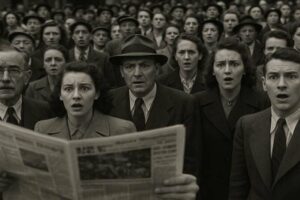
Michigan’s newspapers, led by the Detroit Free Press and The Detroit News, covered the year’s events with intensity. Headlines in April proclaimed the Salk vaccine’s approval, with the Ann Arbor News reporting on the press conference at the University of Michigan. The UAW agreements were front-page news, with labor reporters detailing the negotiations. The slayings of the three children dominated headlines for months, as police pursued leads and the public demanded answers. The record auto production was celebrated in business sections, with articles touting the industry’s contribution to the state’s economy.
Editorials praised the ballot measures as progressive reforms, while letters to the editor debated the vaccine’s safety and the need for school funding. The Flint Journal and Lansing State Journal covered local angles, including the impact of auto layoffs and the construction of new schools.
What People Were Talking About
Around dinner tables and in factory break rooms, Michiganders discussed the Salk vaccine with cautious hope. Parents debated whether to vaccinate their children, and many lined up at clinics when it became available. The UAW’s guaranteed annual wage was a source of pride for union members, who saw it as a victory for workers’ security. The unsolved murders fueled fear and speculation, with parents keeping children closer to home.
The record auto production brought talk of overtime pay and new car models. The 1955 Chevrolet, Ford, and Chrysler models were admired for their tailfins and V8 engines. People also discussed the upcoming football season, the Detroit Tigers’ chances, and the rising popularity of rock and roll. The Cold War was a backdrop, with air raid drills and discussions of fallout shelters.
Historical Photographs
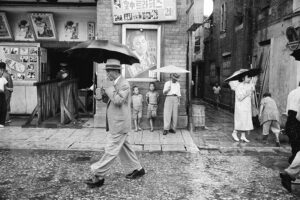
Photographs from 1955 Michigan capture the era’s optimism and style. Images show the April 12 press conference in Ann Arbor, with Dr. Jonas Salk and university officials at a table, microphones in front of them. Factory photographs depict assembly lines with workers in white shirts and fedoras, rows of new cars rolling off the line. Street scenes in Detroit show downtown crowds, streetcars, and neon signs. Family snapshots in suburban backyards show children playing on swing sets, parents posing with new cars.
The University of Michigan’s Bentley Historical Library holds photographs of the football team, including action shots from the Michigan State game and the Ohio State loss. Newspaper photo archives, such as those from the Detroit Free Press, document the crime scenes and police investigations, though these are often graphic and restricted. Overall, the visual record is rich, capturing a state in transition.
Documents & Primary Sources
Historians studying Michigan in 1955 rely on a variety of primary sources. The U.S. Census Bureau’s 1950 and 1960 censuses provide population data, with the 1955 estimates available in state yearbooks. The Official Directory and Legislative Manual of the State of Michigan (1955–1956) details government structure and ballot measures. The UAW’s contracts with automakers are preserved in the Walter P. Reuther Library at Wayne State University, including the guaranteed annual wage agreements.
Newspapers from the period are available on microfilm and digital archives, including the Detroit Free Press and Detroit News. The Bentley Historical Library at the University of Michigan holds the papers of Governor G. Mennen Williams, as well as photographs and university records. The Michigan State Archives in Lansing has court records, police files, and legislative records. Personal letters and diaries, though less common, can be found in local historical societies.
1955 Timeline
| Date | Event |
|---|---|
| March 31 | Body of Barbara Gaca, age 7, discovered near Pontiac. |
| April 4 | Michigan voters approve four constitutional amendments, including school bond borrowing and a bipartisan board of state canvassers. |
| April 12 | Salk polio vaccine declared safe and effective at a press conference in Ann Arbor. |
| June 1 | Body of Jeannie Singleton, age 8, found north of Kalamazoo. |
| August 14 | Body of Peter Gorham, age 12, found north of Muskegon. |
| September 24 | Michigan football opens season with a 42–7 win over Missouri. |
| October 1 | Michigan defeats Michigan State 14–7 before 97,239 fans. |
| October 29 | Michigan beats Iowa 33–21 on homecoming. |
| November 19 | Michigan loses to Ohio State 0–17 in the season finale. |
| Year-long | Record automobile production of 7,942,893 passenger cars. |
What Changed Next
The events of 1955 set the stage for Michigan’s future. The UAW’s guaranteed annual wage became a model for other industries, though it also sparked debates about costs and competitiveness. The Salk vaccine, approved in 1955, led to mass immunization campaigns, and by 1961 polio was virtually eliminated in the U.S. The unsolved murders remained open cases for decades, eventually leading to new forensic techniques.
The record auto production of 1955 was followed by a slight downturn in 1956, but the industry continued to grow through the decade. The state’s political reforms, including the bipartisan canvassers board, improved election integrity. The construction of the Interstate Highway System, authorized in 1956, would transform Michigan’s landscape. The optimism of 1955, however, would be tempered by the social upheavals of the 1960s, including the 1967 Detroit riots, which had roots in the economic and racial tensions of the post-war era.
FAQ
What was the population of Michigan in 1955?
The population was approximately 7.2 million, based on post-war growth trends and census estimates.
What major events happened in Michigan in 1955?
The top stories were the UAW guaranteed annual wage agreements, the approval of the Salk polio vaccine, record automobile production, and the unsolved slayings of three children. Additionally, voters approved four constitutional amendments.
What primary sources are available for studying Michigan in 1955?
Primary sources include newspapers (Detroit Free Press, Detroit News), UAW contract records at the Reuther Library, Governor Williams's papers at the Bentley Library, state legislative manuals, census data, and photographs from the Bentley Historical Library and local archives.
How did daily life in Michigan in 1955 differ from today?
Daily life was less digital, with no internet or smartphones. People relied on landline phones, wrote letters, and watched black-and-white television. The automobile was central, but highways were less developed. Social norms were more formal, with hats and gloves for women, and there was a strong emphasis on family and community. The polio vaccine was a new hope, and the economy was booming with industrial jobs.






Leave a Reply