
Short Answer
On the evening of 1 September 1939, as Europe teetered on the brink of war, London’s lights began to go out. A witness standing on Hungerford Bridge watched the transformation: “I stood on the footway of Hungerford bridge across the Thames watching the lights of London go out. The whole great town was lit up like a fairyland, in a dazzle that reached into the sky, and then one by one, as a switch was pulled, each area went dark, the dazzle becoming a patchwork of lights being snuffed out here and there until a last one remained, and it too went out. What was left was a darkness so profound that it seemed to press down on the city.” That night, the blackout—Britain’s first and most pervasive civil defense measure—began. For the next five years, every British city, town, and village would be forced into darkness after sunset, a darkness that transformed the experience of urban life and left an indelible mark on the national memory.
What Happened?
The blackout was introduced on 1 September 1939, two days before the declaration of war. It was a direct response to the threat of German aerial bombing, which military planners feared would be launched immediately and would be guided by any visible light. The order required all windows, doors, and skylights to be covered with heavy blackout material; all exterior lighting was extinguished; and even the smallest light—a match struck in the street—could result in a fine. The regulations were severe at first, but later allowed limited “glimmer” or “star” lighting for essential purposes.
The blackout was part of a broader civilian defense strategy. On the same day, the first official evacuation scheme began, moving almost 1.5 million people, mostly children, from vulnerable cities to safer rural areas. The blackout remained in force for five years, until September 1944, when it was relaxed to a “dim-out” to ease the strain on civilians.
Key events in the blackout’s history:
- 1 September 1939: Blackout introduced across Britain, two days before war declaration.
- 3 September 1939: War declared; blackout continues as a permanent condition.
- September 1939: Road accidents spike dramatically; 1,130 deaths in the month, double the previous year’s figure.
- January 1942: One in five people had suffered some form of injury directly from the blackout.
- September 1944: Blackout relaxed to a “dim-out” allowing limited lighting.
How It Was Seen at the Time
For most civilians, the blackout was both a physical and psychological shock. It was a constant reminder of the war’s presence, yet it was also a source of frustration and fear. The Imperial War Museum notes that “the first real effect of the Second World War for most British civilians was the blackout.” People understood its military necessity—preventing German bombers from finding targets—but they also resented the loss of safety and comfort.
E.M. Morley, a fourteen-year-old girl in Derbyshire at the outbreak, recalled in her memoir: “When war broke out, in 1939, I was fourteen years old. I was the elder daughter of a miner in one of those scruffy nondescript towns which sprawl northwards through the Erewash valley. We lived on a council estate surrounded by kindly women and hard-drinking men, in a close community with no comprehension of the upheaval which was to come.” Her account captures the mix of ignorance and resilience that characterized the early days.
The blackout also created a new urban landscape. People used torches, painted white lines on kerbs and trees to guide them, and learned to navigate by sound and memory. A contemporary observer wrote: “The blackout was not just darkness; it was a new geography of fear and caution. Every street corner became a hazard, every step a potential fall.”
Historical Snapshot
| Aspect | Detail |
|---|---|
| Date | 1 September 1939 – September 1944 (dim-out thereafter) |
| Place | All of Britain, especially cities like London, Birmingham, Manchester |
| People | All civilians; civil defense wardens; police; workers |
| What Happened | Compulsory blackout of all lights at night to prevent German bombing |
| Why It Mattered | Reduced air raid casualties, but caused road deaths, injuries, and changed social life |
Eyewitness Accounts
Primary accounts from ordinary people reveal the everyday reality of the blackout. E.M. Morley, a teenager in Derbyshire, wrote: “When war broke out, in 1939, I was fourteen years old. I was the elder daughter of a miner in one of those scruffy nondescript towns which sprawl northwards through the Erewash valley, plotting the path of the Industrial Revolution through the area. We lived on a council estate surrounded by kindly women and hard-drinking men, in a close community with no comprehension of the upheaval which was to come.”
Another account, from a Londoner, describes the moment the lights went out: “I stood on the footway of Hungerford bridge across the Thames watching the lights of London go out. The whole great town was lit up like a fairyland, in a dazzle that reached into the sky, and then one by one, as a switch was pulled, each area went dark, the dazzle becoming a patchwork of lights being snuffed out here and there until a last one remained, and it too went out. What was left was a darkness so thick you could feel it.”
Such accounts highlight the profound sensory change—the loss of light was not merely practical but emotional, a symbol of the war’s intrusion into civilian life.
Daily Life
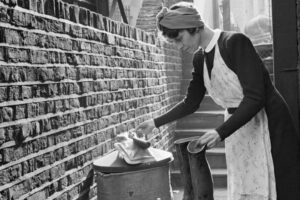
The blackout forced civilians to adapt every aspect of their routines. In the evening, windows had to be covered with heavy black curtains or cardboard. People carried torches with hoods that directed light downward. Streetlights were off, so pedestrians walked in near-total darkness, often using the white-painted kerbs and trees as guides. Women in civil defense units painted white squares along kerbs to facilitate night-time driving, as shown in a photograph from the period.
Work in factories and offices had to be done with limited light. “Glimmer” lighting—a single low-wattage bulb—was allowed in some public spaces, but during air raids all lights had to be extinguished. The blackout also affected social life; theatres, cinemas, and pubs closed early or operated with heavily screened entrances. Many people avoided going out at night altogether, especially the elderly and children.
One of the most significant changes was the dramatic increase in road accidents. The Imperial War Museum reports that in September 1939, 1,130 people died in road accidents, compared to 544 in September 1938. By January 1942, one in five people had some form of injury directly attributable to the blackout. The danger of being run over or falling into a river or canal was constant.
Numbers at the Time
| Statistic | Figure | Source |
|---|---|---|
| Road deaths in September 1939 | 1,130 | Imperial War Museum |
| Road deaths in September 1938 | 544 | Imperial War Museum |
| People injured by blackout by January 1942 | 1 in 5 | Imperial War Museum |
| Duration of full blackout | 5 years (1939–1944) | Imperial War Museum |
Timeline
- 1 September 1939: Blackout introduced; evacuation begins.
- 3 September 1939: Britain declares war on Germany.
- September 1939: Road deaths spike to 1,130.
- 1940–1941: Blitz air raids intensify; blackout remains in force.
- January 1942: One in five civilians have been injured in blackout.
- September 1944: Blackout relaxed to a “dim-out” as threat of air raids diminishes.
- May 1945: Full lighting restored after VE Day.
Aftermath
The blackout was gradually relaxed in September 1944, when the threat of German bombers had lessened. The “dim-out” allowed streetlights to be lit at reduced intensity, and many restrictions were lifted. When the war ended in May 1945, the blackout was officially over, and cities once again blazed with light. The return to normal lighting was a powerful symbol of peace. The blackout had left a deep mark on the British memory: it was a shared experience of darkness, danger, and adaptation. It also had lasting effects on urban design, public lighting standards, and civil defense planning. The blackout was not merely a temporary inconvenience but a transformation of the urban environment that shaped how a generation understood the city.
In the end, the blackout is remembered not only as a military necessity but as a defining experience of the British Home Front. It was a time when the very fabric of city life was turned upside down, and ordinary people learned to live in darkness. The primary sources—diaries, letters, and photographs—preserve that experience, reminding us of the resilience and resourcefulness of those who lived through it.
FAQ
When did the blackout start and end in Britain?
The blackout began on 1 September 1939, two days before the war declaration, and was relaxed to a dim-out in September 1944. Full lighting was restored after the war ended in May 1945.
Why was the blackout imposed?
The blackout was a civil defense measure to prevent German bombers from using city lights as navigational aids at night. It was believed that darkness would make air raids less accurate.





Leave a Reply