
Short Answer
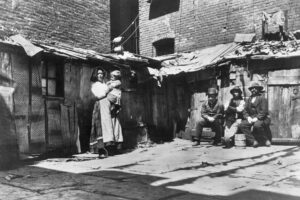
In the summer of 1936, photographer Arthur Rothstein, working for the Farm Security Administration, aimed his camera at a cluster of makeshift shelters on the outskirts of Portland, Oregon. The shacks—built from used lumber, scrap metal, and cardboard—housed families who had lost their homes and jobs in the Great Depression. They called their settlement a “Hooverville,” a bitter pun on President Herbert Hoover’s name, suggesting that the man in the White House was responsible for their misery. Rothstein’s photograph, now preserved in the Library of Congress, is one of many primary sources that document these transient communities. It shows a stark landscape: a few rough-built cabins, a dirt path, and the bare necessities of life. The image is a visual record of what contemporaries saw, but also of what many preferred to ignore. It captures a moment when the American Dream had turned into a nightmare for millions, and when the homeless were forced to create their own shelter out of scraps.
What Happened?
The Great Depression, which began with the stock market crash of October 1929, led to unprecedented unemployment and homelessness. As the economy collapsed, people who had lost their homes and jobs began to construct temporary settlements on vacant land, often near city dumps, rivers, or railway yards. These communities came to be known as “Hoovervilles,” a term coined as an insult to President Herbert Hoover, who was widely criticized for his handling of the crisis.
Primary sources record the spread of these settlements across the country:
- In 1931–1932, the Los Angeles County Health Department photographed a series of temporary encampments throughout the county, including a “Hoover Town” in the Graham neighborhood. The photographs were accompanied by typewritten captions describing the sites, documenting the scale of the problem.
- In July 1936, Arthur Rothstein photographed a Hooverville in Portland, Oregon, for the Farm Security Administration. The photograph, now in the Library of Congress, shows the community’s structure and materials.
- In 1935, sociologist Donald Francis Roy conducted a study of the Hooverville in Seattle, Washington, describing it as a community of about 500 shanties on a former shipyard site. His study, “Hooverville: A Study of a Community of Homeless Men in Seattle,” remains a key primary source.
- In September 1935 and September 1936, the Works Progress Administration’s Division of Social Research conducted a survey of the transient and homeless population in 12 cities, producing a research bulletin that documented the scale of homelessness.
These sources show that Hoovervilles were not isolated, but widespread. They were populated by men, women, and children—though many were single men—and they varied in size from a few shacks to hundreds of structures. The settlements were often built on public or unused land, and they were frequently dismantled by authorities, but they persisted as long as the Depression did.
How It Was Seen at the Time
Contemporaries understood Hoovervilles as a direct indictment of the federal government’s failure to provide relief. The very name “Hooverville” was a form of political protest. The Gilder Lehrman Institute notes that these communities were “so named as an insult to President Herbert Hoover, who seemed to be hardened to the plight of Americans during the Depression.”
Social workers and health officials documented the settlements with a mixture of concern and moral judgment. The Los Angeles County Health Department’s captions described the sites as unsanitary and dangerous. Donald Francis Roy, in his 1935 study, described the physical appearance of the Seattle Hooverville:
“Five hundred tiny shanties huddle in the rain and steam in the sun on a former shipyard site to form a picture quite different from the usual American residential scene. Even the traditional street patterns of occidental civilization have been discarded. Aside from one graded road that bisects the community to form connections with a pier, there are no street or boulevards—no named and numbered avenues to aid the stranger in finding his way about. Paths weave…”
Roy’s description captures the sense of a separate, almost foreign world within the city. The name “Hooverville” was not used by the residents themselves; it was an outsider’s label, often used with pity or disdain. The photographs taken by Rothstein and the Health Department show the settlements as they were, but the captions and reports that accompany them reveal the contemporary perspective: these were seen as a problem to be managed, not a community to be understood.
Historical Snapshot
| Aspect | Detail |
|---|---|
| Date | 1931–1936 (and throughout the Depression) |
| Place | Across the United States, including Portland, Oregon; Los Angeles, California; Seattle, Washington; and 12 other cities surveyed by the WPA |
| People | Homeless men, women, and families; the unemployed; migrant workers; the “transient” population |
| What Happened | Temporary shantytowns were built from scrap materials on public or unused land |
| Why It Mattered | They symbolized the failure of the federal government’s response to the Depression and highlighted the scale of homelessness |
Eyewitness Accounts
The most detailed eyewitness account among the sources is Donald Francis Roy’s 1935 study of the Seattle Hooverville. Roy, a sociologist, lived in the community and described its physical structure and social organization. His account is not merely a list of observations; it conveys the daily reality of the settlement:
“The name is deceiving. Hooverville is not an incorporated community, proudly referring to itself with the surname of one of its distinguished founders—not a small rural village struggling to preserve its identity in an era of voracious metropolitanism. It is not a discrete community at all, but an integral part of a highly differentiated urban design within the city, and of the city, it functions as a segregated residential area of distinct physical structure, population composition, and social behavior.”
Roy’s account emphasizes that the settlement was not a random collection of shacks but a functioning, if improvised, neighborhood. He notes that the residents had created their own paths, social norms, and even a kind of order. The photograph taken by Rothstein in 1936 also serves as an eyewitness record, though it is a visual rather than a written account. The image shows the materials used—wood, cardboard, and scrap metal—and the lack of basic comforts that the residents suffered.
Official Reports
The Works Progress Administration’s Division of Social Research issued a research bulletin titled A Survey of the Transient and Homeless Population in 12 Cities, covering September 1935 and September 1936. This official report was part of a larger series on the migratory labor problem, requested by the Secretary of Labor in response to Senate Resolution 298. The bulletin, prepared by Starr Northrop, Malcolm J. Brown, and Katherine Gordon, under the supervision of John N. Webb, documented the scope of homelessness in urban centers. The report was based on surveys conducted in 12 cities, and it provided statistics on the number of transients, their age, gender, and employment history. It also described the conditions of the temporary encampments, including the Hoovervilles, and the relief efforts that were being attempted. The report was intended to inform federal policy on relief and housing. It is a key official primary source, showing that the federal government was actively studying the problem, even as the administration of Franklin D. Roosevelt had replaced Hoover’s, and the New Deal was beginning to take shape.
Daily Life
The daily life of Hooverville residents was a constant struggle for survival. The photograph of the Portland Hooverville shows shacks built from scrap materials—wood, cardboard, and metal—that offered minimal protection from the elements. Residents lacked running water, electricity, and sanitation. The Los Angeles County Health Department’s photographs, taken in 1931–1932, were accompanied by captions that described the sites as unsanitary and a threat to public health. The Health Department’s interest was not only to document, but to address the health risks posed by the encampments.
In Seattle, Roy described the community’s internal organization: paths were the only thoroughfares, and the shanties were arranged without any formal street plan. Residents cooked over open fires, and water was often carried from nearby sources. Clothing was mended and reused, and food was scarce. Many residents worked for meager wages in day labor, while others scavenged for scrap metal, wood, and other materials to sell. The community was overwhelmingly male, but there were families as well. Children grew up in these settlements, and the lack of schooling and medical care was a constant concern.
Contemporary Terminology
The term “Hooverville” was the most famous name for these settlements. It was a pun on President Hoover’s name, implying that he was responsible for the crisis. The Gilder Lehrman Institute notes that the name was “an insult to President Herbert Hoover, who seemed to be hardened to the plight of Americans during the Depression.” Other terms used included “Hoover Town,” as seen in the Los Angeles County photograph, and “Hoover Heights.” The term “shantytown” was also used, though less politically charged. The word “transient” was used in official reports to refer to the homeless population, as in the WPA survey. The term “hobo” was often used for the homeless men who traveled in search of work. These terms were used by officials and the press, but the residents themselves often referred to their settlements simply as “the camp” or “the jungle.” The term “Hooverville” carried a political sting, and it was not always embraced by the residents themselves.
Numbers at the Time
| Statistic | Value | Source/Year |
|---|---|---|
| Number of shanties in Seattle’s Hooverville | Approximately 500 | Donald Francis Roy, 1935 |
| Number of cities surveyed by WPA | 12 | WPA Survey, 1935–1936 |
| Dates of LA County encampment photographs | 1931–1932 | Los Angeles County Health Department |
| Date of Rothstein’s Portland photograph | July 1936 | Arthur Rothstein, Farm Security Administration |
Common Misconceptions
Hoovervilles were only in large cities.
While many were urban, they also appeared in smaller towns and rural areas, though the primary sources we have focus on cities like Los Angeles, Portland, and Seattle.
Hoovervilles were only inhabited by single men.
While many residents were single men, families and children also lived in these communities. The photographs and reports show women and children as well.
Hoovervilles were chaotic and disorganized.
As Roy’s study shows, some communities had a social order and informal governance. The residents often created paths, shared resources, and maintained a degree of organization.
The name “Hooverville” was used by the residents themselves.
The term was an external label, often used by officials and the press to criticize the Hoover administration. Residents may have used other terms.
Aftermath
The Hoovervilles did not disappear overnight. They persisted throughout the Depression, and some continued into the early 1940s until the economic boom of World War II provided jobs and housing. The New Deal programs, such as the Works Progress Administration and the Federal Housing Administration, aimed to provide relief and stimulate housing construction, but the immediate impact on the Hoovervilles was limited. As the economy improved, many residents found work and moved to more permanent housing. The communities were often cleared by local authorities, and some were burned or dismantled. The primary sources we have today—photographs, surveys, and studies—remain as a testament to the resilience of the homeless during the Great Depression, and as a reminder of the social cost of economic crisis.
The primary sources of the Hoovervilles—the photographs of Rothstein and the Health Department, the survey of the WPA, and the sociological study of Roy—offer a window into a moment when the American promise of prosperity collapsed. They show not only the physical deprivation, but also the human spirit of those who built communities out of scrap. They also reveal the attitudes of the time, the political criticism, and the bureaucratic response. The Hoovervilles are not just a footnote in history; they are a testament to the resilience of the human spirit in the face of adversity, and a reminder that the past is never far from the present.
FAQ
Why were they called Hoovervilles?
The name was a political insult aimed at President Herbert Hoover, who was widely blamed for the Great Depression. The term implied that Hoover was responsible for the homelessness and poverty that forced people to build these shantytowns.
What did Hoovervilles look like?
According to primary sources like the 1936 photograph by Arthur Rothstein and the 1935 study by Donald Roy, Hoovervilles were made of scrap materials—used lumber, cardboard, and metal. They often had no streets or sanitation, and were built on vacant land near cities.
Who lived in Hoovervilles?
They were inhabited by unemployed workers, families, and transients. The WPA survey of 1935–1936 documented the transient population in 12 cities, and Roy's study of Seattle noted that the community was largely male but also included women and children.
How long did Hoovervilles exist?
They appeared early in the Depression, around 1931, and continued until the economic recovery during World War II. The WPA survey was conducted in 1935–1936, and the Rothstein photograph was taken in 1936, showing they were still present then.








Leave a Reply