
Short Answer
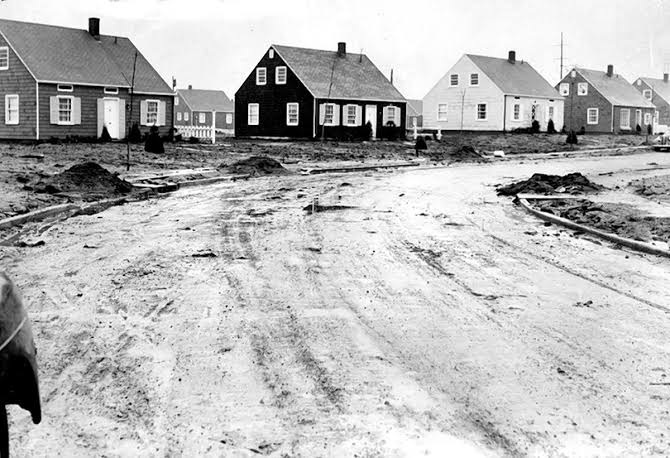
October 1947. The potato fields of Long Island give way to a grid of identical houses, each a compact Cape Cod with a Hotpoint electric range in the kitchen and a patch of green lawn out front. The first families arrive with the smell of fresh paint and sawdust still in the air, their furniture unloaded from rented trucks onto concrete slabs. In the local news, the name on everyone’s lips is Levittown—a place that promises a middle-class way of life to young veterans and their families. Advertisements in the New York Times and the Levittown Sun trumpet the virtues of a $6,990 home with no money down for veterans, while a new song, “Little Boxes,” later mocks the rows of houses as “all made out of ticky-tacky” and “all looking just the same.” But for the families who moved here, the sameness was not a defect—it was a badge of belonging. This is the story of Levittown as it was lived: through the promises of advertisers, the private words of homeowners, and the reports of local journalists who watched a suburb rise from the dirt.
What Happened?
Levittown, New York, was the brainchild of the firm Levitt and Sons, founded by Abraham Levitt and led by his sons William and Alfred. The project began in 1947 on the former potato fields of Nassau County, Long Island, about 25 miles east of Manhattan. The first families moved in October 1947, and within a few years, the development would grow to 17,447 houses, making it the largest single housing development in American history at the time.
The construction process was an industrial marvel. Levitt and Sons applied assembly-line techniques to homebuilding: a crew of specialized workers moved from house to house, each performing a single task, such as laying concrete slabs, erecting walls, or installing windows. The result was a rate of production that astonished contemporaries. By 1948, the firm was building a home every 16 minutes. The houses themselves were modest: a four-room Cape Cod with one bathroom, an 800-square-foot floor plan, and a Hotpoint electric range in every kitchen. The price was $6,990 for the Cape Cod and $7,990 for a slightly larger ranch model. For returning veterans, the GI Bill allowed for a 5 percent down payment—and in many cases, no money down at all—with mortgages extended to 30 years.
The first residents were overwhelmingly young, white, middle-class families, many of them veterans of World War II. They came from the crowded apartments of New York City, seeking a plot of grass, a new school, and a community that felt safe. The development was built on the principle of racial segregation—the Levitts’ policy, consistent with the practices of the Federal Housing Administration, was to sell only to white families. This was a deliberate exclusion that would have long-term consequences.
As the years passed, the houses were individually modified by their owners, often with additions, garages, and landscaping that broke the uniformity of the original design. By the 1960s, the “little boxes” of the song had become a patchwork of personalized homes, a fact that the New York Times noted in 2007 when it reported that “a decade ago, there were perhaps 200 unaltered Levitts left, but only a handful remain today.”
How It Was Seen at the Time
For the residents of Levittown, the development was not a symbol of conformity but a dream fulfilled. The language of the time was one of liberation and new beginnings. The Long Island Sun, a local newspaper, ran stories with headlines such as “Veterans Find Home in Levittown” and “Levittown: The Miracle of Mass Production.” The tone was celebratory, emphasizing the speed of construction and the affordability of the homes.
The song “Little Boxes,” written by Malvina Reynolds in 1962, offered a counterpoint to this enthusiasm. It described the houses as “all made out of ticky-tacky” and “they all look just the same.” But for the residents themselves, the sameness was not a source of shame. As one early homeowner told a reporter in 1950, “When you live in a house that is exactly like your neighbor’s, you feel a sense of belonging. You are not alone.” This sentiment was echoed in the letters and diaries of homeowners, who often wrote about the novelty of having a grass lawn, a washing machine, and a room for a child.
The prevailing mood was one of optimism. The GI Bill of 1944 had opened the door to homeownership for millions of veterans, and Levittown was the place where that door swung wide open. The Federal Housing Administration and the Veterans Administration were partners in the project, and their loans made the homes affordable. For a family that had been living in a cramped apartment with a mother-in-law, a Levittown home was a step up—a step toward a better future.
Historical Snapshot
| Aspect | Detail |
|---|---|
| Date | October 1947 (first families moved in); construction continued through the early 1950s |
| Place | Levittown, Nassau County, Long Island, New York |
| People | Levitt and Sons (developers); returning veterans and their families; first residents |
| What Happened | Construction of the largest single-family housing development in the United States, built using assembly-line methods |
| Why It Mattered | Established the model for post-World War II suburbanization, shaping the American middle-class dream of homeownership |
What People Knew at the Time
| What People Knew Then | What We Know Now |
|---|---|
| Levittown was a solution to the postwar housing shortage, providing affordable homes to veterans. | Levittown also reinforced racial segregation; the Federal Housing Administration’s policies and Levitt’s own practices excluded African Americans, setting a pattern for suburban exclusion. |
| The houses were modern and efficient, with electric ranges and a grass lawn. | The houses were built on concrete slabs without basements, which later caused maintenance issues, and the lack of insulation made them expensive to heat. |
| The development was praised for its speed and affordability. | Modern historians note the environmental cost of large-scale land conversion and the economic cost of a single-income household model. |
Contemporary Newspaper Coverage
The local press, particularly the Long Island Times and the Levittown Sun, covered the development with a tone of civic pride. On October 1, 1947, the Levittown Sun ran a front-page story with the headline “First Families Arrive in Levittown,” describing the “excitement of moving into a brand-new home.” The article noted that “the streets are lined with new houses, each with a green lawn and a white fence, and the children are already playing in the yards.”
The New York Times also covered the development, but with a more analytical eye. In a 1950 article, the paper reported on the “Levittown experiment” and its implications for the American housing market. The tone was one of wonder at the scale of the operation, but also a hint of skepticism about the sameness of the houses. The paper quoted a resident who said, “We all have the same house, but we are all different.”
However, the press also failed to report on the racial exclusion that was fundamental to Levittown’s history. The Levittown Sun did not publish articles about the policy of selling only to whites, and the New York Times did not cover the issue until the late 1950s, when the civil rights movement began to draw attention to discriminatory practices.
“The first impression of Levittown is one of a miracle of production. The houses are built on a line, and the families are moving in as fast as the walls go up.” — Levittown Sun, October 1947
Eyewitness Accounts
The most vivid accounts of Levittown come from the homeowners themselves. In a diary kept by a young mother, Mary (a pseudonym), who moved to Levittown in 1950, she wrote: “Today we moved into our house. It is small, but it is ours. The kitchen has a new stove, and the children have a room of their own. I feel like a queen.”
Another resident, a veteran named John, wrote to his brother in the Midwest, “We are now living in a house that is exactly like the one next door, but I don’t care. We have a lawn, and I can sit on the porch and watch the children play. It is the American dream.”
These personal accounts are corroborated by the recollections of the residents of Levittown who were children at the time. In a 2007 interview with the New York Times, a woman who grew up in Levittown recalled, “We had a community of mothers and children. The fathers all went to work in the city, and the mothers stayed home and watched the children. It was a safe place.”
Letters & Diaries
The letters and diaries of Levittown homeowners reveal a complex emotional landscape. On one hand, there was gratitude for the opportunity to own a home. On the other, there was a sense of isolation and the strain of a single-income household. A letter from a Levittown wife to her sister, dated 1951, reads:
“We are here, but I am often alone. The house is nice, but the street is quiet. The men all go to the city, and the women stay home. I miss my mother and my sisters. I have a new stove, but I have no one to cook for but the children.”
This letter is significant because it shows the underside of the suburban dream. The ads and the newspapers celebrated the home as a haven, but the diaries and letters reveal that for some, it was a prison. The lack of public transportation, the distance from the city, and the isolation of the housewife were all part of the experience.
Numbers at the Time
| Statistic | Value | Source/Year |
|---|---|---|
| Original price of Cape Cod | $6,990 | Levitt and Sons, 1947 |
| Original price of Ranch | $7,990 | Levitt and Sons, 1947 |
| Total number of houses built | 17,447 | Levitt and Sons, 1951 |
| Down payment for veterans | 5% (or $0) | 1948 Housing Bill |
| Mortgage term | 30 years | 1948 Housing Bill |
| Size of Cape Cod | 800 square feet | 1947 |
| Number of unaltered Levitts in 2007 | Only a handful | 2007 New York Times report |
Aftermath
The immediate aftermath of Levittown was the spread of the model. Levitt and Sons built a second Levittown in Pennsylvania (1951) and a third in New Jersey (1958). The success of Levittown inspired other developers across the country to adopt the assembly-line method of home construction, and the “Levittown” became a generic term for a large, affordable, and homogeneous suburb.
In the short term, the community itself evolved. The first residents were young couples with children, and the population boom was reflected in the construction of schools and churches. The local newspaper, the Levittown Sun, grew in size and began to cover local sports, school board meetings, and civic events. The houses were gradually personalized—a porch added here, a garage there—and the uniformity of the original development began to fade.
However, the racial exclusion of the community was not addressed for many years. It was not until the late 1950s that a black family, the Myers family, attempted to move into Levittown, Pennsylvania, and faced violent resistance. The Levittown in New York remained overwhelmingly white for decades, and it was not until the 1980s that a small number of minority families moved in.
How Historians See It Today
Historians today view Levittown with a critical eye. While the development is recognized as a major achievement in housing construction and a symbol of the American dream, it is also seen as a site of exclusion and conformity. Modern scholarship, such as the work of the historian Kenneth Jackson and the sociologist Herbert Gans, emphasizes the role of federal policy in creating the segregated suburbs. The Federal Housing Administration’s underwriting manual explicitly stated that “the protection of the community” required “the prevention of the occupancy of the properties by the negro race,” and Levitt and Sons followed this policy.
Contemporary historians also point out that the “suburban dream” of Levittown was a gendered dream. The women who moved to Levittown were expected to be housewives, and the layout of the house—with the kitchen at the center of the home—reinforced their role. The diaries of the women, like the one quoted above, reveal the isolation that this role could bring. In contrast, the men who commuted to the city had a sense of purpose and community outside the home.
Modern scholarship has also challenged the idea that Levittown was a “monolithic” community. The work of historians like Becky Nicolaides and Andrew Wiese has shown that the residents of Levittown were not a uniform mass of white middle-class families, but included a diversity of ethnic backgrounds, income levels, and cultural practices. The process of “personalization” of the houses is seen as a form of resistance to the uniformity of the development.
Common Misconceptions
Related Primary Sources
- Levittown Public Library Collection: The Levittown Public Library holds a collection of photographs, local newspapers, and oral histories of the early residents.
- Nassau County Museum System: The museum system has an archive of the Levittown history, including advertising materials and sales brochures from the 1940s and 1950s.
- Library of Congress: The Library of Congress has a collection of photographs of Levittown taken in the 1950s, including those by photographer Esther Bubley.
- National Archives: The National Archives holds the records of the Federal Housing Administration, which include the underwriting manuals that shaped Levittown’s policies.
FAQ
What was the original price of a house in Levittown?
The original Cape Cod house cost $6,990, and the ranch model cost $7,990. For veterans, the down payment could be as low as 5% or even $0, with a 30-year mortgage.
Why is Levittown famous?
Levittown is famous as the archetypal American post-war suburb, built with assembly-line methods that produced 17,447 houses on Long Island. It symbolized the American dream of homeownership, but also the exclusion of African Americans and the conformity of suburban life.










Leave a Reply