Short Answer
Quick Snapshot
Chicago in 1893 was a city of breathtaking contrasts—a sprawling industrial giant on the shores of Lake Michigan that had rebuilt itself from the ashes of the Great Fire only twenty-two years earlier. The year was dominated by the World’s Columbian Exposition, a dazzling fair that drew more than 27 million visitors to the city’s South Side and showcased American technological and cultural achievement. Yet beneath the gleaming white facades of the fair’s ‘White City,’ Chicago remained a gritty, smoke-choked metropolis of stockyards, steel mills, and crowded immigrant neighborhoods.
The same year brought the Panic of 1893, a severe economic depression that shuttered banks, threw thousands out of work, and exposed the fragility of the city’s boom. The assassination of popular Mayor Carter Harrison Sr. on October 28, just days before the fair closed, cast a pall over the city’s triumphs. For residents, 1893 was a year of wonder and hardship, of grand visions and daily struggles—a moment when Chicago stood as both a symbol of American progress and a warning about its costs.
Chicago in 1893
Chicago occupied a flat, marshy plain along the southwestern shore of Lake Michigan, its grid of streets stretching outward from the Chicago River. The city’s geography was both a blessing and a challenge: the lake moderated temperatures but also brought fierce winds and lake-effect snow in winter, while the low-lying terrain required extensive drainage and sewerage works. In 1893, the climate was typical of the upper Midwest—cold, snowy winters and hot, humid summers. That summer, fairgoers endured sweltering heat, with temperatures often exceeding 90°F (32°C), while the fall brought crisp, clear days ideal for the fair’s final weeks.
The atmosphere in 1893 was electric with civic pride. Chicagoans called their city the ‘Garden City’ and the ‘Queen of the West,’ but visitors more often remarked on its noise, smoke, and relentless energy. The skyline was a jumble of brick and stone commercial blocks, grain elevators, and factory chimneys, while the streets below teemed with horse-drawn wagons, cable cars, and newly electrified streetcars. The fair’s neoclassical buildings, designed by Daniel Burnham and Frederick Law Olmsted, offered a vision of order and beauty that stood in stark contrast to the chaotic industrial city surrounding it.
Population & Economy
Chicago’s population in 1893 was estimated at 1,300,000, up from 1,099,850 in the 1890 federal census—a growth rate of nearly 20 percent in three years. The city was the second-largest in the United States, trailing only New York. Immigrants made up a substantial share: Germans, Irish, Poles, Bohemians, Swedes, and Italians crowded into ethnic enclaves such as Pilsen, Bridgeport, and Little Italy. African Americans, though still a small minority, were establishing a growing community on the South Side.
The economy was dominated by meatpacking, steel production, railroad transportation, and manufacturing. The Union Stock Yards processed millions of animals annually, while the Illinois Steel Company’s South Works and the Pullman Palace Car Company employed tens of thousands. Wages for skilled workers ranged from $2 to $4 per day, but unskilled laborers often earned less than $1.50. The cost of living was relatively low by modern standards: a loaf of bread cost about 5 cents, a pound of beef 10–12 cents, and a modest tenement apartment rented for $8–15 per month. However, the Panic of 1893, which began in May, caused widespread bank failures and unemployment that reached an estimated 20–25 percent by year’s end.
Government & Politics
Chicago was governed by a mayor and a 68-member city council, but real power often lay with ward bosses and political machines. The dominant figure in 1893 was Mayor Carter Harrison Sr., a Democrat first elected in 1879 and serving his fifth non-consecutive term. Harrison was a charismatic, pragmatic politician who cultivated immigrant voters and championed the World’s Fair. He famously declared that Chicago would ‘make the fair a success if it takes the last dollar in the treasury.’
The political climate was turbulent. The city council was rife with corruption, and aldermen routinely traded favors for bribes. The upcoming 1893 mayoral election had been won by Harrison in April, but his assassination in October threw the city into mourning and political uncertainty. John P. Hopkins succeeded him as acting mayor. National politics also intruded: the Panic of 1893 was blamed on the Sherman Silver Purchase Act, and Chicago became a center of labor and populist agitation.
Industry
Chicago’s industrial landscape in 1893 was vast and varied. The Union Stock Yards, covering over 475 acres, was the largest livestock processing center in the world, employing more than 25,000 workers and slaughtering over 8 million animals a year. The Pullman Palace Car Company, located in the model town of Pullman south of the city, manufactured luxury railroad cars and employed about 6,000 workers. The McCormick Reaper Works, later International Harvester, produced agricultural machinery that transformed farming across the Midwest.
Other major employers included the Illinois Steel Company, whose South Works in the Calumet region produced rails and structural steel, and the Western Electric Company, which made telegraph and telephone equipment. The city’s railroads—the Illinois Central, Chicago, Burlington & Quincy, and Atchison, Topeka & Santa Fe—made Chicago the nation’s rail hub, with more than 30 railroads entering the city. The World’s Fair itself stimulated industries from construction to printing, as thousands of workers built the fairgrounds and produced souvenirs.
Education
Chicago’s public school system in 1893 enrolled over 200,000 students in more than 200 schools. The city had made significant strides in compulsory education, though many immigrant children still left school early to work. The University of Chicago, founded in 1890 with a gift from John D. Rockefeller, opened its new Gothic campus in Hyde Park in 1892 and was already gaining a reputation for rigorous scholarship under President William Rainey Harper. The Armour Institute of Technology, predecessor of the Illinois Institute of Technology, offered technical training, while the Chicago Public Library, housed in a grand building on Michigan Avenue, provided free access to books and reading rooms.
Literacy rates were relatively high among native-born whites but lower among recent immigrants. Evening schools and settlement houses, such as Jane Addams’s Hull House, offered classes in English, citizenship, and vocational skills. The World’s Fair also served as an educational spectacle, with exhibits on science, history, and art that drew school groups from across the city.
Transportation
Chicago in 1893 was a city in motion. The dominant mode of urban transport was the cable car, which ran on major thoroughfares like State Street and Madison Street, but electric streetcars were rapidly replacing horse-drawn and cable lines. The city’s first elevated railway, the South Side Elevated, had opened in 1892 and was extended to serve the World’s Fair, carrying passengers from downtown to Jackson Park in about 20 minutes. Steam railroads connected Chicago to every corner of the nation, and the Illinois Central’s suburban line ran along the lakefront.
For ordinary residents, walking remained the most common way to get around, especially in dense neighborhoods. Bicycles were enjoying a craze, with thousands of Chicagoans taking to the streets on safety bicycles. The Chicago River was still a working waterway, crowded with barges and schooners, while Lake Michigan steamships offered passenger service to Michigan and Wisconsin. The fair itself introduced many visitors to the intramural electric railway, an elevated loop that circled the fairgrounds and carried millions of passengers.
Everyday Life
Daily life in 1893 Chicago varied dramatically by class and neighborhood. Working-class families typically lived in two- or three-room tenements or small frame cottages, often without indoor plumbing. They rose before dawn, ate simple meals of bread, potatoes, and salted meat, and worked ten to twelve hours a day, six days a week. Women managed households, took in boarders, or worked in factories and sweatshops. Children played in alleys and vacant lots, and many contributed to family income by selling newspapers or shining shoes.
Middle-class families enjoyed more comfortable homes in neighborhoods like Hyde Park and Lincoln Park, with gas lighting, running water, and sometimes telephones. They dressed in ready-made clothing from department stores such as Marshall Field’s and Carson Pirie Scott. Entertainment options included vaudeville theaters, baseball games, and the new amusement parks that sprang up around the city. The World’s Fair itself was the great social event of the year, with Chicagoans visiting repeatedly to see the Ferris Wheel, the Midway Plaisance, and the exhibits of foreign nations.
Food was abundant but simple. The stockyards made beef cheap, and Chicago was famous for its steakhouses. Immigrant communities maintained their own cuisines—German beer gardens, Italian groceries, Polish bakeries. The fair introduced many Americans to new foods, including Cracker Jack, Shredded Wheat, and the hamburger, which was popularized on the Midway.
Major Events
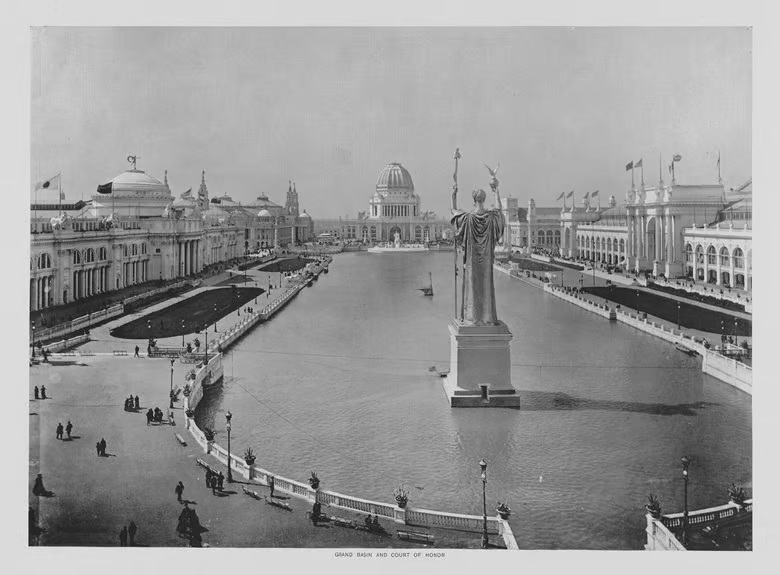
The defining event of 1893 was the World’s Columbian Exposition, which opened on May 1 and closed on October 30. The fair commemorated the 400th anniversary of Columbus’s arrival in the Americas and covered more than 600 acres in Jackson Park and the Midway Plaisance. Its centerpiece was the Ferris Wheel, a 264-foot engineering marvel designed by George Washington Gale Ferris Jr. The fair also introduced the world to alternating current electricity, showcased in the dazzling electrical displays of the Court of Honor.
But 1893 also brought crisis. The Panic of 1893 began in May with the failure of the National Cordage Company and quickly spread, causing bank runs, business failures, and mass unemployment. In Chicago, the panic hit hard: dozens of banks closed, construction halted, and soup kitchens opened. On October 28, as the fair was winding down, Mayor Carter Harrison Sr. was shot and killed in his home by Patrick Eugene Prendergast, a disgruntled office-seeker. The assassination shocked the nation and cast a shadow over the fair’s closing ceremonies.
What Newspapers Were Reporting
Chicago’s newspapers in 1893 were numerous, competitive, and sensational. The Chicago Tribune, Chicago Daily News, Chicago Times, and Chicago Herald all covered the fair extensively, often with lavish illustrations and special editions. On May 2, the Tribune reported:
‘The great fair is open. The dream of years has become a reality. The White City stands revealed in all its beauty, and the world has come to see it.’
As the Panic deepened, headlines turned grim. The Daily News ran stories of bank failures and unemployment lines, while the Tribune editorialized about the need for currency reform. The assassination of Mayor Harrison dominated the front pages in late October, with the Tribune describing the scene:
‘The mayor fell at his own threshold, struck down by the bullet of an assassin, and the city is plunged into grief.’
Newspapers also reported on labor unrest, including strikes by railroad workers and garment workers, and on the growing debate over immigration and urban poverty.
What People Were Talking About
In letters, diaries, and memoirs, Chicagoans of 1893 recorded their conversations and concerns. The fair was the universal topic—its beauty, its crowds, its wonders. A young woman named Hilda Satt, who visited from Iowa, wrote to her sister:
‘I never dreamed such a place existed. The buildings are like palaces, and at night the electric lights make it seem like fairyland. But the city itself is so dirty and noisy—I do not know how people live here.’
Working-class Chicagoans talked about jobs and wages, especially as the Panic deepened. Labor organizers discussed the need for unions and political action, and the American Railway Union, led by Eugene V. Debs, was gaining members. Immigrant communities debated the meaning of American identity and the promise of the fair, even as they faced discrimination and poverty. The mayor’s assassination sparked widespread fear and anger, with many wondering whether the city’s political corruption had finally led to violence.
Historical Photographs
The visual record of Chicago in 1893 is exceptionally rich, thanks to the fair’s official photographer, C. D. Arnold, and the many commercial photographers who documented the city. Arnold’s large-format photographs of the White City—the Court of Honor, the Manufactures and Liberal Arts Building, the Ferris Wheel—are among the most iconic images of the Gilded Age. They show immaculate neoclassical facades, reflecting pools, and crowds of well-dressed visitors, conveying the fair’s idealized vision of order and progress.
Other photographs capture the city beyond the fairgrounds: the smoky skyline, the stockyards, crowded tenement streets, and the bustling riverfront. Stereoscopic views were popular souvenirs, allowing people to see the fair in three dimensions. These images are invaluable primary sources, revealing not only what Chicago looked like but also how it wished to be seen. The contrast between the pristine White City and the gritty industrial city is a central theme of the photographic record.
Documents & Primary Sources
Historians studying Chicago in 1893 rely on a wide range of primary sources. The 1890 federal census and the 1893 Chicago city directory provide demographic and occupational data. The World’s Columbian Exposition records, held at the Chicago History Museum and the Library of Congress, include planning documents, contracts, photographs, and visitor registers. Newspapers such as the Chicago Tribune and Chicago Daily News offer daily coverage of events, while periodicals like Harper’s Weekly and The Dial provide national perspectives.
Personal letters and diaries, such as those collected in the Chicago History Museum’s manuscript collections, reveal individual experiences of the fair and the Panic. Legal documents, including the coroner’s inquest into Mayor Harrison’s assassination, shed light on crime and politics. Maps, fire insurance atlases, and architectural drawings document the city’s physical growth. Together, these sources allow historians to reconstruct 1893 Chicago in remarkable detail.
1893 Timeline
| Date | Event |
|---|---|
| April 4 | Carter Harrison Sr. elected mayor for fifth term. |
| May 1 | World’s Columbian Exposition opens in Jackson Park. |
| May 5 | Panic of 1893 begins with National Cordage Company failure; Chicago banks feel pressure. |
| June 21 | Ferris Wheel opens to the public; becomes fair’s most popular attraction. |
| July 4 | Independence Day at the fair draws record crowds; fireworks over the Court of Honor. |
| August 12 | Chicago’s first elevated railway extension to the fairgrounds completed. |
| October 9 | Chicago Day at the fair; over 700,000 visitors attend, the largest single-day crowd. |
| October 28 | Mayor Carter Harrison Sr. assassinated by Patrick Eugene Prendergast. |
| October 30 | World’s Columbian Exposition closes; mourning for mayor overshadows ceremonies. |
| November–December | Unemployment rises sharply; soup kitchens and relief efforts expand across the city. |
What Changed Next
The aftermath of 1893 was grim. The economic depression deepened into 1894, and Chicago became a flashpoint for labor conflict. In May 1894, the Pullman Strike began when workers at the Pullman Palace Car Company walked out to protest wage cuts. The strike spread nationwide, paralyzing rail traffic, and was broken only by federal troops in July. The strike’s leader, Eugene V. Debs, was jailed, but the event galvanized the labor movement and led to the establishment of Labor Day as a national holiday.
The World’s Fair left a complex legacy. Its buildings were largely destroyed by fire in 1894, but the fair had transformed Chicago’s image and infrastructure. The University of Chicago, the Field Museum, and the Museum of Science and Industry all trace their origins to the fair. The Panic of 1893 also spurred political change, contributing to the rise of the Progressive movement and the eventual election of reform mayors. For Chicago, 1893 was a turning point—a year that revealed both the city’s extraordinary potential and its deep social fractures.
FAQ
What was the population of Chicago in 1893?
Chicago's population in 1893 was estimated at approximately 1,300,000, up from 1,099,850 in the 1890 federal census.
What major events happened in Chicago in 1893?
The World's Columbian Exposition opened on May 1 and closed October 30; the Panic of 1893 caused widespread bank failures and unemployment; and Mayor Carter Harrison Sr. was assassinated on October 28.
What primary sources are available for studying Chicago in 1893?
Key primary sources include the 1890 federal census, 1893 Chicago city directories, World's Columbian Exposition records, newspapers like the Chicago Tribune and Chicago Daily News, personal letters and diaries, photographs by C. D. Arnold, and legal documents such as the coroner's inquest into Mayor Harrison's assassination.
How did daily life in Chicago in 1893 differ from today?
Daily life in 1893 Chicago lacked modern conveniences like automobiles, electricity in most homes, and indoor plumbing for many working-class families. People worked longer hours, often ten to twelve hours a day, and entertainment centered on vaudeville, baseball, and the World's Fair rather than radio, television, or the internet. Social norms were more rigid, and immigrant communities faced significant discrimination and poverty.




Leave a Reply