
Short Answer
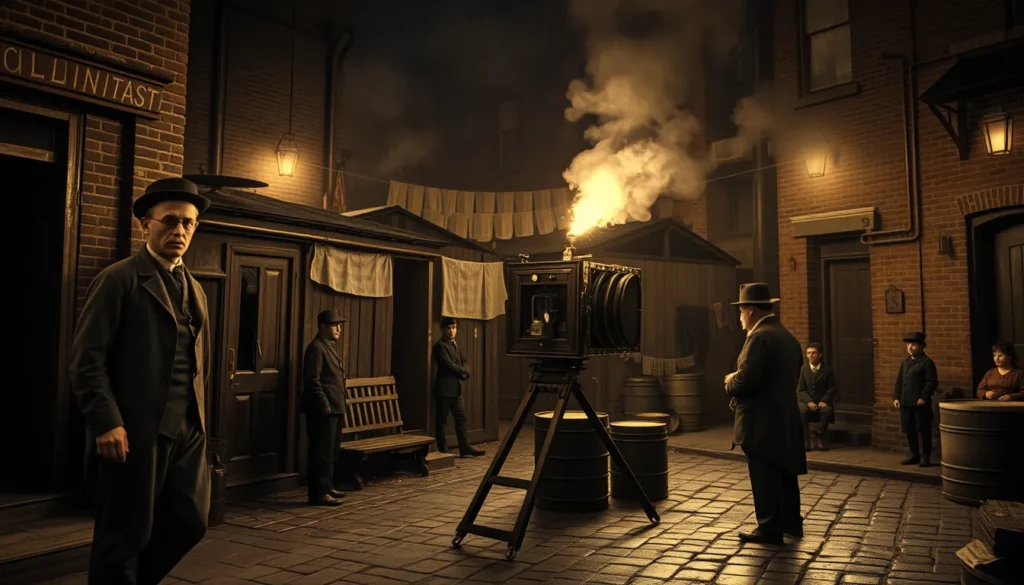
On a winter night in 1887–1888, a slight, spectacled Danish immigrant named Jacob A. Riis hauled a camera and a magnesium flash apparatus into a Mulberry Street yard in lower Manhattan. The flash, when it fired, briefly turned a dark tenement court into a stage: wooden sheds, ash barrels, ragged bedding, and faces startled by the light. Riis was a police reporter for the New York Evening Sun, not a trained photographer; he later called himself a “photographer after a fashion.” Yet in that yard and in hundreds of similar rooms and alleys, he began assembling the images and stories that became How the Other Half Lives (1890). To middle-class readers, the tenement district was both close and unknown—a place of cheap labor, crowded lodging houses, and feared epidemics. Riis set out to make that “other half” visible, using the new technology of flash photography, lantern-slide lectures, and a reporter’s eye for names, rents, and streets.
What Happened?
Jacob August Riis was born in Ribe, Denmark, on May 3, 1849, and emigrated to the United States in 1870. After years of intermittent work, he became a police reporter in New York in 1877. His beat took him through Mulberry Street, the Bend, and the crowded immigrant districts of lower Manhattan, where he saw how tenement housing, poverty, and public health intersected.
- 1887–1888: Riis worked with amateur photographers Richard Hoe Lawrence and Dr. Henry G. Piffard to make nighttime flash photographs in slum yards. Riis’s lecture notes describe the first flashlight photographs; the “Tramp” was posed in a yard near his Mulberry Street newspaper office.
- January 1888: Riis showed lantern slides at the monthly meeting of the Society of Amateur Photographers of New York.
- 1888–1889: Riis assembled about 100 images for his “Other Half” lecture, projected with a magic lantern. His standard lecture fee was $150, and the venue was required to supply a lantern and a technician.
- 1890: Charles Scribner’s Sons published How the Other Half Lives: Studies among the Tenements of New York. The book combined Riis’s reporting with illustrations, though 1890s printing technology reduced the photographs to crude wood engravings or tonally flat halftones.
- 1902: Riis published The Battle with the Slum. By then he was acquiring professional photographs and taking very few himself; after 1895 his photographic output declined as he devoted more time to politics and writing.
How It Was Seen at the Time
Contemporaries did not see Riis’s work as neutral documentation. They saw it as reformist argument. Middle-class audiences were told that the poor were not distant or invisible; they lived a few streets away, in courts and tenements that respectable New Yorkers passed without understanding. Riis’s language—“slum,” “tramp,” “rookery,” “the other half”—mixed compassion with fear and moral judgment. Some listeners came away convinced that bad housing produced crime and disease; others saw the poor as threats or as morally degraded. Riis himself insisted that he was simply reporting what he saw.

“Long ago it was said that ‘one half of the world does not know how the other half lives.’” — Jacob Riis, How the Other Half Lives (1890)
“I was a writer and a newspaper man, and I only yelled about the conditions which I saw.” — Jacob Riis, quoted in the San Jose Mercury, March 11, 1911
The lantern-slide lecture was central to this reception. In a darkened hall, the sudden image of a crowded yard or a child’s workplace made poverty visceral. The photographs were not yet easily reproduced in print, so the lecture gave Riis an advantage over the page: he could control sequence, scale, and commentary. Audiences gasped, reformers organized, and newspapers treated the tenement as a public question.
Historical Snapshot
| Aspect | Detail |
|---|---|
| Date | 1887–1890, with Riis’s photographic work continuing into the 1890s |
| Place | Mulberry Street, the Bend, and tenement districts of lower Manhattan, New York City |
| People | Jacob A. Riis; Richard Hoe Lawrence; Dr. Henry G. Piffard; tenement residents; middle-class lecture audiences |
| What Happened | Riis and collaborators used magnesium flash to photograph slum interiors and yards; Riis lectured with lantern slides and published How the Other Half Lives in 1890. |
| Why It Mattered | The work linked photography to social reform and helped make tenement poverty a public issue in Gilded Age New York. |
Eyewitness Accounts
Riis’s own lecture notes are the fullest eyewitness record of how the photographs were made. He described the Tramp photograph in the Mulberry Street yard with a mixture of reportorial detail and contempt for the man he had asked to pose.
“On one of my visits to ‘the Bend’ I came across this fellow sitting . . . and he struck me as being such a typical tramp that I asked him to sit still for a minute and I would give him ten cents. That was probably the first and only ten cents that man had earned by honest labor in the course of his life and that was by sitting down at which he was an undoubted expert.” — Jacob Riis, handwritten lecture notes, Jacob A. Riis Papers, Library of Congress
The passage is revealing in two directions. It is an eyewitness account of a photographic session, and it is also evidence of Riis’s own assumptions about the poor. The man was paid to sit still; the image was posed, not candid. Riis returned to the same Mulberry Street yard before its demolition and photographed new occupants. In The Battle with the Slum (1902), he captioned one image of the Jersey Street yard: “It costs a Dollar a Month to sleep in these sheds.”
Daily Life
Riis’s photographs and captions record a material world of rent, work, and makeshift shelter. In the Mulberry Street yard, wooden sheds were rented for sleeping; in the Bend, families crowded into rooms that served as kitchen, workshop, and bedroom. Tenement residents took in boarders, did piecework at home, shared water and privies, and lived with the constant risk of fire, disease, and eviction. The line between home and workshop blurred. Riis photographed children carrying bundles, women sewing by dim light, men in lodging houses, and yards where laundry, ash barrels, and sheds filled every available space. These were not abstract conditions. They were daily arrangements made under pressure of rent and wages, and Riis’s reporting preserved the specific streets, yards, and rooms where they took place.
What the Sources Got Wrong
Two corrections are essential. First, Riis’s photographs were not always candid records. His lecture notes openly describe paying the Tramp ten cents to sit still; the photograph was a posed portrait. Riis and his collaborators selected, framed, and sometimes arranged scenes to make a point. Second, the 1890 book did not reproduce the lantern slides as modern viewers imagine. The Library of Congress notes that 1890s printing technology required images to be reproduced as crude wood engravings or tonally flat halftones, so the book’s visual impact differed from the lecture. Third, Riis’s text often assigned moral traits to ethnic groups, treating poverty as a problem of specific nationalities. These generalizations were his interpretation, not neutral observation, and later readers must distinguish between the conditions he documented and the meanings he imposed on them.
How Historians See It Today
Historians now treat Riis as a pioneer of social documentary and photojournalism, but not as a neutral witness. His work linked photography to reform and helped make the tenement a public problem. At the same time, scholars emphasize his paternalism, his moralizing, and his use of stereotypes. The photographs are read as arguments as well as records. The Library of Congress exhibition frames Riis as a multi-skilled communicator—reporter, photographer, writer, reformer, lecturer—rather than a single-origin hero. This modern view does not diminish the primary evidence; it asks readers to notice how Riis’s words and images worked together, and how reform demanded both evidence and persuasion.
Aftermath
How the Other Half Lives made Riis famous. He became a lecturer and an ally of Theodore Roosevelt, who as New York City police commissioner admired Riis’s knowledge of the slums. Riis continued to write: The Children of the Poor (1892), Out of Mulberry Street (1898), A Ten Years’ War (1900), The Making of an American (1901), and The Battle with the Slum (1902). Reformers used such evidence to press for tenement regulation, including the New York Tenement House Act of 1901. Riis died on May 26, 1914. His papers went to the Library of Congress and his photographs to the Museum of the City of New York; the two collections were later brought together in the Library of Congress exhibition Jacob Riis: Revealing How the Other Half Lives.
The primary sources leave a double legacy. Riis made poverty visible with a new technology and a reporter’s persistence, but his images also show the limits of reform vision: the poor were often spoken for, posed, and categorized rather than heard. That tension is what makes his photographs historically valuable. They are evidence of Gilded Age New York and evidence of how middle-class reformers saw it.
FAQ
What did Jacob Riis photograph in Gilded Age New York?
Riis photographed tenement interiors, crowded yards, lodging houses, street children, sweatshop labor, and slum alleys, especially around Mulberry Street and the Bend. He used magnesium flash to illuminate dark spaces that middle-class New Yorkers rarely saw.
Did Jacob Riis stage his photographs?
Some were posed or arranged. Riis’s own lecture notes describe paying a man ten cents to sit still for the “Tramp” photograph in a Mulberry Street yard. Riis and his collaborators selected and framed scenes to make reform arguments, even as they documented real conditions.
Why was How the Other Half Lives important?
Published in 1890, the book combined reporting and images to make tenement poverty a public issue. It helped link photography with social reform and influenced reformers, including Theodore Roosevelt, though its printed illustrations were cruder than Riis’s lantern slides.






Leave a Reply