
Short Answer
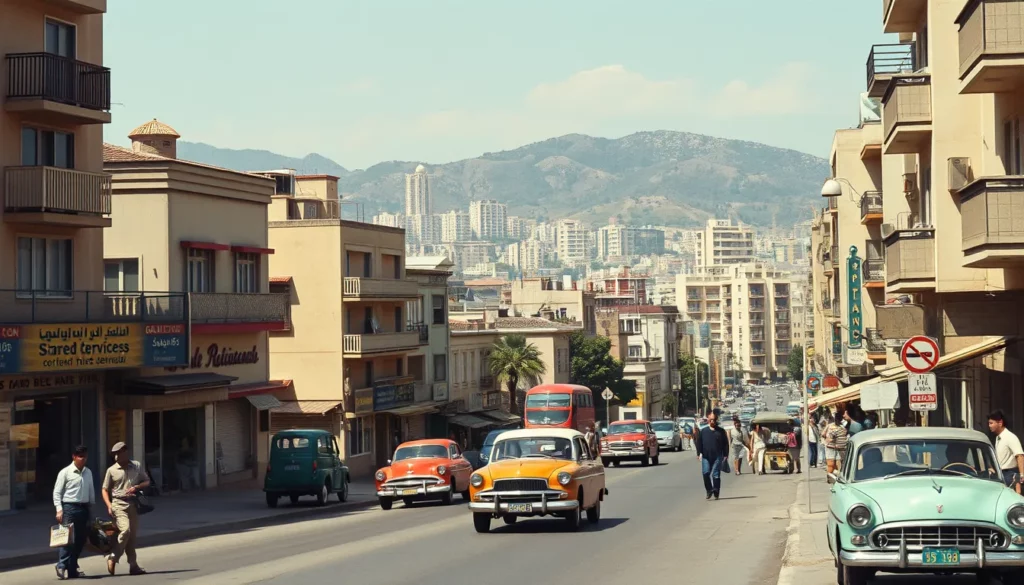
In the 1960s Beirut was a Mediterranean port city that woke early. Bakers fired their ovens before dawn, port laborers moved between the docks and the warehouses, clerks opened shutters on Hamra Street, and schoolchildren crossed neighborhoods that could feel, within a few blocks, prosperous and precarious at the same time. The city was Lebanon’s commercial, publishing, educational, and financial center, tied to the Arab hinterland, Europe, and the mountain villages from which many residents had come. Contemporary color postcards sold Beirut as a place of hotels, beaches, boulevards, and nightlife, but the daily record is more varied: apartment households budgeting for bread and rent, domestic workers in affluent homes, vendors in produce markets, drivers negotiating crowded squares, and families in the informal district of Karantina rebuilding after fire. This article describes the city in the years before the civil war, roughly 1960 to 1969, with the war’s outbreak in 1975 as the later boundary. It uses the traces contemporaries left behind: postcards, social surveys, newspapers, Red Cross records, land records, and banking accounts.
What Happened?
Beirut in the 1960s was not defined by a single event but by a sequence of political, economic, and social developments that shaped everyday routines.
- 1958 and its aftermath: The decade opened just after the 1958 insurrection and the U.S. military intervention. The crisis left a legacy of political caution and state-building under President Fuad Chehab, who governed from 1958 to 1964.
- Chehab and Helou: Reform and state administration under Chehab, and then the presidency of Charles Helou from 1964 to 1970, coexisted with a liberal, service-led economy and persistent social and confessional inequalities.
- Rapid urban change: A detailed land-use and household survey conducted by Samir Khalaf and Per Kongstad in Hamra between 1964 and 1967 recorded the replacement of gardens and detached houses by multistory residential and commercial buildings.
- Fire in Karantina: In the informal district beside the port and slaughterhouse, residents lived in concrete buildings and wooden shacks clad with flattened tin. At least ten fires occurred between 1960 and the major fire of 28 February 1965, which destroyed hundreds of shacks and left thousands without homes.
- Banking shock: In October 1966 the failure of Intra Bank exposed the fragility beneath the banking boom. A contemporary World Bank mission recorded a run by large and small depositors.
- Regional politics after 1967: After the Arab-Israeli war of June 1967, political print and Palestinian organizing became more prominent in Beirut.
Through these years the city remained a center of schools, universities, publishing houses, banks, shops, cafes, and transport links. Yet the same city contained sharply different material worlds: Hamra apartments and villas, port-side shacks, dense mixed-use streets, and neighborhoods where access to schooling, housing, and transport depended on income and family support.
How It Was Seen at the Time
Contemporaries saw Beirut through two overlapping lenses. One was the language of modernity, comfort, and consumption: new apartment blocks, cars, appliances, hotels, beach clubs, and international air travel. The other was the language of household calculation, work, rent, traffic, and political uncertainty. Souvenir postcards captured the first vision with slogans and captions that presented the city as a destination of pleasure and fantasy.
“WONDERFUL BEIRUT” and “BEIRUT — CITY OF 1000 AND 1 NIGHTS,” from 1960s color souvenir postcards collected in the Photorientalist exhibition Color Postcards of Lebanon from the 1960s.
Newspapers and surveys show the second vision. Contemporary discussion of traffic rules, pedestrians, parking, and congestion indicates that automobility was already contested rather than effortless. The Hamra survey recorded rapid building and a relatively prosperous, unusually mixed population, but its authors did not present Hamra as a model for all Beirut. After Intra Bank failed, depositors’ anxiety and the language of financial confidence gave way to questions about the security of small savings. After June 1967, political print and organizing became more visible. The prevailing mood was not simple optimism; it was a mixture of civic pride, commercial energy, social anxiety, and awareness of regional danger.
Daily Life
Housing shaped daily experience more than any single image of the city. In wealthier districts, residents occupied spacious apartments and detached villas; in older or poorer areas, families lived in subdivided buildings, modest flats, and dense mixed-use streets where shops and homes stood close together. Balconies, shutters, tiled roofs, and cross-ventilation mattered in a coastal climate with hot summers and damp winters. Where space permitted, a sitting room or salon allowed visitors to be received without opening the rest of the dwelling. Electricity and piped water were established urban services, and refrigerators, washing machines, and air conditioning were marketed and used in the capital, but appliance ownership was not universal. For affluent households, paid domestic help could reduce the burden of laundry, cleaning, and childcare; in many homes this work remained unpaid and was distributed unevenly among women, girls, and other relatives.
Food routines reflected Lebanese urban food culture and the city’s market connections. Bread and other cereal foods, rice, bulgur, chickpeas, lentils, yogurt, olives, vegetables, fruit, and oils were important categories. National food-balance data for 1961–63 indicate that cereals, including bread, supplied about half the available dietary energy, but such figures measure commodities available in Lebanon after production, imports, and exports, not what a particular Beiruti ate. Bakeries, neighborhood grocers, produce sellers, butchers, market stalls, cafes, and restaurants joined household cooking to the public food economy. Where storage space, cash, or refrigeration was limited, shopping could be frequent and local.
Work and movement divided the city by class and location. A clerk in Hamra, a dockworker near the port, a schoolteacher in Ras Beirut, a domestic servant in an affluent household, and a street vendor in a market district could live in the same city under very different conditions. Residents close to shops, schools, offices, and seafront roads could make more journeys on foot, while those farther from commercial corridors depended more heavily on buses, shared service taxis, or longer walks. Cars were increasingly prominent, but traffic rules, pedestrians, parking, and congestion were already subjects of public complaint.
Leisure and social life were visible in the postcard record: the hotel district, St Georges and the Phoenicia, beach clubs in Jnah and Raouche, the Carlton Hotel, Hamra by night, Martyrs Square, Riad Solh Square, Nejmeh Square, the flower market, the fruit and vegetable market, the racetrack, and the American University of Beirut. These images document a real culture of consumption and leisure, but they also represent a particular viewing angle: the city as visitor attraction, not the whole working city.
Historical Snapshot
| Aspect | Detail |
|---|---|
| Date | 1960–1969, with the civil war beginning in 1975 as the later boundary |
| Place | Beirut, Lebanon: port, Hamra, Ras Beirut, Martyrs Square, Raouche, Karantina, and surrounding districts |
| People | Clerks, dockworkers, teachers, domestic servants, street vendors, bankers, students, families, refugees, and migrant laborers |
| What Happened | A period of commercial, educational, and urban expansion alongside persistent inequality, the Karantina fires, the Intra Bank collapse, and rising regional political tension after 1967 |
| Why It Mattered | The decade shaped the city’s self-image as a cosmopolitan center while exposing the social and financial fragilities that later became part of the background to civil war |
Numbers at the Time
| Figure | Detail and source |
|---|---|
| About half | Share of available dietary energy supplied by cereals, including bread, in Lebanese national food-balance data for 1961–63 |
| At least 10 | Fires recorded in Karantina between 1960 and the major fire of 28 February 1965, according to a study drawing on Lebanese newspapers, Red Cross records, and land records |
| Hundreds destroyed; thousands homeless | Impact of the 28 February 1965 Karantina fire, which destroyed hundreds of shacks and left thousands without homes |
| October 1966 | Failure of Intra Bank, followed by a depositor run recorded by a contemporary World Bank mission |
| 1958–1964; 1964–1970 | Presidencies of Fuad Chehab and Charles Helou, the political frame for the decade |
These figures are not a complete social profile. They show what contemporary institutions measured or recorded, and they leave out much of household life, informal work, and neighborhood difference.
Different Perspectives
Consumers, visitors, and the leisure city
The postcard and hotel image of Beirut presented the city as a place of beaches, nightlife, air travel, shopping, and modern buildings. This perspective was real for residents and visitors who could afford it, but it was also a commercial selection. The Photorientalist collection of 1960s postcards includes MEA airplanes, Beirut International Airport, the Lebanese Riviera, the hotel district, St Georges, the Phoenicia, Hamra shopping street, beach clubs, and Raouche. These images reveal how the city was marketed, not how all Beirutis lived.
Port workers and residents of informal districts
In Karantina, beside the port and slaughterhouse, refugees, migrant laborers, factory workers, and informal workers lived in concrete buildings and wooden shacks clad with flattened tin. The contrast between concrete and tin-clad housing was material and visible. After fires, residents salvaged possessions or rebuilt while landowners sought to prevent some returns. Residents repeatedly suspected eviction by arson, though responsibility for individual fires is less certain than those suspicions. This perspective is essential because it shows the city’s housing crisis from below.
Women, domestic workers, and household labor
For affluent households, paid domestic help could reduce the burden of laundry, cleaning, and childcare. In many homes this work remained unpaid and was distributed unevenly among women, girls, and other relatives. The apartment-centered image of Beirut often hides this labor. Domestic service and family support were part of the daily infrastructure that made middle-class and elite life possible.
What People Feared
Fears in 1960s Beirut were both rational and speculative. After the 1958 crisis, many residents worried about political instability and the fragility of confessional balance. After Intra Bank failed in October 1966, depositors feared for savings and for the banking confidence on which the service economy depended. In Karantina, residents feared fire, eviction, and the loss of shelter; their repeated suspicions of arson reflected a real struggle over land and return after disasters. After June 1967, regional war and Palestinian organizing raised fears of external conflict spilling into Lebanese politics. Some anxieties were grounded in documented events, while others circulated as rumor or worst-case expectation. The sources do not support a single citywide panic; they show different groups fearing different losses.
How Historians See It Today
At the time, the language of modernity and leisure was widely used to describe Beirut, and the postcard image of hotels, beaches, and boulevards was not invented later. But historians now distinguish that visible culture of consumption from the whole decade and population. The familiar label “golden age” describes one visible culture of consumption and leisure, not the entire city. The Hamra survey’s relatively prosperous and unusually mixed population makes Hamra a poor model for Beirut as a whole. Appliance ownership and apartment living should not be treated as universal. The Karantina fires and the Intra Bank collapse expose the fragility beneath the banking boom and the unequal access to housing and services.
Modern scholarship also stresses that the 1960s had a chronology. The decade opened just after 1958, passed through Chehab-era reform and Helou-era continuity, was shaken by the 1965 Karantina fire and the 1966 Intra Bank failure, and was reshaped by the June 1967 war. Historians now read the postcards as evidence of marketing and self-image, and the surveys, Red Cross records, land records, and newspaper reports as evidence of material life. The shift is not from false to true but from one dominant image to a more stratified account.
The primary sources leave a complex picture. Beirut in the 1960s was a city of real amenities, schools, publishing, commerce, and cosmopolitan exchange, and also a city of rent, informal housing, domestic labor, traffic, bank runs, and fire. To recover daily life before the civil war is to hold these realities together rather than choose between the postcard and the shack, the hotel and the port, the slogan and the household budget.
FAQ
Was 1960s Beirut uniformly a 'golden age'?
No. The postcard image of hotels, beaches, and boulevards documents a real culture of consumption and leisure, but it does not represent the whole population. Housing ranged from Hamra apartments and villas to Karantina shacks; domestic labor, informal work, traffic, bank runs, and fires shaped daily life for many residents.
What did people eat in 1960s Beirut?
Daily meals drew on Lebanese urban food culture: bread and cereals, rice, bulgur, chickpeas, lentils, yogurt, olives, vegetables, fruit, and oils. National food-balance data for 1961–63 suggest cereals supplied about half of available dietary energy, but this does not describe every household. Bakeries, grocers, produce sellers, butchers, market stalls, cafes, and restaurants connected home cooking to the public food economy.
How did the Intra Bank failure affect daily life?
The October 1966 failure of Intra Bank triggered a run by large and small depositors, recorded by a contemporary World Bank mission. It exposed the fragility beneath the banking boom and raised fears about savings and financial confidence in a service-led economy.





Leave a Reply