
Short Answer
Quick Snapshot
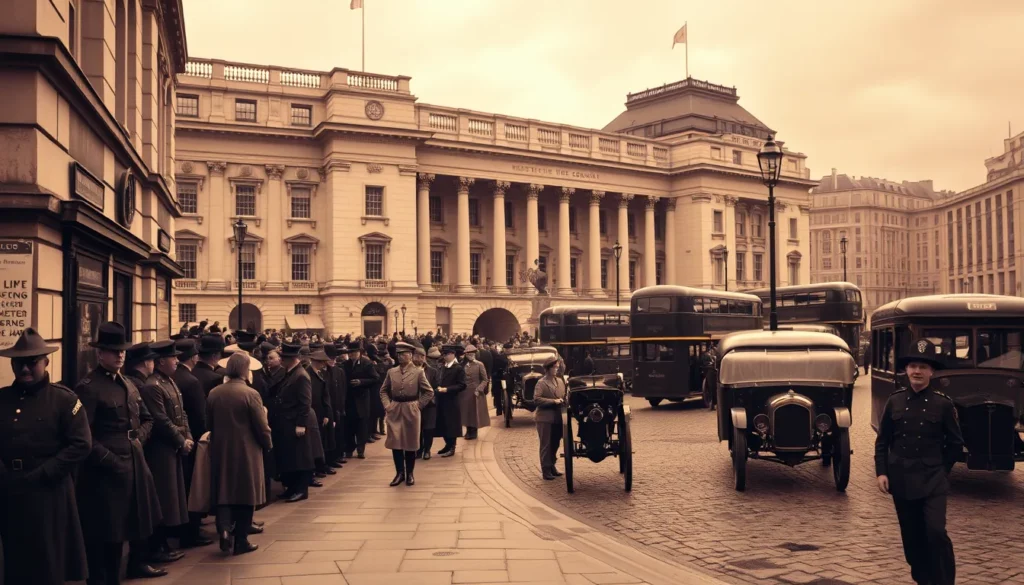
London in 1914 was the capital of the world’s largest empire and a city of stark contrasts. Its West End boasted theatres, department stores and fashionable streets, while the East End and riverside districts contained overcrowded housing, dockside casual labour and deep poverty. In the first months of the Great War, that world did not collapse overnight, but it was visibly transformed. On 4 August 1914, Britain declared war on Germany after the German invasion of Belgium. Within days, London became a centre of recruitment, charitable relief, censorship and imperial administration.
The city was not yet under air attack, and the first Zeppelin raids on London would not come until 1915. Yet the war was immediately present in the streets: khaki uniforms, recruiting posters, queues outside banks and shops, Belgian refugees, spy scares and anxious crowds outside Buckingham Palace and Downing Street. The mood was less jubilant than later myth sometimes suggests. The American journalist Samuel G. Blythe, writing in The Saturday Evening Post in September 1914, described Londoners who watched soldiers silently, almost stolidly, with emotion held in check. By Christmas, London was still recognisably Edwardian, but it had become a capital at war.
London in 1914
This article treats London primarily as the County of London and the surrounding metropolitan area, often called Greater London in contemporary usage. In 1914 there was no Mayor of London; local government was divided between the London County Council, the City of London Corporation, the metropolitan boroughs and various ad hoc bodies. The Thames remained the city’s economic spine, carrying shipping to the Port of London and separating the north bank’s commercial and governmental districts from the industrial and residential suburbs to the south.
The year began in the shadow of domestic political crisis, including Irish Home Rule and militant suffrage campaigning, but the European crisis of July 1914 quickly overshadowed these disputes. The summer was warm and dry, and the August Bank Holiday weekend became the setting for one of the most famous moments in London’s wartime history: the extension of the holiday and the rush of crowds to hear news of the war. The atmosphere was tense rather than uniformly patriotic. London was a world city, with German-born residents, Irish nationalists, Socialists, pacifists and imperial loyalists all sharing its streets. The war sharpened old divisions and created new ones.
Population & Economy
Greater London had a population of roughly 7.1 million in 1914, while the administrative County of London contained about 4.5 million people. The city was still growing outward into suburbs served by railways, trams and the Underground. Its economy was extraordinarily diverse. The City of London was the centre of international finance, banking, insurance and shipping. The Port of London handled food, raw materials and manufactured goods from around the world. Beyond the docks, London depended on clothing and tailoring, furniture-making, printing, brewing, building, retail and domestic service.
The outbreak of war initially disrupted trade and employment. The Stock Exchange closed on 31 July 1914 and did not fully reopen until January 1915. A moratorium on bills of exchange and emergency banking measures prevented panic, but uncertainty was acute. Some luxury trades and building works slowed, throwing workers out of jobs; within weeks, however, recruitment and war contracts began to absorb labour. Food prices rose, especially for imported goods, and working-class families felt the strain.
| Item or income | Approximate 1914 London figure |
|---|---|
| 4lb loaf of bread | About 5½d |
| Unskilled weekly wage | Roughly 20s to 30s |
| Two-room working-class tenancy | About 7s to 10s per week |
| Pint of beer | Usually a few pence |
These figures varied widely by district and trade, but they show how quickly war news could affect household budgets. A rise in bread or coal prices mattered more to many Londoners than the diplomatic details of the July crisis.
Government & Politics
National government was led by Prime Minister H. H. Asquith, with Sir Edward Grey at the Foreign Office. In early August 1914, Asquith appointed Field Marshal Lord Kitchener as Secretary of State for War. Kitchener’s stern face soon appeared on recruitment posters across London, urging men to join the New Armies. King George V remained a symbolic focus of loyalty, and crowds gathered outside Buckingham Palace in the first days of the war.
Local governance was complex. The London County Council, led by its chairman and committees, managed schools, housing, streets and public health. The City of London Corporation guarded the financial district’s ancient privileges. The metropolitan boroughs handled local services and relief. In 1914 the Lord Mayor of the City of London was Sir Charles Johnston, whose office became a focus for patriotic charity and war relief. Political debate did not disappear: Liberals argued over the morality of intervention, Conservatives emphasised national duty, and Labour and Socialist groups warned against profiteering and hardship. Suffragette militancy was largely suspended as patriotic duty overshadowed the campaign for the vote, though the issue did not vanish.
Industry
London’s industry was less dominated by huge factories than the popular image of wartime Britain might suggest. The Port of London was the city’s greatest industrial asset: dockers, stevedores, lightermen and warehouse workers handled food, timber, wool, tea, rubber and other imports. The Royal Arsenal at Woolwich, just beyond the County of London, was a major centre of armaments production and became still more important as the war continued. Within London itself, engineering works, clothing workshops, printing houses, breweries, furniture factories and food-processing plants employed hundreds of thousands.
War contracts brought new work but also confusion. Firms that had traded with Germany or Austria-Hungary lost markets; shipping was disrupted; and some industries faced shortages of materials. At the same time, the demand for uniforms, boots, blankets, tents, transport equipment and munitions grew. Women began to enter workshops and offices in larger numbers, though the great expansion of female munitions work came later. The first months were a period of adjustment rather than full-scale industrial mobilisation.
Education
London had one of the most extensive educational systems in Britain. The London County Council ran hundreds of elementary schools, while voluntary and denominational schools also operated across the metropolis. Elementary education was compulsory, and literacy was high by 1914, though many children left school early to work. The University of London and its colleges, along with technical institutes and evening classes, served the city’s middle and professional classes and a growing number of working people.
The war affected schools almost immediately. Teachers and older pupils left for military service, classrooms were used for relief work, and Belgian refugee children needed schooling. Schools also became sites of patriotic instruction and fundraising, with collections for soldiers’ comforts and parcels for prisoners of war. Educational reformers hoped the war would expose the need for better health care, meals and physical training for poor children.
Transportation
London’s transport system was already one of the most advanced in the world. Underground railways carried passengers between the suburbs and the centre; electric trams, horse-drawn and motor omnibuses, and suburban trains moved millions daily. The Thames remained a working river, crowded with barges, colliers and passenger steamers. Taxis and horse-drawn vehicles shared streets that were often congested and sometimes dangerous.
The war brought new demands. Railway stations such as Waterloo, Victoria and Charing Cross became points of departure for soldiers and arrival points for refugees and wounded men. Horses were requisitioned for military use, affecting delivery and transport firms. Recruitment posters appeared at bus stops and railway stations. In the first months there was no general blackout or systematic air-raid precaution, but the transport network was already being reorganised around the needs of war.
Everyday Life
For most Londoners, daily life continued to revolve around work, family, shopping, school and neighbourhood. Working-class families often lived in cramped terraces or tenements, with shared water taps and outdoor lavatories. Food was plain and seasonal: bread, tea, cheese, fish, potatoes, cabbage and beer played central roles. Better-off households employed servants and enjoyed gas lighting, telephones and department stores.
War changed small things first. Women queued for food and worried about rent as husbands and sons enlisted. Charitable committees collected clothes and comforts for soldiers. Pubs and music halls remained popular, and cinemas were multiplying, offering newsreels and escapist entertainment. Football and other sports continued for a time, though recruitment campaigners pressed young men to enlist rather than watch from the stands. Churches held special services, and schools organised patriotic collections. Belgian refugees, many from Antwerp and other invaded areas, arrived in London from late August and September, prompting both sympathy and suspicion.
Major Events
The defining event was Britain’s declaration of war on 4 August 1914. Crowds gathered outside Buckingham Palace and Downing Street, but eyewitnesses noted anxiety as much as excitement. On 5 August, Kitchener became Secretary of State for War, and the famous recruitment campaign began. The Battle of Mons in late August and the First Battle of the Marne in September brought the reality of casualties and stalemate. In October and November, the First Battle of Ypres consumed the old regular army, and Londoners began to see wounded soldiers and bereaved families.
London also experienced the war’s social consequences: attacks on German-owned shops, especially in the East End; a rising spy scare; restrictions on enemy aliens; and the arrival of Belgian refugees. In November, Britain declared war on the Ottoman Empire, widening the conflict. By Christmas 1914, the hope of a short war had faded, even if the phrase that it would be over by Christmas lingered in memory and myth.
What Newspapers Were Reporting
London newspapers were dominated by the crisis. The Times, the Daily Mail, the Daily Express and the evening press carried headlines about the German invasion of Belgium, the British ultimatum, recruitment rallies, food prices, Belgian refugees and the fighting in France. The press also warned that the war would be long and bloody, contradicting the later assumption that everyone expected a quick victory.
“The crowds have stood silently alongside the curbs, saying nothing — not cheering — not shouting — just watching.” — Samuel G. Blythe, London in War Time, The Saturday Evening Post, 19 September 1914.
Blythe also reported that the great papers were issuing daily and solemn warnings that the war was likely to be long and bloody. Newspaper readers encountered a mixture of official communiqués, patriotic appeals, rumour and censorship. The Defence of the Realm Act, passed in August 1914, gave the government sweeping powers over the press and public life, and editors quickly learned to be cautious about military information.
What People Were Talking About
Conversation in London turned on enlistment, separation and money. Families debated whether young men should volunteer at once or wait; mothers and wives worried about the separation allowance; workers discussed whether war work would raise wages or destroy jobs. Rumours circulated about spies, German sympathisers, Zeppelins and invasion. Shopkeepers complained about rising prices, while soldiers’ families talked about rents and food.
Letters and diaries from the period show a mixture of patriotism, duty, fear and bewilderment. Some Londoners welcomed the war as a moral test or an adventure; others mourned the breakdown of European civilisation. Pacifists and Socialists warned against jingoism and profiteering. Women discussed new public roles, from nursing and relief work to taking over jobs left by enlisted men. The phrase that the war would be over by Christmas was repeated, but so were darker predictions.
Historical Photographs
Photographs from London in late 1914 show crowds outside Buckingham Palace and Downing Street, soldiers marching through streets, recruitment posters pasted on walls, and Belgian refugees arriving at railway stations. Press photographers captured women queuing, children playing in poorer districts, and men in khaki saying goodbye. The images are mostly black and white, often formal or posed, but they reveal the visual culture of the war: flags, uniforms, placards and crowded pavements.
Significant collections survive at the Imperial War Museums, the London Metropolitan Archives, the National Portrait Gallery and the Library of Congress, which holds press photographs of the period. These images are valuable not because they show the whole truth, but because they show how Londoners were expected to see themselves in wartime.
Documents & Primary Sources
- The 1911 census, useful for household structure, occupation and birthplace, though no census was taken during the war.
- London County Council records, including school, housing, public health and relief committee papers, held at the London Metropolitan Archives.
- Metropolitan Police and Home Office files on aliens, public order and wartime regulations, held at The National Archives.
- Newspapers such as The Times, Daily Mail and local London papers, available in the British Library and online archives.
- Diaries, letters and memoirs of soldiers, nurses, charity workers and ordinary residents, held in the Imperial War Museums and local archives.
- Maps and street directories, which show the geography of recruitment offices, hospitals, relief centres and refugee accommodation.
- Parliamentary papers and Bank of England records, which document the financial emergency of July and August 1914.
1914 Timeline
| Date | Event |
|---|---|
| 28 June | News of the assassination of Archduke Franz Ferdinand reaches London. |
| 28 July | Austria-Hungary declares war on Serbia; the July crisis deepens. |
| 31 July | The London Stock Exchange closes amid financial panic. |
| 3 August | Britain mobilises; the Bank Holiday is extended as the crisis intensifies. |
| 4 August | Britain declares war on Germany; crowds gather outside Buckingham Palace and Downing Street. |
| 5 August | Lord Kitchener is appointed Secretary of State for War. |
| 23 August | The Battle of Mons; the British Expeditionary Force fights in Belgium. |
| 5–12 September | The First Battle of the Marne halts the German advance. |
| 19 September | Samuel G. Blythe’s eyewitness report, London in War Time, is published. |
| 19 October | The First Battle of Ypres begins; casualties mount and recruitment continues. |
| 5 November | Britain declares war on the Ottoman Empire. |
| 25 December | Christmas truce on parts of the Western Front; Londoners reflect on a wartime Christmas. |
What Changed Next
The first months of war set the pattern for the years that followed. In 1915, German Zeppelin raids brought the war directly to London’s skies, and the sinking of the Lusitania intensified anti-German feeling. A coalition government replaced Asquith’s Liberal ministry in May 1915, and the demand for munitions grew. Conscription followed in 1916, and by 1918 London was a heavily regulated wartime capital, with rationing, air-raid precautions and mass mobilisation. The city that emerged after 1918 was changed: women had entered public life and industry on a new scale, the old Liberal order was weakened, and commemorative culture had begun to shape streets and squares. The first months of 1914 were only the beginning, but they had already altered the rhythm of London life.
Sources
- Jon Lawrence, Martin Dean and Jean-Louis Robert, The Outbreak of War and the Urban Economy: Paris, Berlin, and London in 1914, Economic History Review 45, no. 3 (1992): 564–593. https://ehs.org.uk/article/the-outbreak-of-war-and-the-urban-economy-paris-berlin-and-london-in-1914/
- Samuel G. Blythe, London in War Time, The Saturday Evening Post, 19 September 1914. https://www.saturdayeveningpost.com/2014/09/1914-london-goes-to-war/
- Jerry White, Zeppelin Nights: London in the First World War (London: Bodley Head, 2014).
- London Metropolitan Archives, City of London Corporation, records of the London County Council and Metropolitan Police. https://www.cityoflondon.gov.uk/things-to-do/london-metropolitan-archives
- The National Archives, Kew, Home Office, War Office and 1911 census records. https://www.nationalarchives.gov.uk/
FAQ
What was the population of London in 1914?
Greater London had roughly 7.1 million people, while the County of London contained about 4.5 million.
What major events happened in London in 1914?
Britain declared war on Germany on 4 August; Kitchener launched his recruitment campaign; crowds gathered outside Buckingham Palace; Belgian refugees arrived; and London newspapers reported the fighting at Mons, the Marne and Ypres.
What primary sources are available for studying London in 1914?
Key sources include the 1911 census, London County Council records, Metropolitan Police and Home Office files, newspapers, diaries, letters, photographs, maps and parliamentary papers held at The National Archives, London Metropolitan Archives, Imperial War Museums and the British Library.
How did daily life in London in 1914 differ from today?
There was no Mayor of London, no widespread electricity or motor traffic, and no welfare state. Housing was often overcrowded, food was plainer, and the war brought recruitment posters, refugees, censorship and rising prices rather than air raids or mass conscription, which came later.










Leave a Reply