
Short Answer
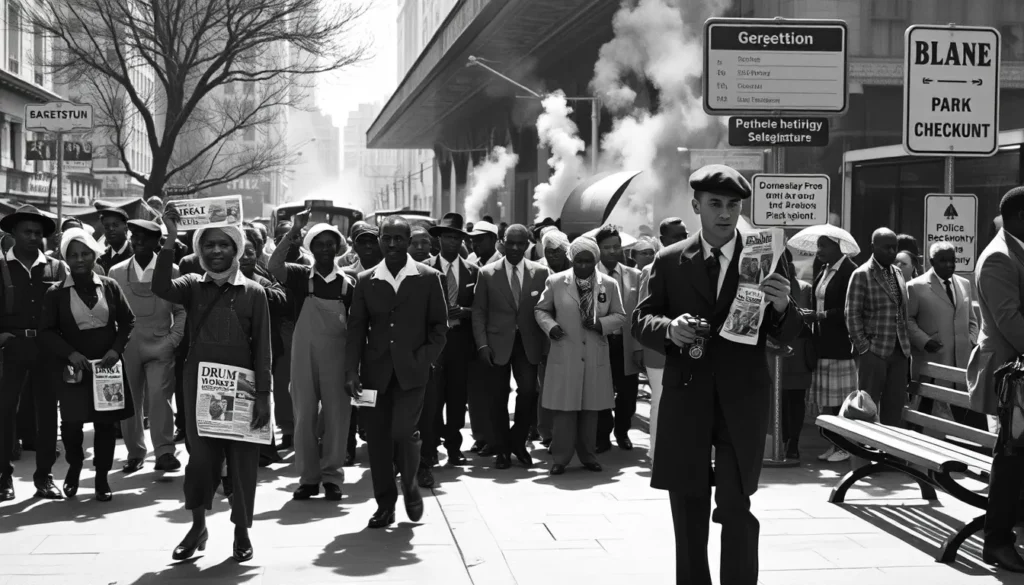
On a winter morning in the early 1950s, the platforms of Johannesburg’s Park Station filled with commuters from Orlando, Alexandra and the western townships. Men in overalls and women in domestic workers’ uniforms clutched passbooks; police checks could turn an ordinary journey into arrest. Outside the station, newspaper sellers called out headlines, and Drum photographers moved through the crowd looking for the ordinary scenes that would fill the next issue. The city was modern, noisy and prosperous, but apartheid was remaking its streets, trains, schools and homes according to race. This article examines Johannesburg from the early 1950s to the early 1990s through the photographs and newspapers that recorded daily life: the picture magazine Drum, black-owned and black-read newspapers, the liberal English-language press and the propaganda of the apartheid state. It asks not only what happened, but how people saw it at the time and what the sources preserve, distort or leave out.
What Happened?
Apartheid was not a single event but a system built through law, bureaucracy and daily enforcement. The Population Registration Act and Group Areas Act of 1950 classified people by race and segregated where they could live, work and own property. Pass laws controlled the movement of black Africans into and within Johannesburg. Bantu Education, introduced in 1953, deliberately limited black schooling. Against this background, newspapers and photographers became crucial witnesses to everyday life.
- 1950–1953: Johannesburg’s racial geography hardened. Group Areas proclamations and pass controls shaped housing, transport and employment. Drum was founded in Cape Town in 1951 and soon became a Johannesburg-centred picture magazine known for its photographers and writers.
- September 1951: Drum published an uncredited photographic essay, “Johannesburg Lunch-Hour”, showing black city workers during their midday break. It marked a shift toward photographing ordinary urban Africans with dignity and curiosity rather than paternalism.
- 1952: The Defiance Campaign against unjust laws brought mass arrests. Photographers such as Jürgen Schadeberg recorded protests and police actions, including the arrest of African National Congress Women’s League members.
- 1955: The Freedom Charter was adopted at Kliptown, while the state began removing residents from Sophiatown, a mixed-race Johannesburg suburb celebrated for its writers, musicians and crowded streets.
- 1956–1961: The Treason Trial dragged on. In 1960 the Sharpeville massacre and the ensuing state of emergency intensified censorship and police surveillance. Nelson Mandela went underground in 1961.
- July 1963: Drum published Peter Magubane’s photographic essay “Lunch-Hour”, formally similar to the 1951 essay but appearing during a period of tightening apartheid legislation and repression. By April 1965 Drum had ceased publication as an independent monthly.
- 1976–1994: The Soweto uprising of 16 June 1976 was photographed and reported under severe restrictions. States of emergency in the 1980s further limited the press. After Mandela’s release in 1990 and the 1994 election, photographers and newspapers recorded the transition.
How It Was Seen at the Time
Contemporaries did not experience apartheid as an abstract system. For officials, it was “separate development” and “law and order”. For black Johannesburg residents, it was a daily gauntlet of pass checks, queues, removals and police raids. For many white readers, the city was a place of progress and commerce; for black readers, newspapers and magazines were among the few places where their own urban life appeared as news, culture and achievement.
Drum’s photographs were often read as evidence of a vibrant African modernity: jazz musicians, boxers, students, nurses, street traders and lovers. Yet they also appeared within a censored public sphere. The English-language liberal press might criticise apartheid’s excesses, but it operated within a society that treated white authority as normal. The black press and Drum used language that was often careful, indirect or double-edged.
“There is no place for the Bantu in the European community above the level of certain forms of labour.” — Hendrik Verwoerd, defending Bantu Education, 1953
“South Africa belongs to all who live in it, black and white.” — Freedom Charter, adopted at Kliptown, 1955
The mood was not simply despair. It mixed anxiety with defiance, and segregation with a stubbornly shared urban culture. Newspapers and photographs helped people recognise themselves and their neighbours in a city that official language often treated as a problem to be administered.
Historical Snapshot
| Aspect | Detail |
|---|---|
| Date | Early 1950s to early 1990s |
| Place | Johannesburg, including Sophiatown, Alexandra, Orlando and later Soweto |
| People | Black workers, residents and journalists; white officials and readers; Drum photographers and writers; police and municipal officers |
| What Happened | Apartheid laws reorganised daily life by race while newspapers and photographers recorded pass raids, removals, township culture, resistance and censorship |
| Why It Mattered | The visual and newspaper record shows how apartheid was lived in ordinary places and how people claimed dignity under surveillance |
Contemporary Newspaper Coverage
Johannesburg’s press was segregated and unequal. Drum, modelled on Life and Picture Post, combined photographs, crime exposés and celebrity profiles with social documentary. Its most famous reporter, Henry Nxumalo, wrote under the byline “Mr Drum” and exposed prison and farm labour abuses. Drum’s photo essays gave black readers images of themselves as modern city people, even as the state classified them as temporary sojourners.
Black newspapers such as Bantu World, The World and Golden City Post covered township life, bus boycotts, school issues and police raids. Their readerships were black, but their reporting often had to negotiate censorship and white-owned printing and distribution. The liberal Rand Daily Mail and The Star reached mostly white readers and could be critical of apartheid, yet their daily news agendas still centred white politics and commerce. Afrikaner nationalist papers generally presented apartheid as Christian order and modernisation.
After Sharpeville in 1960 and again after Soweto in 1976, emergency regulations made reporting dangerous. Photographers were detained, film was seized and newspapers were closed or censored. Captions became political: whether a photograph showed a “riot” or a “protest”, a “location” or a “community”, depended on who was writing the words.
Daily Life
The primary sources show a city of contrasts. In Sophiatown before its removal, houses were overcrowded and services inadequate, but the streets were also famous for jazz, shebeens, writers and a mixed social life. In Orlando and later Soweto, many families lived in small “matchbox” houses with coal stoves, shared taps and long commutes. Alexandra’s cramped yards and hostels housed workers close to white suburbs that depended on their labour.
Work began early. Trains and buses carried domestic workers, factory hands, clerks and nurses into white areas. Passbooks had to be carried at all times; a missing stamp could mean arrest. At home, women stretched wages, cooked maize meal, ran shebeens and organised burial societies. Children queued for school under Bantu Education. Newspapers were read on trains and passed from hand to hand; Drum’s photographs were discussed as evidence of who was being arrested, who was stylish, who had won a boxing match.
Ernest Cole’s photographs, later published in House of Bondage in 1967, captured the bureaucratic humiliations of passes and segregated facilities. Drum photographers such as Schadeberg and Magubane recorded both the violence of the state and the ordinary pleasures of urban life. Their images are not neutral windows: photographers chose subjects, cropped scenes and worked under editors and censors. Yet they remain among the most direct visual records of how Johannesburg was lived.
Different Perspectives
State and Municipal Officials
Officials described removals as “slum clearance”, “rehabilitation” and “separate development”. They presented pass controls as administration and township housing as orderly provision for a labour force. Verwoerd’s statement on Bantu Education made the racial logic explicit: black schooling was designed for a subordinate place in the economy.
Black Residents and the Black Press
Black newspapers and Drum writers documented the same events as family separations, lost homes and daily insult. The Freedom Charter offered a rival vision of belonging. For many readers, photographs of arrests and removals were proof of a shared grievance, while pictures of concerts, weddings and sports were proof of a life beyond apartheid’s categories.
White English-Language Liberals
The Rand Daily Mail and The Star sometimes exposed abuses and criticised censorship. But their liberalism was limited by ownership, readership and the comforts of white life. They often framed black politics through the language of crime, disorder or “moderate” versus “extremist” leadership.
Afrikaner Nationalists
Nationalist newspapers and state information presented apartheid as Christian guardianship and orderly modernisation. They rarely showed the interior of a pass office or a demolished Sophiatown home as their readers’ problem. This was not a false balance between equal positions: it was a contest between a state with power to classify and detain and a press that could be censored or banned.
“I have fought against white domination, and I have fought against black domination.” — Nelson Mandela, Rivonia Trial, 1964
What the Sources Got Wrong
Contemporary sources were shaped by censorship, propaganda and the routines of news gathering. Some errors were factual; others were built into the language of the time.
- Official “slum clearance” language: State reports justified removals from Sophiatown and other areas as necessary hygiene and housing reform. Photographs, residents’ testimony and black newspaper reports show coercive demolition, disrupted communities and racially motivated relocation.
- Casualty confusion at Sharpeville: Initial press and wire reports gave fluctuating casualty figures before the final count of 69 dead was established. Early editions show how quickly numbers could harden into competing political claims.
- Captions and credits: Drum’s influential 1951 “Johannesburg Lunch-Hour” essay appeared without a photographer credit. This reminds historians that captions, credits and attributions in old newspapers are not always reliable guides to authorship or intention.
- The myth of “separate but equal”: Apartheid publicity claimed that segregated facilities served all races fairly. Photographs of inferior schools, overcrowded transport and rudimentary township services contradict that claim.
How Historians See It Today
Modern scholarship treats photographs and newspapers as both evidence and interpretation. Darren Newbury’s study of Drum’s 1951 and 1963 lunch-hour essays places them at the beginning and endpoint of a particular South African humanist photography, shaped by editorial policy and tightening repression. The 2012 exhibition Rise and Fall of Apartheid: Photography and the Bureaucracy of Everyday Life, curated by Okwui Enwezor and Rory Bester, argued that apartheid penetrated the most mundane aspects of existence: housing, transport, education, religion and business.
Historians now pay more attention to everyday life, visual culture and the black press than earlier accounts that focused mainly on high politics and resistance leaders. They read Drum’s images critically, asking who was photographed, who was captioned and who controlled the archive. They also recover the agency of black journalists and photographers who worked under surveillance. The shift does not diminish the political history of apartheid; it shows how politics was lived in queues, trains, kitchens and streets.
The primary sources leave a double legacy. They document the bureaucracy of racial separation and the violence that upheld it. They also preserve the creativity, humour and ordinary sociability of people whom apartheid tried to reduce to categories. To read them carefully is to see Johannesburg as contemporaries saw it: a city of injunctions and improvisation, of passbooks and photographs, of fear and stubborn life.
FAQ
What role did Drum magazine play in recording everyday life under apartheid?
Drum combined photojournalism, crime exposés, music and sports coverage to show black urban life with dignity and detail. Its 1951 and 1963 lunch-hour photo essays are key examples of South African social documentary photography, though the magazine worked under editorial and political constraints.
How did newspapers report forced removals such as Sophiatown?
Black newspapers and Drum writers tended to report removals as family and community disasters, while official statements described them as slum clearance or rehabilitation. The liberal English-language press sometimes criticised the removals but often reflected white readers’ assumptions about order and housing.
Did censorship affect photographs of Johannesburg under apartheid?
Yes. States of emergency and security laws restricted reporting, allowed police to seize film and detained journalists. Photographers and editors developed careful captions and sometimes indirect ways of showing pass raids, protests and township conditions.
What can photographs tell us that newspapers cannot?
Photographs preserve gestures, clothing, housing, streets and faces that news copy often omits. They can also mislead if cropped or captioned tendentiously, so historians read them alongside the printed text, archival credits and eyewitness testimony.




Leave a Reply