
Short Answer
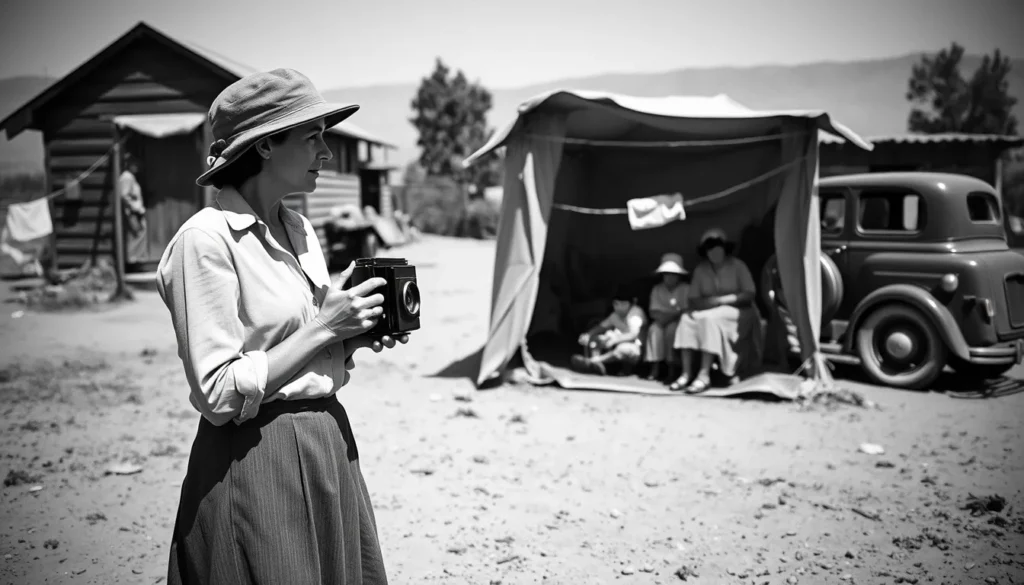
By 1933 the Depression had settled over San Francisco like a damp fog. Men in frayed coats queued at the White Angel breadline near the waterfront, holding tin cups and staring at nothing in particular. Dorothea Lange, a successful portrait photographer with a studio in the city, walked among them with a camera. She was not yet a government investigator or a famous documentarian; she was a portraitist who had become restless with the tidy limits of studio work. The faces outside her window were insistent, and the economic crisis was rewriting the rules of American life. In the early 1930s, as banks failed and unemployment mounted, Lange began to photograph breadlines, labor demonstrations, and soup kitchens. Soon she would carry her large Graflex camera into migrant camps and rural counties for the Resettlement Administration and its successor, the Farm Security Administration. Her photographs, captions, and field notes became one of the most important records of how Americans experienced the Great Depression. As Lange later recalled of those years: “Everyone was so shocked and panicky. No one knew what was ahead.”
What Happened?
Dorothea Lange was born in Hoboken, New Jersey, in 1895 and studied photography at Columbia University before moving to San Francisco. By the 1920s she had a thriving portrait studio, but the Depression pushed her toward the street. Her 1933 photograph of the White Angel breadline, with its huddled men and empty cups, marked a turn from studio portraiture to documentary work. In 1934 the economist Paul Schuster Taylor saw her photographs and recognized their value for studying rural labor; they soon began collaborating, and in 1935 they married. That same year Lange was hired by the California State Emergency Relief Administration and then by the federal Resettlement Administration, which became the Farm Security Administration in 1937.
Between 1935 and 1939 Lange worked as a field photographer for the FSA, traveling through California, the Southwest, and the South. She photographed dust-blown farmsteads, roadside camps, cotton fields, and crowded relief offices, and she recorded the words of the people she met. Her reports were not only visual; they combined negatives, captions, and field notes that quoted migrants directly. The most famous episode came in March 1936, when she stopped at a pea-pickers’ camp in Nipomo, California, after a freeze had ruined the crop. There she made five exposures of a mother and children in a lean-to tent. One of those negatives became known as “Migrant Mother.” The San Francisco News published her Nipomo photographs in March 1936, and the image soon circulated far beyond California.
- 1929–1933: The Depression deepens; Lange photographs San Francisco breadlines and unemployed men.
- 1934–1935: Paul Taylor sees Lange’s work; she is hired by state and federal relief agencies to document rural poverty.
- 1935–1939: Lange works for the Resettlement Administration and Farm Security Administration, producing thousands of negatives and field reports.
- March 1936: At Nipomo, California, Lange photographs the woman and children who become “Migrant Mother.”
- 1939: Lange and Taylor publish An American Exodus: A Record of Human Erosion, combining photographs and testimony.
- 1941–1942: Lange receives a Guggenheim Fellowship, then works for the War Relocation Authority documenting Japanese American internment.
How It Was Seen at the Time
Contemporaries did not see Lange’s photographs as neutral art. New Deal officials saw them as evidence for reports and press releases; newspaper editors saw them as human-interest stories about suffering; migrants saw them, sometimes, as a possible route to relief. The FSA’s Historical Section, headed by Roy Stryker, wanted a file of images that could explain rural poverty to taxpayers and policymakers. Lange’s images were sharper and more intimate than many official photographs, and their power came from the way she combined a portraitist’s attention to faces with a reporter’s attention to circumstance.
The language of the period was blunt. Officials spoke of “relief,” “transients,” “migrants,” and “rural rehabilitation.” Newspapers used terms such as “Okies” and “fruit tramps,” often with contempt. Lange’s field notes recorded a different tone: anger, confusion, and political skepticism among people who felt abandoned. One migrant told her, “Somethin’ is radical wrong.” Another said, “I don’t believe the President knows what’s happening to us here.” Lange herself described the makeshift camps of the Central Valley in words that mixed reportage and moral witness.
“They have built homes here out of nothing. They have planted trees and flowers. These flimsy shacks represent many a last stand to maintain self-respect.”
— Dorothea Lange, field notes on California migrant camps
For many viewers, the photographs confirmed what relief workers had been saying: the Depression was not merely a statistical slump but a physical and emotional ordeal. For others, especially growers and local officials, the images were an indictment that threatened to attract more federal intervention—or more unwanted laborers—to their counties.
Historical Snapshot
| Aspect | Detail |
|---|---|
| Date | 1933–1939, with the Nipomo photographs made in March 1936 |
| Place | San Francisco, California’s Central Valley, the Southwest, and the rural South |
| People | Dorothea Lange; Paul Schuster Taylor; Roy Stryker; FSA photographers; migrant and sharecropper families |
| What Happened | Lange left portrait photography for government documentary work, photographing Depression-era poverty and recording migrants’ words. |
| Why It Mattered | Her images and field notes shaped public understanding of the Depression and helped define American documentary photography. |
Eyewitness Accounts
Lange’s most famous field encounter occurred at Nipomo in March 1936. She later described approaching a hungry mother in a lean-to tent:
“I saw and approached the hungry and desperate mother, as if drawn by a magnet. I do not remember how I explained my presence or my camera to her, but I do remember she asked me no questions. I made five exposures, working closer and closer from the same direction. I did not ask her name or her history. She told me her age, that she was thirty-two. She said that they had been living on frozen vegetables from the surrounding fields, and birds that the children killed. She had just sold the tires from her car to buy food. There she sat in that lean-to tent with her children huddled around her, and seemed to know that my pictures might help her, and so she helped me. There was a sort of equality about it.”
— Dorothea Lange, recollection of the Nipomo camp, 1960
Lange’s field notes from other camps preserve the voices of people who rarely appeared in official records. They spoke of hunger, eviction, wages, and distrust of distant authority. Their words were not framed as testimony for posterity; they were fragments caught in the middle of movement and uncertainty. That makes them valuable, but also partial: Lange chose whom to photograph, what to ask, and which quotations to transcribe.
Different Perspectives
Dorothea Lange and the FSA
Lange believed that photographs could make suffering visible and provoke a response. Her FSA work was intended to document rural poverty for government reports, but she often pushed beyond bureaucratic purpose. Stryker wanted usable files and clear captions; Lange wanted images that carried emotional and moral weight. The tension helped produce photographs that were both official records and acts of witness.
Migrant families
Migrant and sharecropper families generally wanted work, food, shelter, and a measure of dignity. Some cooperated with photographers; others were wary of being displayed as charity cases. The quotations Lange collected show political awareness and frustration as well as exhaustion. “Somethin’ is radical wrong,” one person told her—a phrase that captured both economic diagnosis and emotional strain.
Growers and local officials
California agricultural interests and county officials often saw the migrant influx as a relief burden and a labor problem. Growers’ associations worried about federal camps and labor organizing; local authorities worried about costs and disorder. Their perspective appears in contemporary reports and in the opposition to federal relief for transient workers. These were not abstract debates: they shaped whether families received food, medical care, or permission to stay.
What the Sources Got Wrong
The most famous photograph in the series carries a misleading simplicity. The FSA caption for the Nipomo negative read: “Destitute pea pickers in California. Mother of seven children. Age thirty-two. Nipomo, California.” The caption was factual in its own bureaucratic way, but it stripped the woman of a name and made her a type.
- The anonymous mother: The woman in the photograph was later identified as Florence Owens Thompson, a woman of Cherokee descent. Lange did not ask her name, and the image circulated for decades without it.
- The “pea picker” label: The family was stranded in the camp after their car broke down; they were not simply employed pea pickers. The caption’s shorthand obscured the family’s actual journey and circumstances.
- Lange’s 1960 memory: Lange’s account of the encounter is a retrospective recollection, written decades later. It is vivid and important, but it should be read as memory rather than as a contemporaneous field note.
These corrections do not diminish the photograph. They show how even careful documentary sources flatten complicated lives into captions, and why the names and voices behind the images matter.
Timeline
- October 1929: The stock market crashes; the Depression deepens through the early 1930s.
- 1933: Lange photographs the White Angel breadline in San Francisco.
- 1934: Paul Schuster Taylor sees Lange’s photographs and begins collaborating with her.
- 1935: Lange is hired by the California State Emergency Relief Administration and then the Resettlement Administration.
- March 1936: Lange photographs the Nipomo camp; “Migrant Mother” is published in the San Francisco News.
- 1937: The Resettlement Administration becomes the Farm Security Administration.
- 1939: Lange and Taylor publish An American Exodus.
- 1941: Lange receives a Guggenheim Fellowship.
- 1942: Lange works for the War Relocation Authority, documenting Japanese American internment.
Lange’s Depression photographs endure because they are not merely illustrations of an economic crisis. They are encounters: a face, a tent, a child’s dirty hands, a sentence transcribed in a field notebook. The primary sources—negatives, caption cards, government reports, and Lange’s own recollections—show a photographer working inside a bureaucracy while trying to preserve the particularity of the people she met. They also show those people as actors, not only victims, who spoke back, questioned authority, and tried to maintain self-respect. To look at Lange’s work is to see the Great Depression as contemporaries saw it: uncertain, frightening, and human.
FAQ
Why did Dorothea Lange photograph the Great Depression?
Lange left a successful San Francisco portrait studio because the economic crisis seemed impossible to ignore. She photographed breadlines, labor demonstrations, and soup kitchens, then worked for California relief agencies and the Resettlement Administration/Farm Security Administration to document rural poverty. She hoped her images would make suffering visible and support relief efforts.
What is the story behind “Migrant Mother”?
In March 1936 Lange stopped at a pea-pickers’ camp in Nipomo, California, after a freeze had ruined the crop. She made five exposures of a mother and children in a lean-to tent. The San Francisco News published the Nipomo photographs, and one image became known as “Migrant Mother.” The woman was later identified as Florence Owens Thompson.
Did Lange’s photographs change government policy?
Her photographs were used in government reports and newspaper coverage and helped shape public understanding of Depression poverty. Direct claims that a single photograph caused a specific policy are difficult to prove. The FSA used photography for documentation and publicity, and Lange’s images contributed to a wider climate of concern about migrant and rural relief.
What camera did Lange use?
In her early documentary work Lange used a large-format Graflex camera, which required careful framing and a deliberate approach. Its size and the need to work close to subjects helped shape the intimate, formal quality of many FSA photographs.












Leave a Reply