
Short Answer
Quick Snapshot
In January 1933 Berlin was still the vibrant, anxious capital of the Weimar Republic: a city of some 4.2 million people, electric trams, crowded tenements, world-famous theatres, and bitter political conflict. On 30 January, Reich President Paul von Hindenburg appointed Adolf Hitler Reich Chancellor. Within weeks the Reichstag fire, mass arrests, the Reichstag Fire Decree, and the Enabling Act had shattered the constitutional order. Berlin became the stage on which the Nazi seizure of power was most visible—and most contested. This article treats Berlin as Germany’s capital city in 1933 and focuses on how national events reshaped local government, work, education, transport, and everyday social life.
The transformation was rapid but uneven. Nazi stormtroopers marched through the streets, Jewish shops were boycotted, left-wing and liberal newspapers were silenced, and book burnings marked the public humiliation of dissent. Yet Berliners also went to work, queued for food, rode the U-Bahn, listened to the radio, and tried to protect families and livelihoods. The year was experienced differently by Nazi supporters, bystanders, political opponents, and Jews; for the last groups, 1933 was the beginning of exclusion, terror, and exile.
Berlin in 1933
Berlin lay on the sandy, flat glacial plain of the Spree and Havel rivers in Brandenburg. Its climate was continental-temperate: cold, grey winters, warm summers, and frequent dampness. In 1933 the city was a patchwork of imperial avenues, dense working-class districts such as Wedding and Neukölln, bourgeois west-end neighbourhoods, and modern housing estates. The Brandenburg Gate, the Reichstag, the government quarter, and the boulevard Unter den Linden formed the symbolic centre, while factories, railway yards, and tenement blocks stretched outward.
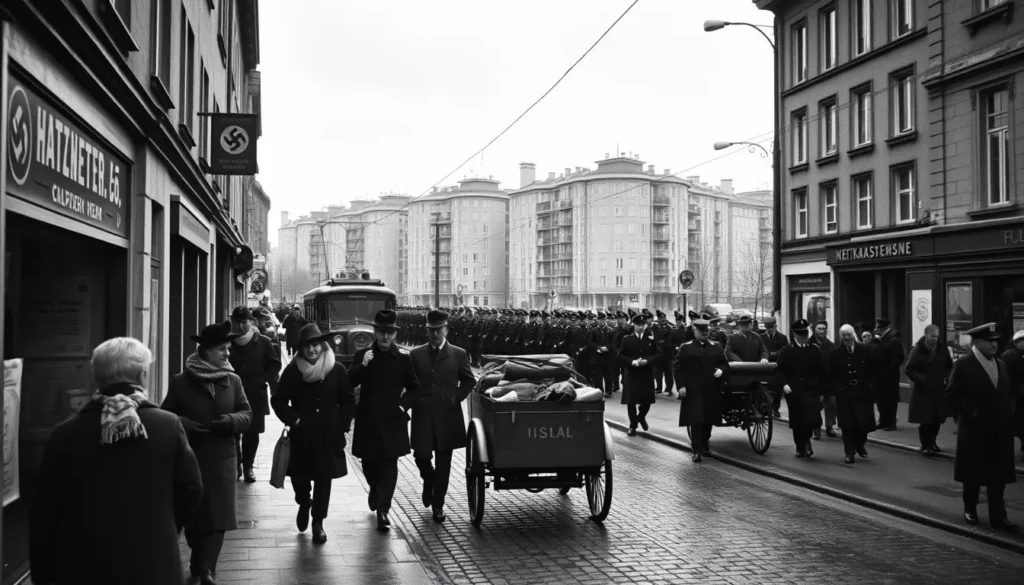
The atmosphere was tense. Political posters, SA and SS uniforms, Communist and Social Democratic leaflets, and police patrols were part of the visual landscape. Cafés, department stores, cinemas, and cabarets still operated, but public life was being Nazified. The Nazi seizure of power did not erase Berlin’s cosmopolitanism overnight; it placed it under siege.
Population & Economy
The 1933 census recorded roughly 4.2 million inhabitants in Berlin, making it one of Europe’s largest cities. The population included a Jewish community of about 160,000, roughly four percent of the city, as well as Catholic and Protestant Berliners, trade unionists, civil servants, industrial workers, and a large service sector. The Great Depression had hit Berlin hard: unemployment was mass and long-term, with many dependent on welfare or odd jobs. Recovery in 1933 was real but uneven, driven partly by public works, rearmament contracts, and the destruction of independent trade unions.
Prices and wages must be understood in Reichsmarks. Contemporary price lists suggest that a loaf of rye bread cost roughly 0.30 RM and a modest flat might rent for 25–50 RM per month, though housing and wages varied sharply by district and occupation. A tram fare was a few pfennigs. For many workers, rent and food consumed most income. The Nazi regime pressed for employment and public order while excluding Jews and political enemies from jobs, shops, and professional life.
Government & Politics
National power after 30 January 1933 rested with Hitler as Reich Chancellor, backed by Hindenburg and a cabinet of conservatives. In Berlin, the city government was led by Oberbürgermeister Heinrich Sahm, but real power increasingly flowed through Nazi party officials and the Prussian interior ministry under Hermann Göring. The police were purged and used against Communists, Social Democrats, Jews, and critics. The 5 March Reichstag election gave the Nazis 43.9 percent nationally; in Berlin they performed less strongly than in many rural Protestant areas, but violence and intimidation distorted the campaign.
The Enabling Act of 23 March allowed the government to legislate without the Reichstag and to deviate from the constitution. Party organizations, newspapers, unions, and associations were coordinated or banned. Berlin’s city council and administration were purged and brought into line. Political opposition did not vanish, but it was driven underground, into exile, or into private grumbling. The SA’s street violence remained central to Nazi rule, even when the regime presented itself as restoring order.
Industry
Berlin was Germany’s leading industrial and administrative centre. Electrical engineering firms such as Siemens and AEG, machine-building works, clothing and textile workshops, printing and publishing houses, breweries, and the film industry around UFA gave the city a diversified economy. The government quarter, banks, department stores, and transport networks employed thousands. Small workshops and family businesses were as important as the great factories.
In 1933 the Nazi regime began coordinating business and labour. Independent trade unions were smashed on 2 May; the German Labour Front replaced them. Jewish-owned firms faced boycott, pressure, and Aryanization. Arms contracts and public works slowly revived some sectors, but the year was still marked by unemployment, insecurity, and the exclusion of Jews and political opponents from economic life.
Education
Berlin possessed a dense educational landscape: primary and secondary schools, vocational institutes, the Friedrich-Wilhelms-Universität, and the Technical University in Charlottenburg. Literacy was near universal. The Nazi regime moved quickly to control schools and universities. The Law for the Restoration of the Professional Civil Service of 7 April 1933 led to the dismissal of Jewish and politically unreliable civil servants, including teachers and professors. Student organizations were Nazified, curricula were revised, and academic freedom was sharply curtailed.
On 10 May 1933 students and SA men burned books by Jewish, Marxist, pacifist, and liberal authors on the Opernplatz. The event symbolized the regime’s assault on critical thought. For Jewish pupils, teachers, and academics, 1933 brought humiliation, dismissal, and the search for escape.
Transportation
Berliners moved by tram, bus, U-Bahn, and S-Bahn. The Berliner Verkehrs-Aktiengesellschaft operated a vast network, and the Reichsbahn carried commuters and freight. Private cars remained rare; bicycles, horse-drawn carts, and walking were common. Tempelhof Airport was a modern gateway, and the city’s railway stations linked Berlin to the Reich and to emigration routes.
Political events disrupted transport: marches, rallies, and road closures were frequent. The regime also used transport for control—police patrols, checks, and the deportation of prisoners to early camps. Everyday movement continued, but public space was increasingly unsafe for those marked as enemies.
Everyday Life
Most Berliners lived in rented flats, often in dense Mietskasernen with courtyards and shared stairwells. Daily routines began early: work, shopping, school, cooking, and commuting. Food was plain—bread, potatoes, cabbage, sausage, and seasonal produce—while better-off households enjoyed meat, coffee, and cakes. Clothing was practical; men wore suits or work clothes, women dresses, coats, and hats. Cinemas, radio, dance halls, sports clubs, and cafés offered entertainment, though cabaret and avant-garde culture were under pressure.
Nazi rule intruded into ordinary life. SA men stood outside Jewish shops during the 1 April boycott. Uniforms, flags, and loudspeakers became commonplace. Children were drawn into Nazi youth groups, and adults faced pressure to join party organizations. Jews, Communists, Social Democrats, and other targets lived with fear of arrest, dismissal, and violence. Even those who supported Hitler experienced the year as a mixture of hope, propaganda, and anxiety.
Major Events
The year’s decisive events were national but centred on Berlin. On 30 January Hitler was appointed chancellor; that evening SA and SS men marched through the Brandenburg Gate. On 27 February the Reichstag burned; the next day the Reichstag Fire Decree suspended basic rights. The 5 March election was followed by the 21 March Day of Potsdam, a propaganda spectacle linking Hitler to the old Prussian elite. On 23 March the Enabling Act passed. April brought the boycott of Jewish businesses and the civil service purge. On 10 May books were burned. By midsummer the parties had been banned or dissolved, and on 14 July Germany became a one-party state. In November a Reichstag election and plebiscite ratified Nazi rule.
What Newspapers Were Reporting
Berlin’s press was among the most diverse in Europe, but 1933 destroyed that diversity. Nazi papers such as the Völkischer Beobachter and Goebbels’s Der Angriff celebrated the seizure of power, while liberal and Jewish-owned papers such as the Berliner Tageblatt and Vossische Zeitung were intimidated, coordinated, or soon closed. Social Democratic Vorwärts and Communist Die Rote Fahne were banned. Headlines dwelt on the Reichstag fire, the election, the Enabling Act, the boycott, and the book burnings. The Enabling Act itself announced the end of constitutional government:
Laws of the Reich may also be enacted by the government of the Reich in addition to the procedure prescribed by the Constitution.
Newspapers also carried ordinary news—weather, sport, cinema listings, classified advertisements—but the space for independent reporting shrank week by week.
What People Were Talking About
Letters and diaries from 1933 record fear, rumour, and careful self-censorship. People asked who had been arrested, which shops were marked with boycott posters, whether a Jewish colleague would emigrate, and whether the Nazis would last. Some Berliners welcomed Hitler as a restorer of order and work; others whispered jokes, sheltered friends, or prepared to leave. Diarists such as Count Harry Kessler and Sebastian Haffner captured the mixture of disbelief and accommodation among educated Berliners. In kitchens, courtyards, and offices, the same questions recurred: Is it safe to speak? Should we join the party? Can we get a visa? What will happen next?
Historical Photographs
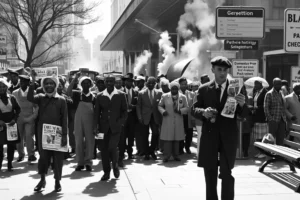
Photographs from 1933 are abundant and chilling. They show SA torchlight parades through the Brandenburg Gate, the burned-out Reichstag, Hitler at a window acknowledging crowds, SA guards outside Jewish shops, and students throwing books onto bonfires. Press photographers and Nazi propagandists such as Heinrich Hoffmann produced images that shaped both contemporary opinion and later memory. Some photographs were staged for propaganda; others are documentary records of violence and exclusion. Together they preserve the visual texture of a city being transformed.
Documents & Primary Sources
Historians rely on a wide range of sources: the 1933 census and city directories; police and Gestapo files; administrative records of the Berlin city government; Nazi party membership lists; newspapers and posters; maps and transport schedules; diaries, letters, and memoirs; and photographs. Key archives include the Landesarchiv Berlin, the Bundesarchiv, the Deutsches Historisches Museum, the Topography of Terror Documentation Center, and the Staatsbibliothek zu Berlin. These records allow historians to reconstruct both the machinery of dictatorship and the texture of daily life.
1933 Timeline
| Date | Event |
|---|---|
| 30 January | Hindenburg appoints Hitler Reich Chancellor; SA torchlight parade in Berlin. |
| 27 February | Reichstag fire in Berlin. |
| 28 February | Reichstag Fire Decree suspends civil liberties. |
| 5 March | Reichstag election; Nazi intimidation and violence. |
| 21 March | Day of Potsdam propaganda ceremony. |
| 23 March | Enabling Act passed. |
| 1 April | Nazi boycott of Jewish businesses. |
| 7 April | Civil service law purges Jewish and political opponents. |
| 26 April | Prussian Gestapo established under Göring. |
| 1 May | Nazi May Day rallies. |
| 10 May | Book burning on the Opernplatz. |
| 22 June | Social Democratic Party banned. |
| 14 July | Law against new parties; one-party dictatorship. |
| 12 November | Reichstag election and plebiscite. |
What Changed Next
In 1934 the regime consolidated further: the Night of the Long Knives in June–July 1934 destroyed the SA leadership and potential rivals, and after Hindenburg’s death in August Hitler combined the offices of president and chancellor as Führer. The Nuremberg Laws of 1935 stripped Jews of citizenship and forbade marriages between Jews and non-Jews. Berlin hosted the 1936 Olympics as a propaganda showcase, while persecution continued. Kristallnacht in November 1938 brought mass violence against Jewish property and people. By 1939 Berlin was the capital of a regime launching a war that would destroy the city and much of Europe.
Sources
- Stiftung Topographie des Terrors, Berlin 1933 – The Path to Dictatorship (Berlin, 2013), ISBN 978-3-941772-12-0; https://www.topographie.de/en/publications/detail/berlin-1933-the-path-to-dictatorship
- BBC Four, Berlin 1933; https://www.bbc.co.uk/programmes/p0gjkj43
- Richard J. Evans, The Coming of the Third Reich (Penguin, 2003).
- Ian Kershaw, Hitler 1889–1936: Hubris (W. W. Norton, 1998).
- Staatsbibliothek zu Berlin, digitized Berliner Tageblatt and other 1933 newspapers.
FAQ
What was the population of Berlin in 1933?
The 1933 census recorded approximately 4.2 million inhabitants in Berlin.
What major events happened in Berlin in 1933?
Key events included Hitler’s appointment as chancellor on 30 January, the Reichstag fire on 27 February, the Enabling Act on 23 March, the boycott of Jewish businesses on 1 April, and the book burning on 10 May.
What primary sources are available for studying Berlin in 1933?
Researchers can use census records, city directories, police and Gestapo files, newspapers, posters, diaries, letters, photographs, and administrative records held in archives such as the Landesarchiv Berlin and the Bundesarchiv.
How did daily life in Berlin in 1933 differ from today?
Daily life was marked by political terror and propaganda, limited technology, dense rented housing, tram and U-Bahn transport, and extreme insecurity for Jews and political opponents. Newspapers, radio, and public space were rapidly coordinated by the Nazi regime.










Leave a Reply