
Short Answer
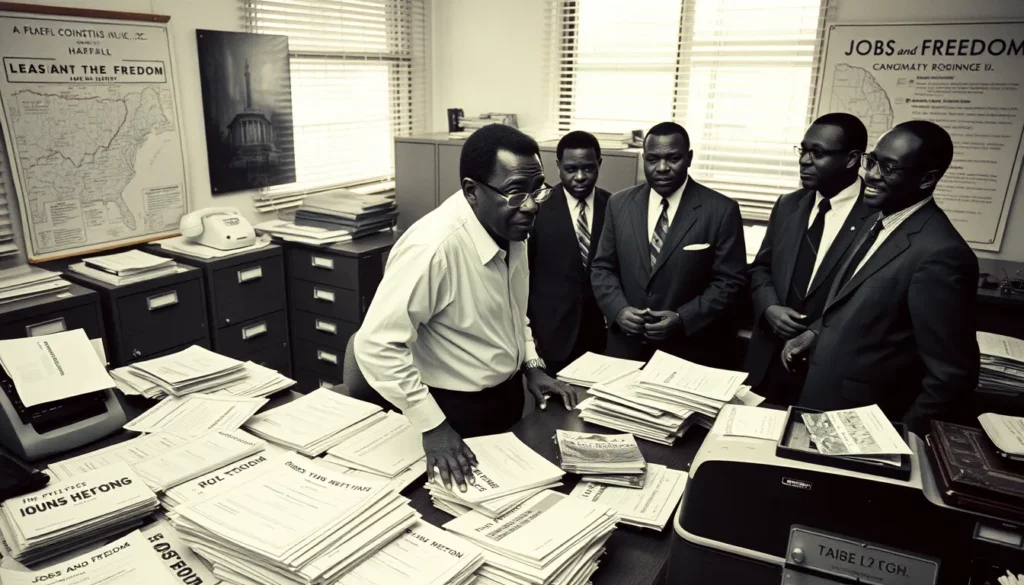
In August 1963, the New York office of the March on Washington for Jobs and Freedom at 170 West 130th Street smelled of mimeograph ink and summer heat. Bayard Rustin, the march’s deputy director, worked beneath Cleveland Robinson, chairman of the administrative committee, turning a vast national protest into a set of instructions: where buses would park, which avenues marchers would use, how marshals would be identified, what signs could be carried, and how food, sanitation, and medical aid would reach a crowd expected to exceed one hundred thousand. The final Organizing Manual No. 2 warned that arrangements had changed since the first manual: there would be “NO separate state locations,” and all buses would proceed directly to the Washington Monument. The route would run along Independence and Constitution Avenues. These were not bureaucratic details alone. They were the practical language of a movement that intended to appear disciplined, dignified, and impossible to ignore. Rustin had been organizing since the 1940s, and he knew that a mass march could fail through disorder as surely as through opposition. The memos, letters, flyers, and manuals preserved from that summer show how he and a coalition of civil rights, labor, and religious leaders transformed a protest into a national operation—and how they tried to control the meaning of the event before a single marcher arrived.
What Happened?
The March on Washington for Jobs and Freedom took place in Washington, D.C., on August 28, 1963. Its public demand was economic and political: jobs, freedom, civil rights legislation, and an end to racial discrimination. The idea was closely associated with A. Philip Randolph, president of the Negro American Labor Council, who had threatened a mass march on Washington in 1941 and had helped lead the 1957 Prayer Pilgrimage. In 1963 Randolph served as director of the march; Bayard Rustin served as deputy director; Cleveland Robinson chaired the administrative committee. The New York office at 170 West 130th Street became the command post for transportation, publicity, and discipline.
- July 2, 1963 — An organizational proposal, possibly drafted by Rustin, circulated for the first March planning meeting.
- July 30, 1963 — Roy Wilkins of the NAACP issued a mobilization letter to recruit marchers and organize contingents.
- August 1963 — Organizing Manual No. 1, credited to Cleveland Robinson and Bayard Rustin, laid out the first plan. Manual No. 2 revised it: no separate state locations; buses direct to the Washington Monument; march route along Independence and Constitution Avenues.
- August 13, 1963 — Randolph wrote to President John F. Kennedy requesting an appointment for civil rights leaders on the day of the March; the request was granted.
- August 22, 1963 — Courtland Cox of SNCC sent Rustin a memo listing the number of buses coming from the South, evidence of the march’s national logistics.
- August 28, 1963 — More than 200,000 people gathered at the Lincoln Memorial. The program included speeches by Randolph, King, John Lewis, Roy Wilkins, and others; King delivered “I Have a Dream.”
The final manual listed ten chairmen: Mathew Ahmann, Eugene Carson Blake, James Farmer, Martin Luther King Jr., John Lewis, Joachim Prinz, A. Philip Randolph, Walter Reuther, Roy Wilkins, and Whitney Young. It also set out ten demands, including comprehensive civil rights legislation, withholding federal funds from discriminatory programs, desegregation of schools, a fair employment practices law, and a massive federal training and jobs program. Rustin’s task was to make those demands visible in a single day of orderly national witness.
How It Was Seen at the Time
Contemporaries saw the March as both a moral appeal and a test of organizational discipline. The organizing literature did not present it as a riot or a festival. It spoke of grievance, crisis, and historic notice. “We march to redress old grievances and to help resolve an American crisis,” Manual No. 2 declared. The crisis was “born of the twin evils of racism and economic deprivation.” The manual insisted that “Our bodies, numbering over 100,000, will bear witness—will serve historic notice—that Jobs and Freedom are needed NOW.” That language joined the moral urgency of the black freedom struggle to the sober cadence of a labor and religious coalition.
“We march to redress old grievances and to help resolve an American crisis. That crisis is born of the twin evils of racism and economic deprivation.” — March on Washington, Organizing Manual No. 2, August 1963
Newspapers and participants emphasized the crowd’s order and dignity, but not everyone read the March the same way. Some younger activists regarded the coalition’s emphasis on respectability and legislation as too cautious; others in Congress and the press feared disorder. The organizers answered both fears with paper: marshals’ manuals, usher instructions, transportation forms, and repeated warnings to follow the revised routes. To many observers at the time, the March was already a success before the speeches ended because it had arrived, assembled, and dispersed without the violence that critics had predicted.
Historical Snapshot
| Aspect | Detail |
|---|---|
| Date | August 28, 1963 |
| Place | Washington, D.C.; assembly near the Washington Monument and program at the Lincoln Memorial |
| People | Bayard Rustin, deputy director; A. Philip Randolph, director; Cleveland Robinson, administrative committee chairman; Martin Luther King Jr., Roy Wilkins, John Lewis, and the ten chairmen |
| What Happened | More than 200,000 people marched for jobs and freedom; speeches and demands were presented |
| Why It Mattered | Demonstrated a national coalition, pressured Congress for civil rights legislation, and established Rustin’s reputation as an organizer |
Key Documents
- Organizing Manual No. 1 (August 1963) — Early blueprint credited to Cleveland Robinson and Bayard Rustin; set the first transportation and assembly plan.
- Organizing Manual No. 2 (August 1963) — Final twelve-page manual with revised routes, demands, sponsorship list, marshal instructions, and logistics.
- Roy Wilkins mobilization letter (July 30, 1963) — NAACP call to chapters to recruit marchers and organize contingents.
- A. Philip Randolph letter to President Kennedy (August 13, 1963) — Requested a meeting with civil rights leaders on the day of the March; granted.
- Courtland Cox memo to Bayard Rustin (August 22, 1963) — SNCC report listing buses from the South, showing how Rustin tracked national participation.
- Marshals Manual for Bus, Train, and Plane Captains (1963) — Instructions for discipline and crowd management.
- Program with statement, demands, and route map (1963) — The public face of the March, distributing its demands and schedule.
Letters & Diaries
The surviving correspondence shows that the March was coordinated through a web of offices and organizations, not from a single desk. Roy Wilkins’s July 30 mobilization letter went from the NAACP to its chapters. A. Philip Randolph’s August 13 letter to President Kennedy asked for an appointment for civil rights leaders on the day of the March, and the request was granted. Courtland Cox of SNCC wrote to Chicago Friends of SNCC about organizing materials on July 30, to Stokely Carmichael about funds for chartering buses on August 18, and to Rustin on August 22 with a memo listing the number of buses coming from the South. An undated letter from Cox to Rustin concerned Freedom Trains. These are not ceremonial documents; they are working papers of a national mobilization.
“READ IT CAREFULLY. There have been change in arrangements since the publication of Organizing Manual No. 1.” — March on Washington, Organizing Manual No. 2, August 1963
Rustin’s manual was itself a memo to the movement, written to correct logistics and impose common instructions. Its tone is urgent, practical, and slightly impatient. The march files also include unsigned reminders, flyers, and lists of speakers and entertainers. The absence of a single author in some items is itself revealing: the March depended on many hands, but Rustin’s office supplied the template.
Contemporary Newspaper Coverage
Contemporary newspapers treated the March as a major national story, and their language reveals both admiration and the racial vocabulary of the period. The New York Times reported the event on August 29, 1963, under a front-page headline that announced the crowd and the movement’s anthem:
“200,000 Negroes March on Washington For Equality; ‘We Shall Overcome’”
The Times’s use of “Negroes” was standard journalistic usage of the era, now outdated. The headline joined a numerical estimate to a song title, signaling that the March was both a mass demonstration and a moral performance. The Washington Post and other papers gave prominent space to Martin Luther King Jr.’s “I Have a Dream” speech, helping to fix the day in public memory. Coverage emphasized the crowd’s order, the presence of white clergy and labor leaders, and the speeches’ demands for jobs and freedom. Not all commentary was favorable; some conservative papers and members of Congress treated the March as pressure politics or potential disorder. But the dominant contemporary image was of a peaceful, enormous assembly that had been carefully managed.
What People Feared
The fears surrounding the March were concrete. Organizers worried about chaos, violence, heat, inadequate food and sanitation, lost children, and the possibility that a single scuffle would discredit the movement. Manual No. 2 included sections on food, health and sanitation facilities, children and overnight accommodation, captains, and marshals. A separate Marshals Manual for Bus, Train, and Plane Captains and instructions for ushers tried to create a chain of command. The revised plan eliminated separate state locations and sent buses directly to the Washington Monument, reducing confusion. These precautions show that Rustin and his colleagues did not assume order would happen naturally; they planned for it.
Political fears ran alongside logistical ones. Some civil rights leaders feared that the March would be portrayed as a riot or that it would alienate sympathetic members of Congress. Others feared that the coalition would be too moderate and would soften radical demands. A SNCC petition distributed at the March, “Halt Justice Department Persecution,” reflected tensions between the national coalition and grassroots activists who believed the federal government was still persecuting local organizers. The day’s calm did not erase those disagreements; it held them in public view.
Bayard Rustin’s achievement in the summer of 1963 was to make a moral protest administratively possible. The memos, manuals, letters, and speeches preserved from the March on Washington show a movement thinking in print: counting buses, correcting routes, assigning marshals, listing demands, and imagining how a crowd of more than 200,000 would appear to the nation. The primary sources do not reduce the March to logistics, but they show that logistics were part of its meaning. Discipline was a political argument. Order was a form of witness. The paper trail Rustin left behind teaches that social movements are not only gatherings of conscience; they are also networks of correspondence, deadlines, and instructions—fragile human arrangements that can become history.
FAQ
What was Bayard Rustin’s role in the March on Washington?
Rustin served as deputy director under A. Philip Randolph. He ran the New York office, coordinated transportation and logistics, helped produce the organizing manuals, corresponded with civil rights groups, and planned the march’s discipline and routes.
How did Rustin use memos and letters to organize the March?
Rustin and his office used memos and letters to count buses, correct routes, recruit marshals, distribute demands, and coordinate with groups such as SNCC and the NAACP. The surviving documents show a national mobilization managed through working papers rather than speeches alone.
Was the March on Washington Bayard Rustin’s idea?
No. The idea was most closely associated with A. Philip Randolph, who had proposed a mass march as early as 1941. Rustin was the chief organizer and deputy director who turned Randolph’s proposal into an operational plan in 1963.











Leave a Reply