
Short Answer
Quick Snapshot
At one minute past midnight on June 30, 1960, the Belgian Congo formally ceased to exist. King Baudouin of Belgium proclaimed the new Republic of the Congo (Léopoldville) independent, and Patrice Lumumba, the nation’s first prime minister, delivered an impassioned address condemning colonial rule. The Eisenhower administration in Washington had hoped for a stable, pro-Western central government in Central Africa; within days, those hopes evaporated as the country descended into chaos.
By July 5, Congolese soldiers had mutinied against their Belgian commanders, attacking European civilians and prompting a mass exodus of Belgian nationals. On July 11, Moïse Tshombe declared the mineral-rich province of Katanga independent. The United Nations dispatched its largest peacekeeping operation to date, yet the crisis deepened through the year, culminating in a coup by Colonel Joseph Mobutu on September 14, 1960.
The Republic of the Congo (Léopoldville) in 1960
The Republic of the Congo (Léopoldville)—so named to distinguish it from the neighboring French Congo across the river—occupied a vast territory in the heart of Africa, roughly the size of Western Europe. Its capital, Léopoldville, sat on the south bank of the Congo River, a bustling port city of wide boulevards and colonial-era architecture that had grown rapidly in the postwar decades. The country’s geography ranged from dense equatorial rainforest in the north to the savannas of the south and the mineral-rich highlands of Katanga.
The climate in 1960 followed its familiar tropical rhythm: a long rainy season from October to May, a short dry season in June and July, and a second rainy period in August and September. The dry season of 1960 coincided with the political storm that would define the year. The atmosphere in Léopoldville was electric with anticipation in the early months, as the June independence date approached, and then thick with anxiety and fear as violence erupted in July.
Population & Economy
The Republic of the Congo had an estimated population of roughly 14 million people in 1960, the vast majority of them Africans belonging to scores of ethnic groups, including the Kongo, Luba, Lunda, Mongo, and others. Europeans—primarily Belgians—numbered around 100,000, most of them concentrated in Léopoldville, Élisabethville, and other urban centers. Léopoldville itself had grown to approximately 400,000 residents, many of them recent migrants from rural areas drawn by employment opportunities.
The economy was dominated by mineral extraction. Katanga province produced copper, cobalt, and uranium; the Kasai region yielded industrial diamonds. Belgian companies, particularly the Union Minière du Haut-Katanga, controlled these resources and repatriated much of the profits. Agriculture—palm oil, coffee, cotton, and rubber—formed the second pillar of the economy. Congolese workers earned wages far below those of their Belgian counterparts, and unemployment in the cities was a persistent problem. The cost of living in Léopoldville was modest by Western standards, but prices for imported goods rose sharply in the months after independence as supply chains were disrupted.
Government & Politics
In the months leading up to independence, the Congolese elected a president, Joseph Kasavubu, a prime minister, Patrice Lumumba, a senate and assembly, and similar bodies in the country’s numerous provinces. The new government inherited a colonial administrative structure that had been hastily Africanized, with few Congolese possessing experience in senior positions.
Lumumba’s government was a fragile coalition of nationalist parties, regional groupings, and ideological factions. Kasavubu, leader of the ABAKO party, represented a more federalist vision, while Lumumba advocated a strong central government. The political climate was further complicated by Cold War tensions: the Eisenhower administration viewed the Congo as a strategic prize and feared Soviet penetration, while Moscow sought to cultivate Lumumba as an ally. On July 13, 1960, the UN Security Council authorized an intervention, acting under Article 99 of the Charter at the request of the Congolese government, after Belgian troops returned to protect European civilians.
Industry
The industrial heart of the Congo lay in Katanga, where the Union Minière du Haut-Katanga operated vast copper mines and smelting facilities at Élisabethville, Jadotville, and Kolwezi. The company’s mines produced more than 300,000 tons of copper annually, along with significant quantities of cobalt and uranium—the latter having been used in the Manhattan Project during World War II. In Kasai, the Forminière company extracted industrial diamonds.
In Léopoldville, industry was lighter: breweries, textile mills, cigarette factories, and food-processing plants served the urban market. The port of Matadi, connected to Léopoldville by rail, handled the country’s overseas trade. The secession of Katanga in July 1960 threatened to deprive the central government of its most valuable source of revenue, a factor that intensified the political struggle over the province.
Education
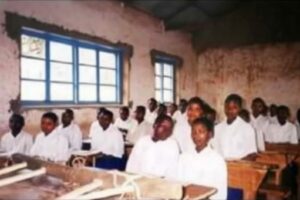
Education in the Congo in 1960 bore the deep imprint of colonial policy. Mission schools—Catholic and Protestant—provided the bulk of primary education, teaching in local languages with French introduced at higher levels. Literacy rates among Congolese adults were estimated at roughly 40 percent, with significant regional variation. Secondary education was extremely limited; only a few thousand Congolese had completed secondary school by independence.
Higher education was virtually nonexistent until the founding of Lovanium University near Léopoldville in 1954, operated by the Catholic University of Louvain. By 1960, Lovanium had enrolled a few hundred Congolese students, many of whom would go on to become the country’s first generation of professionals and political leaders. The urgent need for educated personnel was one of the most pressing challenges facing the new government, which inherited a civil service that was almost entirely Belgian-staffed.
Transportation
The Congo River was the country’s principal transportation artery. Steamboats operated by the state-owned company OTRACO carried passengers and cargo between Léopoldville and Stanleyville, a journey of several weeks upriver. The river system connected to the railway network at key points: the Matadi–Léopoldville railway linked the capital to the Atlantic port, while the BCK railway connected Katanga’s mining towns to the river port of Port-Francqui.
Roads were sparse and often impassable in the rainy season. Fewer than 10 percent of the country’s roads were paved. Air travel was the most reliable means of long-distance transport; Sabena, the Belgian national airline, operated regular flights between Brussels and Léopoldville, and internal air services connected the major towns. During the July crisis, Sabena’s aircraft were pressed into service to evacuate Belgian citizens—25,711 flew home in the three weeks following the mutiny.
Everyday Life
Daily life in Léopoldville in 1960 reflected the stark contrasts of a society in transition. European residents lived in comfortable villas in the city’s southern districts, with servants, automobiles, and access to imported goods. African residents, by contrast, inhabited crowded quarters such as the African commune of Kinshasa, where housing was often substandard and sanitation inadequate. The city’s nightlife was lively: bars, dance halls, and outdoor cinemas drew crowds of Congolese, while the famous OK Jazz and African Jazz bands played a fusion of rumba and Congolese folk music.
Food reflected both local and colonial influences. Cassava, plantains, maize, and peanuts formed the staples of the African diet, supplemented by fish from the river and game from the countryside. European households enjoyed imported beef, vegetables, and wine. Clothing styles were similarly divided: European men wore suits and ties; African men adopted Western dress for work but often wore traditional cloth at home; women wrapped themselves in colorful pagnes, or printed cotton cloth.
The mutiny of July 5 shattered the routines of daily life. European families fled their homes, many leaving behind furniture, cars, and household goods. African families, too, experienced dislocation as violence spread and the economy faltered. The UN peacekeeping force, which would grow to 20,000 troops, became a familiar presence in the streets of Léopoldville.
Major Events
The year 1960 was one of the most consequential in Congolese history. On June 30, independence was proclaimed at a ceremony in Léopoldville attended by King Baudouin, Prime Minister Lumumba, and President Kasavubu. Lumumba’s speech, delivered after the King’s address, was a blunt denunciation of colonial rule that shocked the Belgian delegation and electrified the Congolese audience.
On July 5, soldiers of the Force Publique mutinied at their barracks near Léopoldville, angered by the retention of Belgian officers and the slow pace of Africanization. The mutiny spread rapidly, and European civilians were attacked. Belgian troops intervened, and the UN Security Council authorized a peacekeeping mission on July 13. On July 11, Moïse Tshombe declared Katanga’s secession, plunging the country into a political crisis that would last for years. In September, President Kasavubu dismissed Lumumba, and on September 14, Colonel Joseph Mobutu—then the army chief of staff—seized power in a coup, expelling Soviet and other Eastern Bloc diplomats.
What Newspapers Were Reporting
Newspapers in Léopoldville and abroad reported the Congo’s crisis in dramatic headlines throughout 1960. The Belgian press, including Le Soir and La Libre Belgique, covered the evacuation of Belgian citizens with front-page stories of violence and panic. The international wire services—Reuters, AP, and AFP—filed dispatches from Léopoldville describing the breakdown of order and the arrival of UN troops.
In the Congo itself, the daily newspaper Courrier d’Afrique, published in Léopoldville, reported on the political maneuvering between Lumumba, Kasavubu, and Tshombe, while also covering the practical concerns of its readers: food prices, transport disruptions, and the safety of the streets. The American press, including The New York Times and The Washington Post, framed the crisis in Cold War terms, speculating about Soviet influence and the fate of Western interests in Central Africa.
What People Were Talking About
In the streets of Léopoldville, conversations in 1960 turned on questions of survival and hope. Congolese workers discussed the meaning of independence—what it would bring in terms of jobs, wages, and dignity—and the betrayal they felt when the mutiny and violence threatened to undo their gains. The secession of Katanga was a topic of intense debate: some saw Tshombe as a puppet of Belgian mining interests, while others sympathized with Katanga’s desire to keep its mineral wealth.
Among European residents, the dominant topic was whether to stay or leave. Many had spent their entire careers in the Congo and were reluctant to abandon their homes, but the violence of July convinced thousands that departure was the only option. Diplomats and UN officials discussed the prospects for a negotiated settlement and the danger of Cold War escalation. The American embassy, under Ambassador Clare Timberlake, worked to maintain contact with all factions while urging a moderate, pro-Western outcome.
Historical Photographs
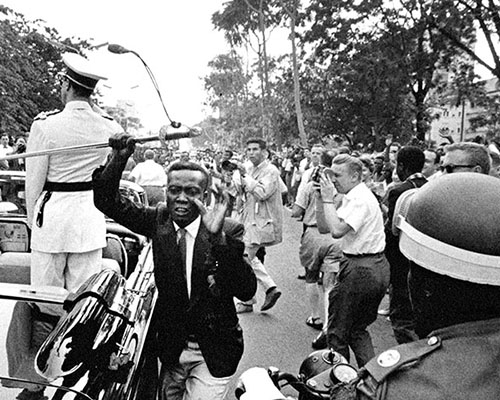
The visual record of the Congo in 1960 is rich and dramatic. Photographs from the independence ceremony show King Baudouin and Patrice Lumumba on the dais in Léopoldville, the King in white uniform and the Prime Minister in a dark suit. News photographers captured the chaos of the July mutiny: Congolese soldiers brandishing rifles, European families queuing at the airport, and the arrival of Belgian paratroopers.
One of the most famous images of the year is the photograph of Colonel Joseph Mobutu, taken on September 14, 1960, showing the young officer in uniform, his expression serious, as he announced the coup that would ultimately lead to his three-decade rule. UN photographers documented the deployment of peacekeeping troops from Ghana, Ethiopia, Ireland, and other nations, creating a visual record of the international response to the crisis.
Documents & Primary Sources
Historians studying the Congo in 1960 rely on a wealth of primary sources. The United Nations archives contain the official records of the Security Council and General Assembly debates, including the request from the Congolese government for intervention and the resolutions authorizing the peacekeeping mission. The U.S. State Department’s Foreign Relations of the United States series includes diplomatic cables and intelligence assessments from the American embassy in Léopoldville.
Belgian colonial records, held in the Belgian State Archives, document the final years of colonial rule and the transfer of power. Personal papers of key figures—Lumumba, Kasavubu, Tshombe, and Mobutu—are scattered across archives in Brussels, Washington, and the Congo itself. The United Nations published a detailed report on its Congo operation, available in the UN document collection, which provides a chronological account of events from July 1960 onward.
1960 Timeline
| Date | Event |
|---|---|
| June 30 | The Belgian Congo is proclaimed independent at 12:01 a.m.; King Baudouin and Prime Minister Lumumba speak at the ceremony; Laurent Eketebi is appointed President of Équateur province. |
| July 5 | Congolese soldiers mutiny in Léopoldville; European civilians are attacked; Lt. Gen. Émile Janssens attempts to enforce discipline. |
| July 9 | Sabena begins airlifting Belgian citizens out of the Congo; 25,711 will fly home over the next three weeks. |
| July 11 | Moïse Tshombe declares the secession of Katanga province. |
| July 13 | UN Secretary-General acts under Article 99; Security Council authorizes a peacekeeping mission. |
| September 14 | Colonel Joseph Mobutu seizes power in a coup; Soviet and Eastern Bloc diplomats are expelled. |
| September 20–December 20 | UN General Assembly’s fifteenth regular session debates the Congo situation. |
What Changed Next
The events of 1960 set the stage for years of conflict. Lumumba was dismissed by Kasavubu in September 1960 and later captured and killed by Katangan forces in January 1961—a murder that shocked the world and deepened the crisis. The UN peacekeeping mission, which had grown to 20,000 troops, remained in the Congo until 1964, when it was withdrawn after a negotiated settlement ended the Katanga secession.
Mobutu consolidated his power gradually, staging a second coup in 1965 that gave him absolute authority. He renamed the country Zaire in 1971 and ruled for more than three decades, until his overthrow in 1997. The instability that began in 1960—ethnic conflict, foreign intervention, and struggles over mineral wealth—would continue to shape the Democratic Republic of the Congo for generations.
FAQ
What was the population of the Republic of the Congo (Léopoldville) in 1960?
The country had an estimated population of roughly 14 million people, with approximately 400,000 living in the capital, Léopoldville. Around 100,000 Europeans, mostly Belgians, resided in the country at the time of independence.
What major events happened in the Republic of the Congo in 1960?
The most significant events were independence from Belgium on June 30, the army mutiny on July 5, the secession of Katanga on July 11, the UN peacekeeping intervention in July, and Colonel Joseph Mobutu's coup on September 14.
What primary sources are available for studying the Congo in 1960?
Key primary sources include UN Security Council and General Assembly records, U.S. State Department diplomatic cables in the Foreign Relations of the United States series, Belgian colonial archives, personal papers of political leaders, contemporary newspaper articles, and photographs from news agencies.
How did daily life in the Congo in 1960 differ from today?
Daily life in 1960 was marked by the recent end of colonial rule, with a rigid racial hierarchy still visible in housing, employment, and social customs. Most Congolese lacked access to modern amenities, while Europeans lived in relative comfort. The post-independence chaos disrupted routines, and the presence of UN peacekeepers became a common sight in major cities.










Leave a Reply