
Short Answer
On 2 May 1945, the guns of Berlin fell silent. The city’s garrison had capitulated, six days before the official end of the Second World War in Europe. Berlin emerged from the battle as a lunar landscape: 600,000 apartments destroyed, entire districts reduced to rubble, and a population that had shrunk from 4.3 million to just 2.8 million. The stillness that followed the fighting was so profound that Berliners called it Stunde Null—zero hour. For many, it felt like an absolute break with the past, a radical new beginning from the ashes. But the new beginning came with the smell of decay, the sting of hunger, and the uneasy presence of foreign soldiers on every corner. The city was not only physically broken; it was about to be politically split. As one freed pastor later wrote of the final weeks of Nazi rule, ‘What I experienced as sadism during those last one and a half weeks cannot be described here.’ The horror was not over; it was merely changing shape.
What Happened?
The chronology of Berlin’s transformation is precise. On 2 May 1945, the Berlin garrison surrendered to the Soviet Red Army, which had stormed the city after weeks of brutal street fighting. The official end of the war in Europe came on 8 May 1945, when Germany signed an unconditional surrender. In the weeks that followed, the city was carved into four occupation sectors, administered jointly by the United States, Great Britain, France, and the Soviet Union, according to an agreement signed by the Allies.
- 2 May 1945: Berlin garrison capitulates to the Soviet Red Army.
- 8 May 1945: End of World War II in Europe; Germany surrenders.
- Summer 1945: Berlin is divided into four sectors, with joint Allied administration.
- 1946: Growing conflicts between the victorious powers end the joint administration; Berlin becomes a Cold War hotspot.
- April 1946: The KPD (Communist Party) and SPD (Social Democratic Party) are forced to merge in the Soviet occupation zone and East Berlin, forming the SED.
The physical destruction was staggering. Of Berlin’s original 4.3 million residents, only 2.8 million remained. About 600,000 apartments had been destroyed, leaving hundreds of thousands of people homeless. The city’s infrastructure—water, electricity, transport—was in ruins. The immediate task was survival.
How It Was Seen at the Time
For contemporaries, the term Stunde Null captured the moment’s essence. As one historian later described it, the phrase implied ‘an absolute break with the past and a radical new beginning.’ Berliners spoke of the stillness that followed the raging battles, a silence that was both relief and dread. The Soviet occupation was the first experience, and it was marked by fear. A pastor freed by Soviet troops from the Nazi prison known as ‘the house of horror’ later wrote: ‘What I experienced as sadism during those last one and a half weeks cannot be described here.’ The mood was a mixture of exhaustion, shame, and uncertainty. The future was a blank slate, but the present was filled with rubble.
“What I experienced as sadism during those last one and a half weeks cannot be described here.” — A pastor freed by Soviet forces from a Nazi prison, 1945.
Many Berliners saw the division of the city as a temporary arrangement. They expected the Allies to work together to rebuild Germany. The reality of the Cold War was not yet apparent. In the summer of 1945, the city was a place of queues for food, of women clearing bricks, and of soldiers from four nations patrolling the streets.
Historical Snapshot
| Aspect | Detail |
|---|---|
| Date | 2–8 May 1945 (capitulation and end of war); division into sectors follows |
| Place | Berlin, Germany |
| People | Berliners (2.8 million remaining), Allied occupation forces (US, UK, France, USSR) |
| What Happened | Berlin garrison capitulated; city divided into four occupation zones |
| Why It Mattered | Established the framework for the Cold War division of Berlin and Germany |
Daily Life
Daily life in Berlin in 1945 was a struggle for survival. The city was a sea of rubble; the streets were covered with broken bricks and dust. Women, called Trümmerfrauen (rubble women), formed human chains to pass bricks and clear debris, working without pay and often without adequate food. Rationing was introduced immediately by the occupying powers. The daily food ration was set at a bare minimum—often just 1,500 to 1,800 calories per day for ordinary citizens, with even less for those not considered essential workers. People stood in line for hours for a loaf of bread or a few potatoes. The black market flourished, but those with nothing to trade suffered.
Housing was scarce. Many families lived in damp cellars or in rooms that had escaped the bombings. The winter of 1945–46 was particularly harsh, with little coal for heating. The city’s transport network was destroyed, so people walked everywhere. The presence of Allied soldiers—Soviet, American, British, French—was a constant reminder of defeat. Women faced the additional threat of sexual violence, especially from Soviet troops in the initial months. The city was a place of exhaustion and desperation, but also of a strange, stubborn will to rebuild.
Eyewitness Accounts
Photographs taken by Allied photographers and Soviet soldiers provide some of the most direct evidence of life in Berlin. One iconic image from July 1945 shows a blind man and his companion sitting in the rubble of a Berlin street, their faces expressionless. Another photograph shows Soviet officers examining bindings inside the Gestapo headquarters. These images capture the emptiness and the shock.
Written eyewitness accounts are rarer but powerful. The pastor freed from the Nazi prison, quoted above, wrote of his experience in the final weeks of the war. Another account comes from a German woman, whose diary described the constant fear of the Soviet soldiers, the hunger, and the despair. She wrote: “We are no longer human; we are only animals trying to survive.” These accounts, though filtered through personal trauma, provide a raw window into the daily reality.
Numbers at the Time
| Statistic | Value (1945) |
|---|---|
| Pre-war population of Berlin | 4.3 million |
| Population after capitulation | 2.8 million |
| Apartments destroyed | 600,000 |
| Daily food ration (typical) | 1,500–1,800 calories |
| Number of occupation sectors | 4 |
Timeline
- 2 May 1945: Berlin garrison surrenders to the Soviet Red Army.
- 8 May 1945: Germany signs unconditional surrender; war in Europe ends.
- June–July 1945: Allied troops enter their designated sectors of Berlin.
- July 1945: Potsdam Conference (17 July–2 August) confirms the division of Germany and Berlin into zones.
- 1946: Growing conflicts between the Soviet Union and Western Allies end the joint administration.
- April 1946: The KPD and SPD are forced to merge in the East, creating the SED.
Aftermath
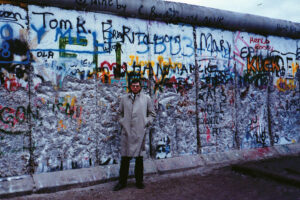
The immediate aftermath of 1945 was a period of occupation and rebuilding, but also of mounting friction. The Big Three allies—the United States, Britain, and the Soviet Union—had different visions for Germany’s future. By 1946, the joint administration of Berlin was breaking down. The Soviet Union pushed for a unified, socialist Germany, while the West sought a democratic state. This conflict led to the Berlin Blockade of 1948–49, when the Soviet Union cut off land access to West Berlin, prompting the Berlin Airlift. The city became a symbol of the Cold War, and in 1961 the Berlin Wall would physically divide it. The division that began in 1945 was not just a political map; it was a lived experience of two separate worlds.
How Historians See It Today
Historians today view the term “zero hour” with a critical eye. While contemporaries spoke of an absolute break with the past, modern scholarship emphasizes the continuities of German society—the lingering presence of former Nazis, the persistence of social structures, and the slow process of denazification. The “zero hour” was more a myth of new beginning than a reality. Moreover, historians stress that the division of Berlin was not inevitable but the result of the growing Cold War between the Soviet Union and the West. The sources from 1945 show that Berliners themselves did not expect the permanent division; they hoped for a single, neutral Germany. The reality of the Wall was not a fulfillment of 1945 but a later development.
The primary sources from 1945—photographs, diaries, and official reports—capture a moment of absolute destruction and ambiguous hope. They remind us that the birth of the divided city was not a single event but a process, one that was lived day by day by the people of Berlin, in the rubble, the ration lines, and the quiet of the zero hour.
FAQ
What was the 'zero hour' (Stunde Null) in Berlin?
The term 'zero hour' refers to the moment of Germany's capitulation on May 8, 1945, and the immediate aftermath. It was used by Germans to describe the absolute break with the Nazi past and the beginning of a new era. For Berliners, it was a time of ruin and uncertainty, but also of potential renewal.
How was Berlin divided in 1945?
Berlin was divided into four occupation sectors: the Soviet, American, British, and French sectors. The division was established by Allied agreements, and the city was administered jointly by the four powers. This arrangement broke down by 1946, leading to the Cold War division that eventually resulted in the Berlin Wall.











Leave a Reply