
Short Answer
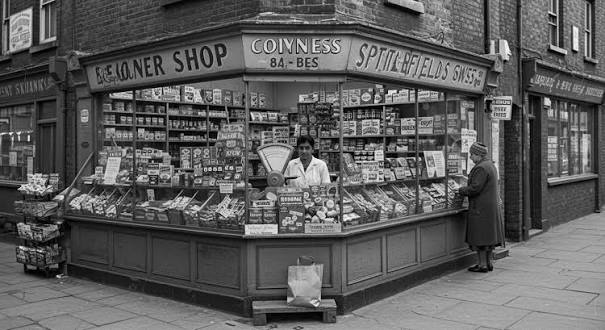
The bell above the door gave a tinny clatter, and the smell of paraffin, boiled sweets, and damp wool filled the air. It was 1952, and Britain was still in the grip of rationing. The corner shop was more than a place to buy groceries; it was the neighbourhood’s heart, its confessional, its early-warning system. The shopkeeper knew who was ill, who was out of work, who had a new baby, and who had been seen with whom. In the steel cities of the North, in the terraced streets of London, in the pit villages of Wales, the corner shop was the one constant in a country still recovering from war. But even as the decade began, the first murmurings were heard that this institution was under threat.
What Happened?
The 1950s opened with Britain still living under wartime rationing. Sugar, bacon, butter, and sweets were all measured out on brass scales behind the counter. In Sheffield, the Ardern family’s shop, “Ardern and Son,” was still subject to rationing, and the shopkeeper’s wife Jo had to tempt customers with tinned fish fritters—”with little success,” as the BBC’s Back in Time for the Corner Shop recorded.
Key developments of the period:
- Rationing continued into the early 1950s, with shopkeepers and customers still constrained by strict allowances.
- 1953: The end of sweet rationing. Sara brought the family new scales and plentiful stock, ready for a “bonanza day” as hordes of eager customers descended to buy sweets freely for the first time in over a decade.
- Commonwealth immigration transformed the customer base. Sheffield’s thriving steel industry drew workers from across the Commonwealth to Britain, creating a new group of customers for the corner shop.
- Small shops fought back against the bigger grocery chains that were beginning to expand, a struggle that would define the decade.
How It Was Seen at the Time
Contemporaries saw the corner shop as an essential British institution. The BBC’s Timeshift documentary observed: “The corner shop has always been there for us, it’s a British institution. It was on the front line of what was happening in society from the ’40s to the noughties.” It had “saved our bacon during World War II,” and it had become “a rite of passage for new immigrants.”
The prevailing mood was one of affection mixed with anxiety. The shop was where the community’s secrets were kept, where the news was exchanged, and where the elderly were checked on. Yet the rise of the larger grocery chains was already visible, and the death of the corner shop was being predicted even then.
As Babita Sharma, who grew up in a corner shop in Reading, wrote:
“I come from a hidden world: I am the daughter of shopkeepers. I’ve seen you on a Sunday morning, nipping out to get a pint of milk or to grab a newspaper. I came to know a lot about you; whether your politics leaned to the right or the left, whether you were gay or straight, and whether you were plagued by cash-flow problems or had enough disposable income to indulge your penchant for Cadbury’s Creme Eggs.”
Historical Snapshot
| Aspect | Detail |
|---|---|
| Date | Early 1950s (c. 1950–1953) |
| Place | Britain, particularly industrial cities such as Sheffield and Reading |
| People | Shopkeepers, factory workers, Commonwealth immigrants, housewives, children |
| What Happened | Rationing continued; sweet rationing ended in 1953; Commonwealth immigrants arrived; small shops fought against larger chains |
| Why It Mattered | The corner shop was the social and commercial heart of British neighbourhoods, a lifeline for workers and a rite of passage for immigrants |
Eyewitness Accounts
Babita Sharma, raised in a corner shop in Reading, gave one of the most vivid accounts of the shopkeeper’s life. Her description, quoted above, captures the intimacy of the relationship between shopkeeper and customer—the shopkeeper knew not only what you bought but who you were.
In Sheffield, the BBC’s reconstruction of the Ardern family’s experience brought the story to life. The family met ex-steel worker Joe Bent and his colleagues, who described the corner shop as a “vital lifeline” for workers doing long shifts in the city’s factories and foundries. The shop opened early and closed late, serving the men who left the factory before dawn and returned after dark.
Daily Life
Daily life in the 1950s corner shop revolved around the rhythm of the working day. The shop opened before the first shift and stayed open until the last customer had been served. Sunday mornings brought the “nip out” for a pint of milk or a newspaper (Sharma).
The shopkeeper was a confidant, a credit broker, and a record-keeper. He or she knew who was ill, who was short of money, who was having a baby. The shop was also a place of sensory experience: the smell of paraffin, the crackle of the newspaper, the weight of the brass scales.
For the new Commonwealth immigrants arriving in Sheffield, the corner shop was often the first place they were welcomed. The BBC described it as a “rite of passage”—a way for newcomers to establish themselves, to learn the rhythms of British life, and to build a business of their own.
What People Feared
The most persistent fear was the death of the corner shop itself. “The death of the corner shop has been predicted many times—but still it soldiers on,” the BBC observed. In the 1950s, the fear was that the larger grocery chains would squeeze the small shops out of the market. The chains had the advantages of scale and lower prices, and small shops with their limited stock and high overheads seemed vulnerable.
There was also a social fear: the corner shop was the glue that held neighbourhoods together. Its disappearance would mean not just the loss of a shop but the loss of a community. The shop was where the elderly were checked on, where the young were watched over, where the neighbourhood’s news was exchanged. Without it, the street would lose its beating heart.
How Historians See It Today
Modern historians have moved beyond the simple narrative of the “death” of the corner shop. The 1983 study by A.G. Wilson and M.J. Oulton, “The Corner-Shop to Supermarket Transition in Retailing: The Beginnings of Empirical Evidence,” was among the first to document this transition systematically. They found that the shift from corner shops to supermarkets was not a sudden collapse but a gradual, uneven process driven by changing consumer habits, the spread of the car, and the economics of scale.
Historians today emphasise that the corner shop was not merely a retail outlet but a resilient social institution. It survived, in part, because it fulfilled a role that the supermarket could not: it was a place of human contact, a source of credit, and a bridge for immigrants into British society. The corner shop, in this view, was not a relic of the past but a microcosm of the changes that would shape Britain for decades to come.
The corner shop of 1950s Britain was more than a place to buy bread. It was the beating heart of the community, a place where the nation’s story was written in the daily transactions of ordinary people. The primary sources show that the shop was not merely a commercial enterprise but a social institution—a witness to the end of rationing, the arrival of new immigrants, and the slow, inexorable rise of the supermarket. It was, as the BBC observed, “on the front line of what was happening in society.” The corner shop did not die in the 1950s, but it began its long, slow transformation. Its story is a reminder that the most profound changes in history are often found not in the headlines, but in the quiet, everyday exchanges over the counter.
FAQ
When did sweet rationing end in Britain?
Sweet rationing ended in 1953. The BBC's 'Back in Time for the Corner Shop' describes the day as a 'bonanza day' for the shop, as customers arrived in hordes to buy sweets freely for the first time in over a decade.
Why was the corner shop important to immigrants?
The BBC describes the corner shop as a 'rite of passage' for new immigrants. It was a way for newcomers, such as the Commonwealth workers who came to Sheffield's steel industry, to establish themselves, learn the language, and build a business of their own.








Leave a Reply