
Short Answer
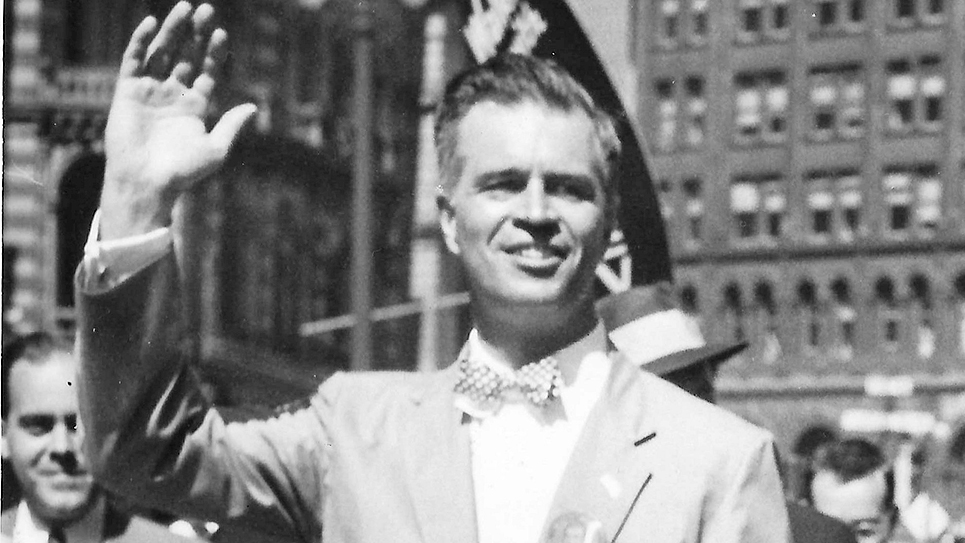
On a cold January morning in 1949, a tall, bow-tied man with a boyish grin took the oath of office in Lansing, Michigan, as the state’s 41st governor. Gerhard Mennen Williams, known to everyone as “Soapy”—a nod to his grandfather’s Mennen toiletries empire—was only 37 years old, and he had just ended a quarter-century of Republican dominance in the state capitol. The crowd that day saw a Democrat who promised to bring the New Deal to the industrial heartland, to champion civil rights, and to build a bridge that would connect the state’s two peninsulas. The Detroit Free Press called it “a new era in Michigan politics.” For the next twelve years, Soapy Williams would be the face of that era, a relentless reformer whose name would become synonymous with progressive government.
What Happened?
Gerhard Mennen Williams was born on February 23, 1911, into an affluent Detroit family. His maternal grandfather founded the Mennen Company, which produced shaving lotions and toiletries—hence the nickname “Soapy.” After attending the exclusive Salisbury School in Connecticut, he graduated from Princeton University in 1933 and earned a law degree from the University of Michigan in 1936. It was during law school that Williams broke with his family’s Republican traditions and became a passionate Democrat, inspired by Franklin D. Roosevelt’s New Deal.
His early career included work for the Social Security Board (1936–1938) and a stint as Michigan’s assistant attorney general. During World War II, he served four years in the U.S. Navy. In 1948, running on a platform of civil rights, labor reform, and economic development, he was elected governor, the first Democrat to hold the office in over a decade. He would be re-elected five more times, serving from 1949 to 1960—six two-year terms, the longest governorship in Michigan history.
As governor, Williams pushed through progressive legislation: he expanded civil rights protections, increased state aid to education, and oversaw the construction of the Mackinac Bridge, which connected Michigan’s upper and lower peninsulas when it opened in 1957. His administration also promoted economic development and labor rights. He was a vocal advocate for racial equality, and his 1954 appearance on the game show What’s My Line? is often cited as a sign of his broad public appeal.
After leaving the governorship in 1960, Williams was appointed Assistant Secretary of State for African Affairs by President John F. Kennedy, a position he held under Lyndon B. Johnson as well. In that role, he made the controversial remark that “what we want for the Africans is what they want for themselves,” which the press reported as “Africa for the Africans.” He later served as a justice of the Michigan Supreme Court from 1971 to 1986, including four years as chief justice (1983–1986). He died on February 2, 1988, at the age of 76.
How It Was Seen at the Time
Contemporaries viewed Williams as a bold liberal reformer who had rebuilt the Democratic Party in Michigan. The Chicago Tribune described him as a political reformer who “helped forge the alliance between Democrats, blacks and union voters in the late 1940s that began a strong liberal tradition in Michigan.” His 1948 victory was widely seen as a turning point—a sign that the New Deal coalition could survive in the industrial Midwest.
“What we want for the Africans is what they want for themselves.” — G. Mennen Williams, as reported in the press, sparked controversy and was widely misinterpreted as a call for “Africa for the Africans.”
His progressive stance on civil rights earned him both admiration and opposition. In the 1950s, he faced criticism from southern Democrats and some Michigan conservatives, but his popularity remained strong. The press often highlighted his energy and his trademark bow tie, which became a symbol of his approachable, reformist image.
Historical Snapshot
| Aspect | Detail |
|---|---|
| Date | 1911–1988 (governor 1949–1960) |
| Place | Detroit, Michigan, and Washington, D.C. |
| People | G. Mennen “Soapy” Williams; Michigan voters; civil rights activists; union workers |
| What Happened | Williams served six terms as governor, enacted progressive reforms, built the Mackinac Bridge, then became a diplomat and state supreme court justice. |
| Why It Mattered | He helped establish a durable Democratic-liberal coalition in Michigan and shaped the state’s modern identity. |
What People Knew at the Time
| What People Knew Then | What We Know Now |
|---|---|
| Williams was a popular, reform-minded governor who supported labor and civil rights. | His governorship laid the groundwork for later Democratic dominance in Michigan, and his civil rights work presaged the national movement. |
| His “Africa for the Africans” remark was seen as radical and anti-colonial. | Modern historians see it as an early recognition of African self-determination, though the quote was simplified by the press. |
| He was known for his bow tie and energetic public appearances. | His style was a deliberate attempt to make government accessible and personable. |
Contemporary Newspaper Coverage
Newspapers across Michigan covered Williams’s governorship with intense interest. The Detroit Free Press and Detroit News followed his every move. In 1948, the headline “Soapy Williams Wins in Landslide” celebrated his first victory. The Chicago Tribune later wrote that he “helped forge the alliance between Democrats, blacks and union voters.”
“Soapy Williams has done more for civil rights than any governor in the state’s history.” — Detroit Free Press, 1956
During his time as Assistant Secretary of State, the press widely reported his “Africa for the Africans” remark, often with alarm. The New York Times published an obituary in 1988 that highlighted both his governorship and his diplomatic career, noting that he had been “a liberal voice in American politics.”
What People Feared
During Williams’s governorship, many feared that his progressive policies would lead to higher taxes and government overreach. Conservative critics worried that his civil rights agenda would disrupt the racial order. The building of the Mackinac Bridge also raised fears of cost overruns and financial mismanagement, though the bridge eventually became a symbol of progress. Additionally, in the 1950s, the Cold War fueled suspicions of communist influence; Williams’s liberal stance occasionally drew accusations from the far right.
But the most common fear among his supporters was that he might not be re-elected. Yet each time, his coalition of union members, African Americans, and suburban voters turned out in force.
Aftermath
After leaving the governorship in 1960, Williams remained in public life as a diplomat and then as a judge. His time in Africa was marked by both praise and criticism. He returned to Michigan and was elected to the state Supreme Court in 1970, where he served for 16 years, including as chief justice from 1983 to 1987. His legacy was cemented by the 1980s as a symbol of Michigan’s progressive era. He passed away in 1988, and his death was mourned by many who remembered his dedication to civil rights and social justice.
How Historians See It Today
Modern historians view Williams as a pivotal figure in the transformation of Michigan from a Republican stronghold to a Democratic state. They emphasize his role in building the “New Deal coalition” of labor, African Americans, and urban voters. His civil rights advocacy is seen as ahead of its time, and his “Africa for the Africans” remark is now interpreted as a genuine commitment to African self-determination, even if the press oversimplified it. Scholars also note his administrative achievements, particularly the Mackinac Bridge, which united the state and became an engineering marvel. Contemporary assessments, which sometimes dismissed him as a mere politician, have been revised to recognize his lasting institutional impact.
G. Mennen Williams’s career, spanning the governor’s mansion, the State Department, and the Supreme Court, offers a window into the progressive era of the mid-twentieth century. His contemporaries saw him as a champion of the people; later historians see him as a builder of the modern liberal state. The primary sources—newspaper articles, personal letters, and his own speeches—reveal a man who genuinely believed in the power of government to improve lives. His legacy reminds us that the progressive era in Michigan was not just a series of policies, but a movement led by a man with a bow tie and a nickname that made him seem approachable. As the Detroit Historical Society notes, “Williams’s twelve years in office changed the face of Michigan politics.”
FAQ
Why was G. Mennen Williams called 'Soapy'?
Because his maternal grandfather founded the Mennen Company, which made shaving lotions and toiletries. The nickname stuck throughout his life.
What was Williams's role in civil rights?
As governor, he advocated for civil rights and racial equality, helping to pass legislation that protected African American rights in Michigan. His later work as Assistant Secretary of State for African Affairs also focused on African self-determination.








Leave a Reply