
Short Answer
Quick Snapshot
The United States in 1963 was a nation of profound contrasts—brimming with postwar prosperity and technological optimism, yet deeply anxious about the Cold War and convulsed by the struggle for civil rights. President John F. Kennedy, who had led the nation through the Cuban Missile Crisis barely a year earlier, guided the country through a year of cultural and political ferment. The year ended in tragedy with Kennedy’s assassination in Dallas on November 22, 1963, an event that forever altered the nation’s sense of itself.
It was also a year of remarkable cultural moments. Leonardo da Vinci’s Mona Lisa made its American debut at the National Gallery of Art in Washington, D.C., on January 8, drawing over 2,000 dignitaries, including President Kennedy, to the opening. Over the next three weeks, an estimated 500,000 people viewed the painting in Washington, and another million saw it at the Metropolitan Museum of Art in New York. The Cold War remained a constant presence, with Americans acutely aware of the nuclear standoff with the Soviet Union that had nearly escalated to war in October 1962.
The United States in 1963
Geographically, the United States spanned a continent, from the Atlantic to the Pacific, encompassing 50 states, with Alaska and Hawaii having been admitted to the Union in 1959. The nation’s climate ranged from the frozen tundra of Alaska to the subtropical warmth of Florida and the desert aridity of the Southwest. In 1963, the country was in the midst of a historic suburbanization wave, with the interstate highway system, authorized in 1956, reshaping the American landscape and enabling commuters to live farther from urban centers.
The atmosphere of the time was one of cautious optimism shadowed by anxiety. The Cuban Missile Crisis of October 1962 had brought the world to the brink of nuclear war, and its memory lingered. On November 20, 1963, just two days before President Kennedy’s assassination, a Lockheed U-2 spy plane returning from a mission over Cuba crashed into the Gulf of Mexico 40 miles northwest of Key West and 188 miles north of Cuba, killing its pilot, Capt. Joe Hyde Jr. The plane sank to the seabed. The incident was a grim reminder of the ongoing tensions with the Soviet Union.
Population & Economy
The Statistical Abstract of the United States: 1963 (Eighty-fourth Edition), published by the U.S. Census Bureau in July 1963, offers an authoritative statistical portrait of the nation. The population stood at approximately 189 million. Median family income was roughly $5,600 per year, and unemployment hovered around 5.5 percent. The economy was growing steadily, driven by manufacturing, defense spending, and consumer consumption.
The cost of living in 1963 was dramatically lower than today. A loaf of bread cost about 20 cents, a gallon of gasoline approximately 29 cents, and a new home averaged between $12,000 and $15,000. A new car could be purchased for around $3,000. The postwar economic boom had created a broad middle class, and consumer goods—televisions, appliances, automobiles—were increasingly affordable and ubiquitous.
Government & Politics
John F. Kennedy (D-Massachusetts) served as President of the United States until November 22, 1963, when he was assassinated in Dallas, Texas. Vice President Lyndon B. Johnson (D-Texas) was sworn in as President later that day aboard Air Force One. The federal government was controlled by the Democratic Party, and Kennedy’s “New Frontier” agenda sought to expand civil rights, cut taxes, and accelerate the space program.
At the state level, governors across the country faced mounting pressures over civil rights. In Alabama, George Wallace was inaugurated as governor on January 14, 1963, delivering a defiant address in which he proclaimed, “Segregation now, segregation tomorrow, segregation forever!” His inaugural speech was written by Ku Klux Klan leader Asa Carter, who later reformed his white supremacist beliefs and wrote The Education of Little Tree under the pseudonym Forrest Carter. In Oklahoma, the governorship changed hands three times in January: J. Howard Edmondson served until January 6, George Nigh from January 6 to 14, and Henry Bellmon, a Republican, took office on January 14. In Wyoming, Jack R. Gage (Democrat) served until January 7, when Clifford P. Hansen (Republican) was inaugurated.
Industry
The American economy in 1963 was powered by manufacturing, aerospace, automotive, and defense industries. The space race with the Soviet Union drove growth in aerospace and technology sectors, with NASA’s budget expanding rapidly. Automobile manufacturing was at its zenith, with General Motors, Ford, and Chrysler dominating global production. The defense industry flourished under Cold War spending, with contractors producing aircraft, missiles, and electronics for the military. The steel industry remained a major employer, though competition from foreign producers was beginning to emerge.
Education
Public education was expanding rapidly in 1963 as the baby boom generation filled classrooms across the nation. School districts struggled to keep pace with growing enrollments, building new schools and hiring teachers. Higher education was also growing, with the G.I. Bill having enabled a generation of veterans to attend college after World War II and the Korean War. Desegregation remained a contentious issue, particularly in the South, where federal court orders to integrate schools were met with resistance from state and local officials.
Transportation
The interstate highway system, authorized by the Federal-Aid Highway Act of 1956, was transforming American travel in 1963. Automobiles were the dominant mode of transportation, with car ownership at historic highs—most families owned at least one vehicle, and many owned two. Railroads were declining in passenger service, though they remained vital for freight transportation. Commercial aviation was expanding rapidly, with jet aircraft making cross-country travel faster and more accessible. In 1963, Americans were increasingly mobile, both geographically and socially.
Everyday Life
Daily life in 1963 was shaped by the rhythms of the postwar era. Families gathered around television sets for evening programming, with shows like The Beverly Hillbillies and The Andy Griffith Show drawing millions of viewers. Suburban living was the American ideal, with single-family homes, backyard barbecues, and station wagons symbolizing middle-class success. Food was increasingly processed and convenient—TV dinners, canned goods, and instant mixes were staples of the American kitchen. Clothing was more formal than today: men wore hats and suits to work, while women wore dresses and gloves for many public occasions.
Major Events
- January 8: The Mona Lisa was exhibited at the National Gallery of Art in Washington, D.C., for the first time in America. Over 2,000 dignitaries, including President Kennedy, attended the opening. An estimated 500,000 people viewed the painting in Washington over three weeks, and another million saw it at the Metropolitan Museum of Art in New York.
- January 14: George Wallace was inaugurated as governor of Alabama, declaring “Segregation now, segregation tomorrow, segregation forever!”
- August 28: The March on Washington for Jobs and Freedom drew over 200,000 people to the National Mall, where Martin Luther King Jr. delivered his iconic “I Have a Dream” speech.
- November 20: A U-2 spy plane returning from a mission over Cuba crashed into the Gulf of Mexico, killing pilot Capt. Joe Hyde Jr.
- November 22: President John F. Kennedy was assassinated in Dallas, Texas. Vice President Lyndon B. Johnson was sworn in as President later that day.
What Newspapers Were Reporting
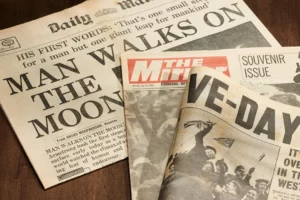
Newspapers in 1963 were dominated by civil rights coverage, Cold War tensions, and the space race. The New York Times, the Washington Post, and local papers across the country reported extensively on the Birmingham campaign, where police dogs and fire hoses were turned on peaceful protesters, and on the March on Washington, which was covered as a historic gathering. The Mona Lisa‘s American debut was a cultural highlight covered by papers nationwide. In November, the assassination of President Kennedy dominated headlines for weeks, with every detail of the tragedy and its aftermath reported in exhaustive detail.
What People Were Talking About
Americans in 1963 were talking about the Cold War, civil rights, the space race, and the growing conflict in Vietnam. The Cuban Missile Crisis of October 1962 was still fresh in people’s minds, and the threat of nuclear war was a constant undercurrent of daily life. The crash of the U-2 spy plane on November 20, just two days before Kennedy’s assassination, was a reminder of the ongoing dangers of the Cold War. The assassination itself was a shock that dominated conversations for the rest of the year, as Americans struggled to make sense of the tragedy.
Historical Photographs
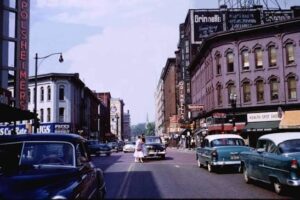
Photographs from 1963 capture a nation in transition. Images of the March on Washington show a massive, peaceful gathering on the National Mall, with crowds stretching from the Lincoln Memorial to the Washington Monument. Photographs of Birmingham, Alabama, show police dogs and fire hoses turned on civil rights protesters—images that shocked the nation and galvanized support for the movement. The iconic photographs of the Kennedy assassination—the motorcade in Dallas, the swearing-in of Lyndon Johnson aboard Air Force One with Jacqueline Kennedy at his side—are seared into the national memory. The Mona Lisa‘s American debut was also well documented, with photographs showing crowds queuing to see the famous painting.
Documents & Primary Sources
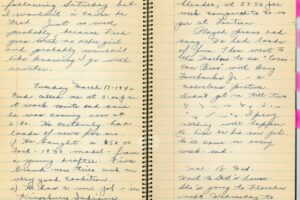
Historians studying the United States in 1963 have a rich array of primary sources at their disposal. The Statistical Abstract of the United States: 1963 (Eighty-fourth Edition), published by the U.S. Census Bureau in July 1963, provides comprehensive demographic, economic, and social data. The Congressional Record documents legislative debates. The Kennedy White House tapes capture presidential decision-making during the year. Civil rights organizations’ records, including those of the Southern Christian Leadership Conference and the NAACP, document the movement’s strategies and activities. Local newspapers, personal letters, diaries, and photographs all provide windows into the era.
1963 Timeline
| Date | Event |
|---|---|
| January 6–14 | Oklahoma governorship changes hands three times |
| January 8 | Mona Lisa exhibited at National Gallery of Art, Washington, D.C. |
| January 14 | George Wallace inaugurated as Alabama governor |
| August 28 | March on Washington for Jobs and Freedom |
| November 20 | U-2 spy plane crashes in Gulf of Mexico; pilot Capt. Joe Hyde Jr. killed |
| November 22 | President Kennedy assassinated in Dallas; Lyndon B. Johnson sworn in |
What Changed Next
The assassination of President Kennedy marked a profound turning point in American history. Lyndon B. Johnson, who assumed the presidency in the wake of the tragedy, used the national grief to push through landmark legislation, including the Civil Rights Act of 1964 and the Voting Rights Act of 1965. The Vietnam War escalated dramatically under Johnson’s administration, drawing the United States into a costly and divisive conflict. The space race continued, with the United States achieving the ultimate victory in 1969 when Apollo 11 landed on the Moon. The cultural and political upheavals of the late 1960s—the counterculture, anti-war protests, and urban unrest—were set in motion by the events of 1963.
FAQ
What was the population of the United States in 1963?
The population was approximately 189 million, according to the Statistical Abstract of the United States: 1963, published by the U.S. Census Bureau.
What major events happened in the United States in 1963?
Key events included the Mona Lisa's American debut at the National Gallery of Art (January 8), George Wallace's segregationist inauguration as Alabama governor (January 14), the March on Washington (August 28), the U-2 spy plane crash in the Gulf of Mexico (November 20), and the assassination of President Kennedy (November 22).
What primary sources are available for studying the United States in 1963?
Primary sources include the Statistical Abstract of the United States: 1963, the Congressional Record, Kennedy White House tapes, civil rights organization records, local newspapers, personal letters, diaries, and photographs.
How did daily life in the United States in 1963 differ from today?
Daily life in 1963 was shaped by the Cold War, suburbanization, and the civil rights movement. Television was the dominant entertainment medium, clothing was more formal, processed foods were increasingly popular, and the interstate highway system was transforming travel. The cost of living was dramatically lower, with bread at about 20 cents and gasoline at about 29 cents per gallon.









Leave a Reply