
Short Answer
On the afternoon of February 5, 1967, a crowd estimated at more than 100,000 people gathered at the Mnazi Mmoja grounds in Dar es Salaam, Tanzania. For two and a half hours, President Julius Nyerere stood before them, explaining a new landmark party document that would soon be known as the Arusha Declaration. “Ndiyo! Ndiyo!” the crowd shouted—“yes! yes!”—as Nyerere extolled the virtues of TANU’s policies of socialism and self-reliance. The full text of the Declaration was carried by the following day’s press. It began with a resolute statement: “The policy of TANU is to build a socialist state.” The tone was polemical, and the moment was electric. Tanzania was committing to a radical path of African socialism, breaking from the economic orthodoxies of both the capitalist West and the Soviet bloc. This was the birth of a distinctive vision for the continent.
What Happened?
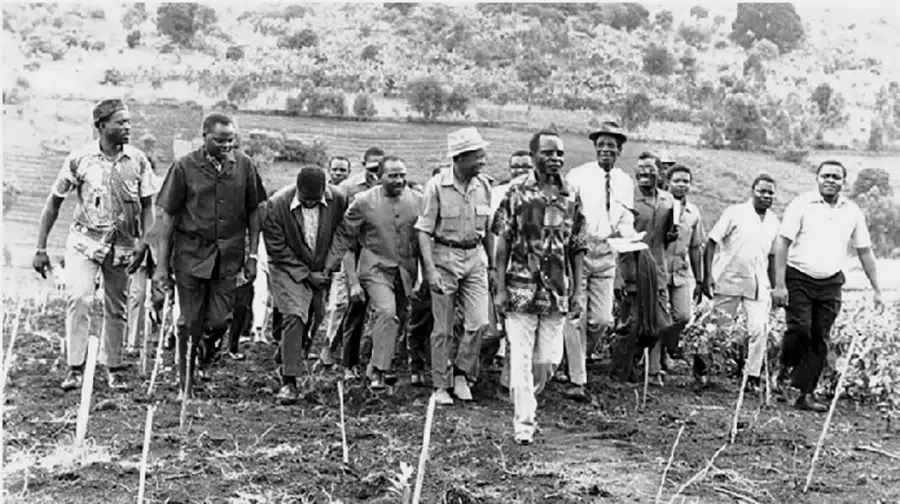
The Arusha Declaration—formally known as TANU’s Policy on Socialism and Self-Reliance—was issued on February 5, 1967, after months of preparation. In December 1966, President Nyerere had toured half of the country, urging unity to pursue national goals of self-reliance and socialism. The declaration itself was divided into five parts: the TANU Creed; the Policy of Socialism; the Policy of Self-Reliance; the TANU Membership; and the Arusha Resolution.
The TANU Creed outlined the principles of socialism: all human beings are equal; every individual has a right to dignity and respect; every citizen is an integral part of the nation and has the right to take an equal part in Government at local, regional, and national level; every citizen has the right to freedom of expression, movement, religious belief, and association within the context of the law; every individual has the right to receive a just return for his labour; and all citizens together possess all the natural resources of the country in trust for their descendants. It also declared that “in order to ensure economic justice the state must have effective control over the principal means of production.”
The Policy of Self-Reliance was a direct rejection of the prevailing development orthodoxy. Nyerere argued that relying on money—which Tanzania did not have—was a mistake. As he later wrote in the declaration: “It is stupid to rely on money as the major instrument of development when we know only too well that our country is poor. It is equally stupid, indeed it is even more stupid, for us to imagine that we shall rid ourselves of our poverty through foreign financial assistance rather than our own financial resources.”
How It Was Seen at the Time
Contemporaries saw the Arusha Declaration as a radical break from the politics of dependency. The crowd’s enthusiastic “Ndiyo! Ndiyo!” response was echoed in the press, which carried the full text the next day. The declaration was quickly dubbed “African Socialism” and was seen as a bold attempt to chart a third path in the Cold War. The tone was deliberately polemical, and the document itself was a manifesto against the “weapon of money.”
“By our thoughts, words, and actions it appears as if we have come to the conclusion that without money we cannot bring about the revolution we are aiming at. It is as if we have said, ‘Money is the basis of development. Without money there can be no development.’”
Many Tanzanians saw it as a call to self-determination and dignity, while some foreign observers expressed skepticism about the economic viability of self-reliance. The declaration was not merely a political statement; it was a cultural and psychological declaration of independence.
Historical Snapshot
| Aspect | Detail |
|---|---|
| Date | February 5, 1967 |
| Place | Dar es Salaam, Tanzania (declaration issued; Nyerere spoke at Mnazi Mmoja grounds) |
| People | Julius Nyerere, President of Tanzania; the Tanganyika African National Union (TANU) |
| What Happened | Nyerere issued the Arusha Declaration, outlining TANU’s policy for socialism and self-reliance. |
| Why It Mattered | It became Tanzania’s most prominent political statement of African Socialism and shaped the nation’s development for decades. |
Eyewitness Accounts
Eyewitness accounts from the Mnazi Mmoja grounds describe a scene of intense enthusiasm. The crowd of more than 100,000 people listened for two and a half hours as Nyerere explained the new party document. According to a later historical account, “The full text of the Declaration was carried by the following day’s press.” The reaction was immediate and vocal:
“For two-and-a-half hours, they listened to President Nyerere explain a new landmark party document, quickly dubbed the Arusha Declaration. ‘Ndiyo! Ndiyo!’ shouted the crowd—‘yes! yes!’”
These descriptions, while based on contemporary reports, capture the energy of the moment. The declaration was not just a political document; it was a public event that united the nation around a new vision.
Official Reports
The Arusha Declaration itself is an official political document issued by TANU. It begins with the TANU Creed, which states the principles of socialism. The document is divided into five parts and includes the following principles:
- All human beings are equal;
- Every individual has a right to dignity and respect;
- Every citizen is an integral part of the nation and has the right to take an equal part in Government at local, regional, and national level;
- Every citizen has the right to freedom of expression, of movement, of religious belief, and of association within the context of the law;
- Every individual has the right to receive from society protection of his life and of property held according to law;
- Every individual has the right to receive a just return for his labour;
- All citizens together possess all the natural resources of the country in trust for their descendants;
- In order to ensure economic justice the state must have effective control over the principal means of production;
- It is the responsibility of the state to intervene in the economy.
This declaration was not a law, but a political statement that guided future policy. It was a direct response to the economic challenges Tanzania faced in the 1960s.
Contemporary Terminology
The Arusha Declaration introduced a vocabulary that would dominate Tanzanian politics for decades:
- Ujamaa – Swahili for “brotherhood” or “familyhood,” referring to African socialism.
- Self-Reliance – The policy of relying on the nation’s own resources and labor, rather than foreign aid.
- TANU – The Tanganyika African National Union, the ruling party.
- Socialism – The stated goal of the party, defined by the creed.
These terms were used to rally the nation and to distinguish Tanzania’s path from both capitalism and Soviet communism.
Aftermath
The immediate aftermath of the Arusha Declaration was a shift in Tanzanian policy. The declaration provided the overall ideological framing for Ujamaa, focusing on collective hard work, agrarian transformation, and anti-colonialism. In the following years, the government nationalized major industries and established communal villages (ujamaa villages). The declaration also sparked international debate about the viability of self-reliance. Domestically, it became a rallying cry for African independence and self-respect.
How Historians See It Today
Modern historians have revisited the politics of the Arusha Declaration. According to a 2022 study by George W. Roberts of King’s College London, the declaration’s significance is now understood in more complex ways. The crowd reaction was genuine, but the actual implementation was fraught with challenges. The declaration was not simply a socialist manifesto; it was a response to specific economic and political tensions in Tanzania. Historians note that the views of contemporaries were influenced by their own backgrounds and did not map neatly onto the Cold War spectrum. Today, the Arusha Declaration is seen as a landmark in African history, but its legacy is debated—some emphasize its successes, while others point to its economic failures.
In the years since 1967, the Arusha Declaration has come to symbolize the hopes and challenges of African independence. The primary sources—the declaration itself, the speeches, and the contemporary press—show us a moment when a nation chose to chart its own course. The shouts of “Ndiyo!” that echoed across the Mnazi Mmoja grounds were a moment of collective optimism, a belief that a poor nation could build its own future. That belief, and its subsequent trials, remains a central chapter in the history of African socialism.
FAQ
What was the Arusha Declaration?
The Arusha Declaration was a political statement issued by TANU on February 5, 1967, outlining Tanzania's policy of socialism and self-reliance. It was divided into five parts, including the TANU Creed, the Policy of Socialism, and the Policy of Self-Reliance.
Why was it called the Arusha Declaration?
It was named after the town of Arusha, where the document was drafted and initially presented. However, Nyerere publicly explained it to a crowd in Dar es Salaam on the same day, February 5, 1967.














Leave a Reply