
Short Answer
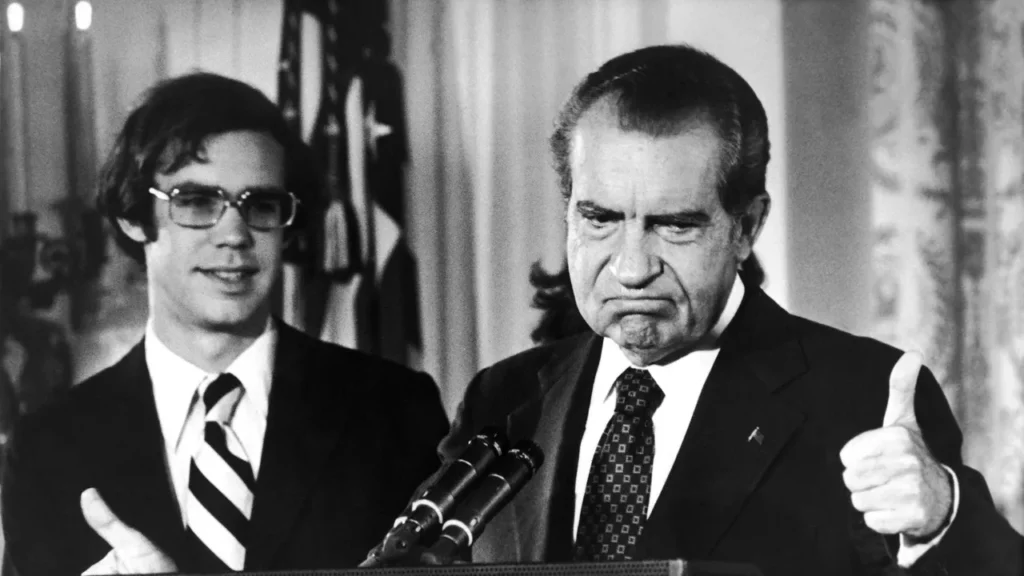
On the evening of August 8, 1974, Richard Milhous Nixon sat before a television camera in the Oval Office and told the American people that he would resign the presidency at noon the next day. Schoolchildren would later learn a single fact about him: he was the first and so far the only president to resign the office (Miller Center). The nation had spent two years gripped by the Watergate scandal, and the man who had once been celebrated for opening ties with China and ending the Vietnam War now faced certain impeachment. In his address, Nixon declared, “In any organization, the man at the top must bear the responsibility. That responsibility, therefore, belongs here, in this office. I accept it.” The words were meant to sound noble, but millions of Americans heard them as a final admission of guilt. The rise had been spectacular—from a California farm boy to a heartbeat from the presidency—and the fall was no less dramatic.
What Happened?
Richard Milhous Nixon was born on January 9, 1913, on his parents’ citrus farm in Yorba Linda, California. His father, Francis Anthony Nixon, and mother, Hannah Milhous Nixon, raised him amid financial hardship and the deaths of two of his brothers. He attended Whittier College (1934) and Duke University Law School (1937), then served in the Navy during World War II. After the war, he won a congressional race in 1946, gained national prominence in the Alger Hiss spy case in 1948, and took a Senate seat in 1950 (Miller Center).
Nixon served two terms as vice president under Dwight Eisenhower in the 1950s. In 1960, he narrowly lost the presidential election to John F. Kennedy—the closest margin of the twentieth century. After a failed run for California governor in 1962, Nixon returned to politics and won the presidency in 1968, defeating Hubert Humphrey. His achievements included forging diplomatic ties with China and the Soviet Union and withdrawing U.S. troops from an unpopular war in Vietnam (History.com).
The Watergate scandal began on June 17, 1972, when five men were arrested for breaking into the Democratic National Committee headquarters at the Watergate complex in Washington, D.C. Nixon and his aides attempted to cover up the administration’s involvement. As evidence mounted, the House Judiciary Committee approved articles of impeachment in July 1974. Facing certain removal from office, Nixon resigned on August 9, 1974, the first and only president to do so.
How It Was Seen at the Time
Contemporaries viewed the Watergate crisis with a mixture of disbelief, anger, and exhaustion. In his address to the nation about the Watergate investigations, Nixon accepted responsibility but insisted he had not known of the cover-up until later. The quote “In any organization, the man at the top must bear the responsibility” became a defining moment, but many saw it as a calculated attempt to avoid legal consequences. Newspaper editorials and public opinion polls showed a sharp decline in trust in government. The mood in Washington was tense; the political drama played out on live television, and Americans watched the Senate Watergate Committee hearings with a sense of civic duty and morbid fascination.
Historical Snapshot
| Aspect | Detail |
|---|---|
| Date | January 9, 1913 – April 22, 1994; presidency 1969–1974 |
| Place | Yorba Linda, California; Washington, D.C. |
| People | Richard Nixon, John F. Kennedy, Dwight D. Eisenhower, Washington Post reporters, Senate Watergate Committee |
| What Happened | Nixon rose from obscurity to the presidency, achieved détente with China and the Soviet Union, and then resigned amid the Watergate scandal. |
| Why It Mattered | It marked the first presidential resignation in U.S. history and profoundly altered public trust in the executive branch. |
What People Knew at the Time
| What People Knew Then | What We Know Now |
|---|---|
| Nixon was the 37th president, elected in 1968 and re-elected in 1972 by a landslide. | His re-election was later shown to have been tainted by the Watergate scandal. |
| The Watergate break-in was a “third-rate burglary” that Nixon initially dismissed. | We know that Nixon was directly involved in the cover-up, as revealed by the White House tapes. |
| Nixon claimed he had no prior knowledge of the break-in. | Later evidence proved he knew and participated in the cover-up. |
| His resignation was seen as a final admission of wrongdoing. | Historians now view it as a calculated attempt to avoid impeachment and preserve his pension and staff. |
Eyewitness Accounts
Nixon’s own address to the nation on August 8, 1974, is a primary source that captures his self-presentation. In it, he said: “In any organization, the man at the top must bear the responsibility. That responsibility, therefore, belongs here, in this office. I accept it.” (Miller Center). This was a carefully crafted statement, but it did not satisfy many Americans. The Washington Post and other newspapers had reported on the Watergate cover-up for months, and the public had already made its judgment. The speech was the last time Nixon would speak to the American people as president.
Timeline
- January 9, 1913 – Richard Nixon born in Yorba Linda, California.
- 1946 – Elected to the U.S. House of Representatives.
- 1948 – Gains national prominence in the Alger Hiss case.
- 1950 – Elected to the U.S. Senate.
- 1952–1960 – Serves two terms as Vice President under Dwight Eisenhower.
- 1960 – Loses presidential election to John F. Kennedy.
- 1968 – Elected President, defeating Hubert Humphrey.
- 1972 – Re-elected in a landslide; Watergate break-in occurs in June.
- 1973 – Watergate hearings; Vice President Spiro Agnew resigns; Gerald Ford appointed Vice President.
- 1974 – Supreme Court orders release of tapes; House Judiciary Committee approves articles of impeachment; Nixon resigns on August 9.
- September 8, 1974 – President Ford pardons Nixon.
How Historians See It Today
Modern historians recognize Nixon’s presidency for both its achievements and its profound failures. His foreign policy breakthroughs with China and the Soviet Union are widely praised, and his domestic policies included the establishment of the Environmental Protection Agency and the Occupational Safety and Health Administration. However, the Watergate scandal remains the defining legacy, and historians agree that Nixon’s attempts to obstruct justice were a serious abuse of presidential power. The Miller Center notes that “the spectacular fall” followed an “equally spectacular rise.” Historians today see the resignation as a necessary check on executive overreach, and they use the Watergate as a cautionary tale about the dangers of a president who places his own survival above the law.
Common Misconceptions
In the end, the primary sources—Nixon’s own speeches, the congressional records, and the news reports—show a president who rose to the highest office and then fell from it. The Watergate scandal changed the way Americans view their leaders, and the lessons of Nixon’s resignation continue to resonate. The photographs of him waving from the helicopter on August 9, 1974, remain a haunting image of a man who once held the world’s most powerful office, now leaving it in disgrace.
FAQ
Why did Richard Nixon resign?
Nixon resigned on August 9, 1974, to avoid almost certain impeachment and removal from office over his role in the Watergate scandal, specifically his efforts to cover up the break-in and other illegal activities by his administration.
What were Nixon's major accomplishments as president?
Nixon established diplomatic relations with China, pursued détente with the Soviet Union, and withdrew U.S. troops from Vietnam. He also created the Environmental Protection Agency and other domestic programs.










Leave a Reply