
Short Answer
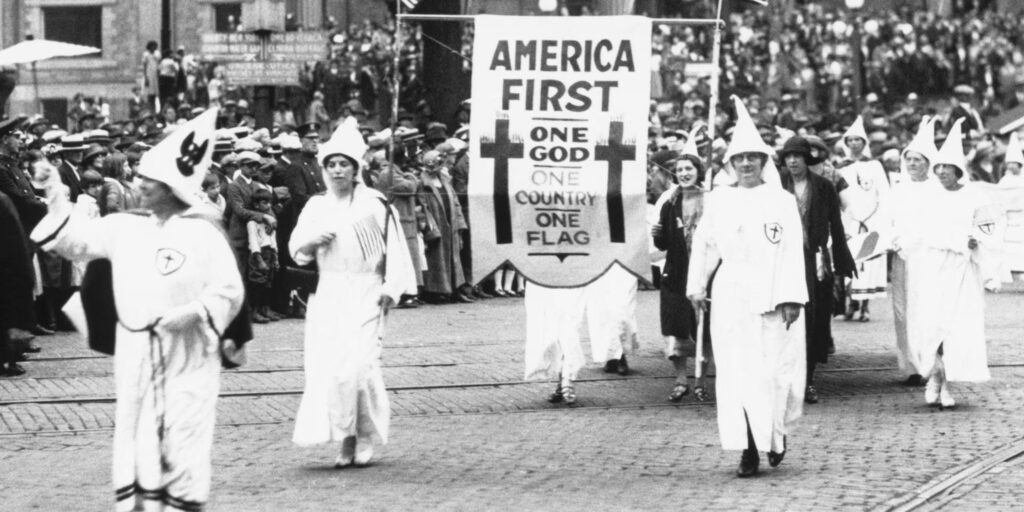
In the summer of 1925, tens of thousands of robed men marched down Pennsylvania Avenue in Washington, D.C., in what many newspapers described as the largest gathering of the Ku Klux Klan in history. They came from every state, wearing the white hoods and robes that had become the uniform of the “Invisible Empire.” Across the nation, the Klan was holding parades, rallies, and cross burnings, proclaiming a gospel of “One Hundred Percent Americanism.” To many Americans, this was a reassuring display of patriotic resolve; to others, it was a terrifying demonstration of organized bigotry. The Klan of the 1920s was not a fringe group but a mass movement with millions of dues-paying members, chapters in all forty-eight states, and political influence that reached from small towns to the halls of Congress. For a brief, intense period, it was one of the most powerful social and political organizations in the United States.
What Happened?
In 1915, forty years after the original Ku Klux Klan disbanded, a former farmer, circuit preacher, and university lecturer named William Joseph Simmons revived the secret society. Simmons, a failed Methodist minister, organized what he called “The Knights of the Ku Klux Klan” primarily as a money-making scheme. The new order shared little but its name with the Reconstruction-era Klan. It shamelessly adopted the hooded robe and burning cross from the film The Birth of a Nation, and it exploited a widespread sense that America was headed in the wrong direction.
By the early 1920s, the Klan had been transformed into a national movement with millions of dues-paying members and chapters in all of the nation’s forty-eight states. Its avowed creed was “One Hundred Percent Americanism”—support of Protestant Christian values, white supremacy, and the rejection of all things foreign. The order spread rapidly, with its most dramatic growth in states above the Mason-Dixon line, where it courted xenophobic fears about the flood of immigrants from southern and eastern Europe.
The Klan’s political influence peaked in the mid-1920s. It became one of America’s most powerful social and political organizations, electing members to legislatures, city councils, and even the U.S. Senate. While it often used intimidation and violence against its foes, the Klan also exercised power through the ballot box, public demonstrations, and an extensive network of newspapers and pamphlets. Its decline was as dramatic as its rise: by the late 1920s, internal scandals, corruption, and public backlash had collapsed its membership and influence.
How It Was Seen at the Time
Contemporaries were sharply divided. To its members, the Klan was a fraternal order and a patriotic defense of American values. To its critics, it was a violent and intolerant mob. The Klan presented itself as a defender of “One Hundred Percent Americanism,” a guardian of Protestant morals, and a bulwark against the foreign and the unknown. Many middle-class Americans—merchants, clerks, ministers, and farmers—joined the order, attending its rallies and parades with genuine enthusiasm.
“We are not a lawless mob. We are a movement for the protection of American ideals and the preservation of our Protestant heritage.” — A Klan spokesperson at a 1924 rally
The prevailing mood of the era was one of anxiety about change. The Klan’s message resonated with those who feared immigration, the growing influence of the Catholic Church, and the breakdown of traditional moral values. The Klan offered simple, clear answers to a complex and uncertain world, and millions of Americans found that message persuasive.
Historical Snapshot
| Aspect | Detail |
|---|---|
| Date | 1915–1929 (peak activity 1921–1926) |
| Place | Nationwide; strongest in the Midwest and South |
| People | William Joseph Simmons (founder); millions of dues-paying members |
| What Happened | Revival of the Ku Klux Klan as a national fraternal and political movement |
| Why It Mattered | It became one of America’s most powerful social and political organizations in the 1920s |
Contemporary Newspaper Coverage
Newspapers across the country covered the Klan extensively. The 1925 Washington, D.C., march was reported by national dailies, which described the columns of robed figures and the crowds that lined the streets. Coverage varied widely in tone: some papers treated the Klan as a legitimate civic organization, others condemned it as a threat to democracy.
The Klan also produced its own publications, including newspapers and pamphlets that were widely distributed. These materials helped build the organization and spread its message of nativism and white supremacy. The press coverage—both favorable and critical—fueled the Klan’s growth, as the spectacle of its rallies attracted national attention.
Eyewitness Accounts
Eyewitnesses described the Klan’s public events with vivid detail. The Washington, D.C., march of 1925 was described as a “sea of white” stretching for blocks, with robed men marching in disciplined formation. Cross burnings were described as eerie and dramatic: a burning cross on a hillside, visible for miles, surrounded by hooded figures standing in silence.
One observer at a 1924 rally in Indiana recalled the “strange silence” of the crowd, broken only by the crackle of the flames and the occasional chant of the leaders. The visual spectacle—the white robes, the burning crosses, the massive crowds—was designed to inspire awe and fear, and it did both.
What People Feared
The Klan’s appeal was built on fear. Its members feared the flood of immigrants who, they believed, were diluting American culture and taking jobs from native-born citizens. They feared the influence of the Catholic Church, which they saw as a foreign power seeking to control American institutions. They feared the breakdown of traditional moral values, the changing roles of the women, and the rise of a modern, urban society. The Klan exploited these fears, presenting itself as the defender of the “One Hundred Percent American” way of life.
Numbers at the Time
| Statistic | Figure | Source/Year |
|---|---|---|
| States with Klan chapters | 48 | Early 1920s |
| Dues-paying members | Millions | Early 1920s |
| Washington, D.C., march | Tens of thousands | 1925 |
How Historians See It Today
Modern historians have reshaped the understanding of the 1920s Klan. Scholars such as Linda Gordon and Rory McVeigh have shown that the Klan was not a fringe southern movement but a national organization with its greatest strength in the North and Midwest. It was a broad social and political movement that drew millions of members from the middle class and exercised real political power. The Klan is now understood as a response to the rapid social changes of the early twentieth century—immigration, urbanization, and the shifting moral order. Its decline is attributed to internal corruption and public backlash rather than to a triumph of progressive reform.
The Klan’s rise and fall offers a cautionary tale about the power of nativism and the fragility of democratic institutions when fear overtakes reason. The primary sources—newspapers, eyewitness accounts, and the Klan’s own publications—reveal a movement that was both a product of its time and a warning for the future.
FAQ
Was the 1920s Klan the same as the Reconstruction-era Klan?
No. The 1920s Klan was a new organization, revived by William Joseph Simmons in 1915. It shared little with the original Klan except its name and symbols, and it was organized primarily as a money-making scheme.
Why did the 1920s Klan decline?
The Klan's decline in the late 1920s was driven by internal scandals, corruption among leaders (notably in Indiana), public backlash, and a loss of political influence. By 1929, membership had plummeted.




Leave a Reply