
Short Answer
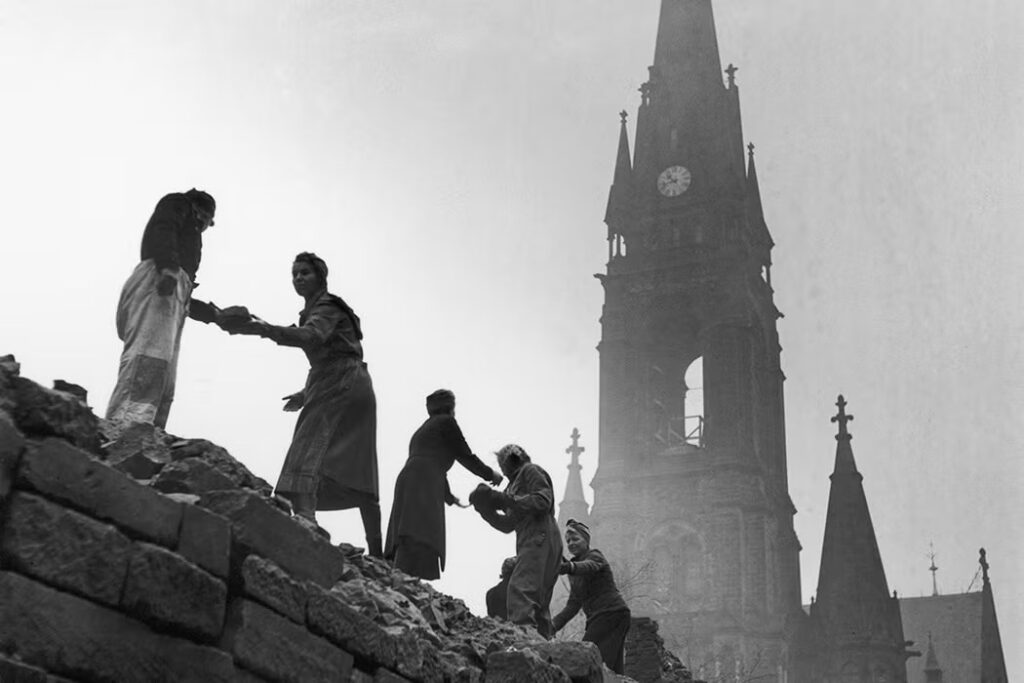
In the winter of 1942, as the first heavy British raids began to fall on German cities, ordinary citizens huddled in damp cellars and concrete bunkers, listening to the drone of bombers and the thunder of explosions. The air raid siren had become the heartbeat of the German home front. In Hamburg, Cologne, and Berlin, families carried their most precious belongings—ration books, documents, a few photographs—into shelters each night. They emerged at dawn to find streets turned into canyons of rubble, gas mains burning, and the smell of dust and cordite hanging over everything. The Nazi regime had promised total victory; what it delivered was total war, and civilians were now on the front line. This is the story of those civilians, as told through the reports, diaries, and letters they left behind.
What Happened?
The Allied strategic bombing offensive against Germany escalated dramatically from 1942 onward. The British, under Bomber Command, pursued area bombing of cities to destroy German industrial capacity and civilian morale. The Americans joined with daylight precision raids. From 1942 to 1945, the air war touched nearly every major German city. Key events included:
- March–June 1942: The first thousand-bomber raids on Cologne and Rostock demonstrated the new scale of attack.
- July–August 1943: Operation Gomorrah against Hamburg, where firestorms killed at least 30,000 people and left over a million homeless.
- 1943–1944: Sustained raids on the Ruhr industrial region and Berlin, with the ‘Battle of Berlin’ continuing into early 1944.
- February 1945: The firebombing of Dresden, which killed tens of thousands of civilians and became a symbol of the war’s destructiveness.
- April 1945: The final raids as Allied armies approached, leaving many cities in ruins.
As the Southampton University article notes, the bombing brought to the surface many social and cultural tensions within German society and led to a widespread process of atomization and dissolution of community ties. The local authorities were quickly overwhelmed by the scale of the bombing, and Nazi party propaganda singularly failed to have any impact on the population (source: Southampton ePrints).
How It Was Seen at the Time
The Nazi regime propagated the term Schicksalsgemeinschaft—a ‘community of fate’—to portray the bombing as a unifying experience that welded the German people together. Propaganda posters and radio broadcasts spoke of a nation united in suffering and determination. However, contemporary diaries and internal reports tell a different story. The regime’s own secret SD reports (Sicherheitsdienst) from 1943–44 noted rising despair, cynicism, and even open criticism. One report from a regional official, quoted in the book Under the Bombs by Earl Ray Beck, described the mood: ‘The people are no longer able to think about anything else except the terrible raids. They are tired of the war, tired of the bombing, and they want an end.’
“The bombing brought to the surface many social and cultural tensions within German society and led to a widespread process of atomization and dissolution of community ties.” — from A Schicksalsgemeinschaft?, University of Southampton
Historical Snapshot
| Aspect | Detail |
|---|---|
| Date | 1942–1945 |
| Place | Major German cities: Hamburg, Berlin, Cologne, Dresden, Darmstadt, Nuremberg |
| People | German civilians, particularly women, children, and the elderly; local officials; Nazi party functionaries |
| What Happened | Allied strategic bombing destroyed urban centers, causing massive casualties and homelessness |
| Why It Mattered | It eroded civilian morale, exposed the limits of Nazi control, and reshaped everyday life and social relations |
Daily Life
Daily life under the bombs was a constant negotiation with destruction. Air raids often came at night, forcing families to spend hours in damp, overcrowded shelters. The daytime was filled with queues for rationed food, which grew scarce as the war progressed. Women, who had taken over many jobs in factories and transport, also managed the household and the children. The material conditions worsened with each year. By 1944, a typical urban family subsisted on potatoes, turnips, and occasional bread. Clothing was rationed, and many wore old military uniforms. The destruction of housing meant that millions were forced into makeshift quarters, often with relatives or in overcrowded camps. The Darmstadt study highlights how the gender of affect—the emotional labor of maintaining morale—fell disproportionately on women, who were expected to keep the household running and to comfort their children, even as the city around them crumbled. (Schreiter, 2017).
Eyewitness Accounts
One of the most striking eyewitness accounts comes from the diary of a Berlin housewife, who wrote in 1943 after a raid:
“The whole street is burning. The fire is so bright that you can see the letters on the posters across the street. We are alive, but we have lost everything. I don’t know how we will go on.”
Another account, from a Hamburg resident after the July 1943 firestorm, described the horror:
“We saw a huge fire storm that swept through the streets like a hurricane. People were caught in the flames and burned to death in the open. The city was a furnace.”
These personal testimonies, preserved in the archives used by Earl Ray Beck in Under the Bombs, reveal a people who were not simply loyal Nazis but were exhausted and terrified.
Letters & Diaries
Letters and diaries are among the richest sources for understanding the home front. The diary of a teenage girl in Berlin, for instance, records the constant fear: “We don’t talk about the future anymore. We only talk about the next raid.” A letter from a mother in Dresden to her son on the front, written in February 1945, said: “The city is gone. I don’t know if your father is alive. I am staying with the Schmidt’s. We have nothing left.” These personal documents, many collected in archives and quoted in the scholarship, show the disintegration of trust and the growing distrust of Nazi promises. The Southampton article emphasizes that the official propaganda of ‘community of fate’ was not reflected in these private writings, which instead show a sense of isolation and betrayal.
What People Feared
Beyond the immediate terror of the raids, Germans feared several specific outcomes. They feared the collapse of public order—looting, black market, and the breakdown of social norms. They also feared the arrival of the Soviet army, which many had heard rumors of atrocities. As the war turned against Germany, there was also a growing fear of retaliation for the war crimes committed by the Nazi regime. The regime itself used these fears to tighten control, warning of ‘Bolshevik hordes’ and the ‘Jews’ behind the bombing. Yet, many ordinary citizens also feared the end of the war itself, because they knew defeat would bring occupation and retribution. These fears were not unfounded; they were based on the regime’s own propaganda and the realities of the war.
How Historians See It Today
Modern historians have moved away from the Nazi-era interpretation of the bombing as a unifying force. The scholarly work of the Southampton article and the Darmstadt study demonstrates that the bombing actually fractured German society. Instead of strengthening the ‘community of fate,’ the bombing revealed class tensions (the wealthy often had better shelters), gender inequalities, and the limits of Nazi authority. Historians now emphasize that the German home front was not a monolith but a collection of individual experiences shaped by local conditions, social status, and gender. The primary sources—diaries, letters, and official reports—show that the bombing did not create a ‘community’ but rather a society in which people increasingly looked after themselves. This shift in interpretation, from seeing the bombing as a morale booster to seeing it as a catalyst for social disintegration, is one of the major historiographical changes in the study of the German home front.
The bombing of Germany’s cities was one of the most destructive and terrifying experiences of the twentieth century. The primary sources left behind by German civilians reveal a world of fear, exhaustion, and the slow crumbling of trust in the Nazi state. They show that the official propaganda of ‘community of fate’ was a hollow phrase, contradicted by the daily struggle to survive. These sources remind us that war is not only fought on the front lines but also in the basements, the queues, and the hearts of ordinary people. Their words, preserved in archives and diaries, are a testament to the human cost of war and the resilience—and fragility—of everyday life.
FAQ
Did the bombing break German civilian morale?
According to primary sources and modern scholarship, the bombing did not break morale in a decisive way, but it did cause widespread exhaustion, cynicism, and social atomization. The Nazi regime's propaganda of 'community of fate' was contradicted by the reality of individuals and families focused on survival.
How did German civilians respond to the bombing?
Civilians responded with a mix of fear, despair, and sometimes anger at the Nazi regime. Many sought shelter in cellars and bunkers, but the destruction of homes and infrastructure led to homelessness and hardship. Diaries and letters show a growing desire for the war to end.














Leave a Reply