
Short Answer
On the morning of November 18, 1883, a traveler in Buffalo, New York, would have found a bewildering array of clocks. The station clock did not match the jeweler’s window, which did not match the town hall tower, which disagreed with the pocket watch of every passenger. For centuries, time had been a local affair, set by the sun’s position at high noon over each particular village or city. But on this day, at exactly noon, the railroad companies of the United States and Canada did something unprecedented: they reset their station clocks to four continental time zones, effectively creating the system we use today. The move was bold, controversial, and transformative. It was a day when the sun—the age-old master of time—was dethroned by the locomotive and the telegraph. The ‘Day of Two Noons’ would forever change how humanity measured the passing of the day.
What Happened?
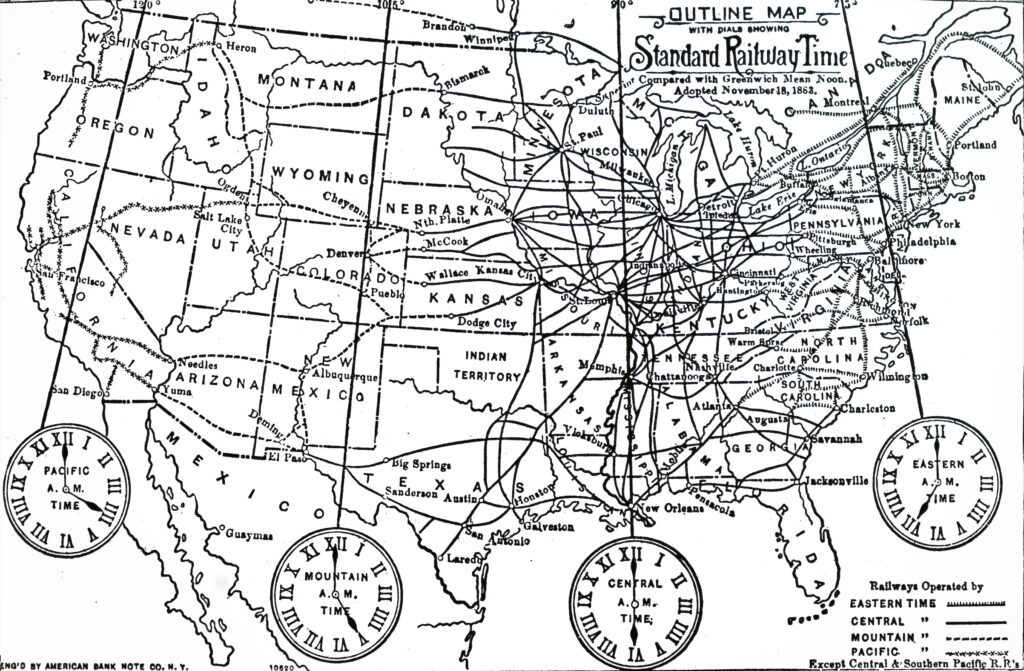
On November 18, 1883, at exactly noon, American and Canadian railroads began using four continental time zones to end the confusion of dealing with thousands of local times. The bold move was emblematic of the power shared by the railroad companies. The need for continental time zones stemmed directly from the problems of moving passengers and freight over the thousands of miles of rail line that covered North America by the 1880s.
Since human beings had first begun keeping track of time, they set their clocks to the local movement of the sun. Even as late as the 1880s, most towns in the U.S. had their own local time, generally based on ‘high noon,’ or the time when the sun was at its highest point in the sky. As railroads began to shrink the travel time between cities from days or months to mere hours, however, these local times became a scheduling nightmare. Railroad timetables in major cities listed dozens of different arrival and departure times for the same train, each linked to a different local time.
The solution was a coordinated effort by the major railroad companies. At exactly noon on November 18, 1883, individual railroad station clocks were reset as standard-time noon was reached within each time zone—hence the ‘Day of Two Noons.’ The four zones were named Eastern, Central, Mountain, and Pacific, each one hour apart. The change was not a government decree but a private initiative by the railroads, which had the power to impose order on a chaotic system.
How It Was Seen at the Time
Contemporaries understood the change as a practical necessity, but also as a radical break with the past. Many people were uncomfortable with abandoning the sun as the arbiter of time. Local communities, especially in rural areas, resented the imposition of a time that did not match their own solar observations. The phrase ‘railroad time’ became a term of both admiration and suspicion.
“The sun is no longer the master of time; the railroad is.”
This sentiment, echoed in editorials and letters to newspapers, captured the mood. Yet the majority of the traveling public recognized the benefits. The new system made schedules predictable and safe. As one railroad official explained, the change was “a necessity of the age, and it is a matter of congratulation that it has been accomplished.” The prevailing mood was one of relief mixed with a sense of awe at the power of the corporations that had made it happen.
Historical Snapshot
| Aspect | Detail |
|---|---|
| Date | November 18, 1883 |
| Place | United States and Canada |
| People | Railroad companies, station agents, travelers |
| What Happened | Railroads adopted four continental time zones, resetting station clocks at noon |
| Why It Mattered | Ended the chaos of thousands of local times, made rail travel safer and more efficient |
What People Knew at the Time
| What People Knew Then | What We Know Now |
|---|---|
| Time was set by the sun’s position at each location; every town had its own noon. | Time zones are standardized globally, with legal definitions and international agreements. |
| Railroad schedules were confusing, with different times for the same train in different cities. | Standard time is enforced by law, and the railroads were the first to implement it. |
| The change was seen as a corporate power grab, not a government mandate. | Historians see it as a crucial step in the globalization of time and a triumph of industrial coordination. |
Contemporary Newspaper Coverage
Newspapers of the era covered the change with a mixture of wonder and criticism. The New York Times and other major dailies reported the event, noting that the railroads had taken a step that would affect every citizen. Many editorials praised the move as a sign of progress, while others warned of the loss of local autonomy. A typical headline read: “The Day of Two Noons—Railroads Adopt a New System of Time.”
“The change was made at the stroke of noon, and the clocks were set back or forward to the new standard, causing no little confusion among the uninitiated.”
The press also noted the practical benefits: fewer collisions, more reliable schedules, and a sense of order. Some papers, however, complained that the railroads had overstepped their authority, acting without the consent of the public.
Timeline
- Before 1883: Thousands of local time standards across North America, based on solar noon.
- 1870s: Railroads begin to experiment with single time for their own lines, but interline confusion remains.
- 1883, November 18: The railroads implement four time zones at noon.
- 1884: The International Meridian Conference in Washington, D.C., adopts the Greenwich meridian as the basis for global time zones.
- 1918: The U.S. Congress passes the Standard Time Act, making the railroad system the legal time of the country.
Aftermath
The immediate aftermath was a gradual acceptance of the new time. Many towns continued to use local time for some years, but the railroads forced the issue by using their own time for all schedules. Within a few years, most public clocks in cities and towns were set to the railroad time. The success of the system led to international adoption, culminating in the 1884 International Meridian Conference, which established the Greenwich meridian as the prime meridian and divided the world into 24 time zones. In the United States, the railroad time zones became the official legal time in 1918 with the Standard Time Act, which also introduced daylight saving time during wartime.
How Historians See It Today
Modern historians view the creation of time zones as a watershed moment in the history of technology and society. At the time, contemporaries saw it as a practical solution to a railroad problem, but historians now interpret it as a profound shift in how humans relate to time and nature. The railroad companies, not the government, forced the world to adopt a standard time, demonstrating the power of corporations in the late 19th century. The change also facilitated the growth of national economies, communications, and travel. Historians also note that the railroad time was not an inevitable result of technology but a social and political choice, made by a few powerful men. The ‘Day of Two Noons’ is now recognized as a key moment in the globalization of time.
The primary sources from the era—newspapers, railroad timetables, and personal letters—reveal the confusion and wonder of a world adjusting to a new master. The sun had kept time for millennia, but the railroad demanded a more precise and uniform clock. The Day of Two Noons marked the moment when humanity chose to follow the machine rather than the sun. It was a decision that made the modern world possible, and it happened on a quiet Sunday afternoon when the railroads stopped their trains, reset their clocks, and put the world in sync.
FAQ
What was the 'Day of Two Noons'?
On November 18, 1883, when the railroads adopted four time zones, each station clock was reset at the moment of standard-time noon. Because local time was different, the clock would be set back or forward, resulting in two noons in one day. This became known as the 'Day of Two Noons'.
Why did the railroads create time zones?
The railroads needed a uniform time to schedule trains and avoid collisions. With thousands of local times, it was impossible to maintain safe and efficient schedules. The adoption of four time zones allowed for predictable timetables and reduced the risk of accidents.
Were the time zones legally recognized in 1883?
No, the change was made by private railroad companies, not by the government. It was not until 1918 that the U.S. Congress passed the Standard Time Act, making the railroad time the official legal time.










Leave a Reply