
Short Answer
In the summer of 1939, before a single bomb had fallen, the British Ministry of Food had already printed 50 million ration books. The government, remembering the shortages of the First World War, expected that this conflict would become a total war, and that civilians would be as much a part of the battle as soldiers. When war was declared in September 1939, the machinery of fair shares was quietly ready. The ration book became the symbol of daily sacrifice, but behind it lay a complex political and administrative effort—one that would be recorded in the diaries of the Minister of Food, Lord Woolton, in the letters he exchanged with Churchill, and in the surveys the government conducted to gauge public opinion. This article reconstructs that experience through the primary sources of the era: the diaries, the official reports, and the propaganda that shaped how Britons understood the queue, the coupon, and the weekly allowance.
What Happened?
Rationing in Britain began in the early months of 1940. Meat, butter, and sugar were the first commodities to be rationed, followed later by tea and other foodstuffs. The system relied on a ‘points’ scheme and price controls. Ration books and clothing coupons were issued to all, with adjustments made for pregnant women, young children, and vegetarians. The Ministry of Food, led by Lord Woolton, had been planning for this since 1936. By the summer of 1939, it had already printed 50 million ration books, ready for immediate use.
When the bombing of British cities began in earnest, the Ministry of Food relocated its core operations to Colwyn Bay, a safe distance from the London Blitz. Woolton, however, remained in London to maintain the propaganda machinery that kept the public informed and supportive. The ministry’s work was not merely administrative; it was also deeply political. Woolton’s diaries reveal how rationing decisions were shaped by public opinion, press reaction, and the need to maintain morale. By June 1942, the government’s Wartime Social Survey was conducting formal inquiries into public attitudes towards rationing, interviewing over 2,000 people across the country.
How It Was Seen at the Time
For most Britons, rationing was a matter of fairness. The official narrative, repeated in government posters and newsreels, was that rationing ensured “fair shares for all.” The public largely accepted this. A survey carried out by the Wartime Social Survey between 9 and 26 June 1942 found that 53.8% of the population approved of the idea of rationing, while 26.7% made no criticism, and only 14.4% were dissatisfied. Women were more favourable than men, and the South of England showed the highest proportion of approval.
“By and large the public supported rationing as ensuring fair shares for all, and though a black market developed it never seriously threatened the system.”
This quote, from a contemporary account of rationing in London, captures the prevailing mood. The black market existed, but it was not seen as a serious threat to the system. The language of “fair shares” was everywhere—in newspapers, on posters, and in the speeches of politicians. Rationing was not just a necessity; it was presented as a patriotic duty.
Letters & Diaries
The diaries and letters of Lord Woolton, Minister of Food from 1940 to 1943, offer a unique window into the political management of rationing. Woolton was a non-party figure, and his diary entries reveal how he navigated the tensions between the Ministry, the Cabinet, and the public. He was acutely conscious of the social impact of his decisions, and he noted how the press received each new policy. The diaries also show how the Ministry of Food was able to operate undisturbed by bombing raids because of its relocation to Colwyn Bay, while Woolton stayed in London to keep the propaganda machinery alive.
In his correspondence with Churchill, Woolton often discussed the political dimensions of food policy. He understood that a failure of food supply would be a failure of the war effort. His diaries show a man who saw rationing not merely as an administrative task, but as a matter of social justice. He was aware that the decisions made at the Ministry of Food would have long-term consequences for the nation’s health and morale. These documents, now published in a scholarly edition, reveal the human side of the ration book—the calculations, the compromises, and the constant effort to balance scarcity and fairness.
Official Reports
The Wartime Social Survey, an official inquiry conducted for the Ministry of Food, provides the most systematic evidence of public opinion on rationing. In June 1942, a general sample of 2,047 persons was interviewed across the country. The purpose was to discover the extent of approval and disapproval among different groups. The summary of the report stated:
“53.8 % approved of the idea, 26.7% made no criticism, 14.4 % were dissatisfied.”
The report also noted that women were rather more favourable than men, and that the South showed the highest proportion favourable and Scotland the lowest. This official survey was a vital tool for the government, allowing it to gauge the public’s mood and adjust its propaganda and policies accordingly. It shows that the government did not take public support for granted; it actively measured and sought to understand it.
Daily Life
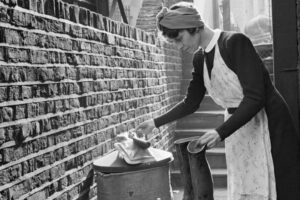
For the average citizen, rationing meant a daily engagement with the ration book. Each week, the ration book was presented to the butcher, the grocer, and other retailers. The points system allowed a limited choice within the ration. Clothing coupons were issued, and the number of coupons per year was strictly limited. Pregnant women and young children received additional allowances, and vegetarians could exchange their meat ration for other foods. The Ministry of Food also encouraged the use of “National Wheatmeal Bread” and other substitutes to stretch the supply.
The experience of rationing was not uniform. Some people had easier access to certain foods than others. The government’s propaganda emphasized the importance of planning meals and avoiding waste. The result, as noted in the historical record, was that the nation’s health actually improved during the war, because the rationing imposed a balanced diet with essential vitamins. The daily routine of shopping, queuing, and counting points became a shared experience, a constant reminder of the war effort. It was a life of scarcity, but also of a strange equality.
What People Feared
At the time, there were widespread fears that the war would bring severe shortages, as it had in the First World War. The government’s early planning was a response to this fear. People feared that food would run out, that the black market would grow, and that the fairness of the system would collapse. There was also a fear that the war would lead to inflation and price gouging. The government’s price controls and rationing were designed to prevent these outcomes.
There were also fears that the rationing would be perceived as unfair, which would damage morale. The government was acutely aware that if the public felt that some groups were getting more than others, the system would break down. The Wartime Social Survey was one tool to monitor these fears. The public feared the future, but they also feared the failure of the system itself. The fact that the black market never seriously threatened the system was a testament to the public’s commitment to the ideal of fair shares.
How Historians See It Today
Modern historians, such as the author of the 2020 edition of Woolton’s diaries, have emphasized the political and social complexity of rationing. They have shown that the Ministry of Food was not a faceless bureaucracy, but a political arena where decisions were made under pressure. The diaries reveal that Woolton was aware of the social impact of his decisions, and that he was a key figure in the development of post-war reconstruction policies, including the National Health Service. Historians now also note that rationing improved the health of the nation, and that the public’s support was crucial to its success.
The historiographical shift has been from a view of rationing as a simple administrative necessity to a recognition of its political dimensions. The diaries and official reports show that the government was constantly managing public opinion, and that the public’s support was not a given. The “fair shares” narrative was a propaganda tool, but it also reflected a genuine social contract. The historian’s view today is that rationing was a success, not just in terms of nutrition, but in terms of social cohesion.
The primary sources of the 1940s—the diaries, the letters, the official surveys, and the propaganda posters—together tell a story of a nation that accepted sacrifice in the name of fairness. They show that rationing was not merely a matter of queues and coupons; it was a political and moral project. The government managed to make the ration book a symbol of unity, and the public responded with a willingness to share. The legacy of that experience is a reminder that in the face of total war, the everyday act of eating could become a civic duty.
FAQ
What was the first item to be rationed in Britain during WWII?
Meat, butter, and sugar were rationed from early 1940. Tea was added later. The government had printed 50 million ration books by the summer of 1939 in preparation.
How did the British public view rationing?
A Wartime Social Survey in June 1942 found that 53.8% approved of the idea, 26.7% made no criticism, and 14.4% were dissatisfied. Women were more favorable than men, and the South showed the highest approval.
What role did Lord Woolton play in rationing?
Lord Woolton was the Minister of Food from 1940 to 1943. His diaries and letters, including correspondence with Churchill, reveal how he managed rationing politically, maintained propaganda in London, and was conscious of the social impact of decisions.











Leave a Reply