
Short Answer
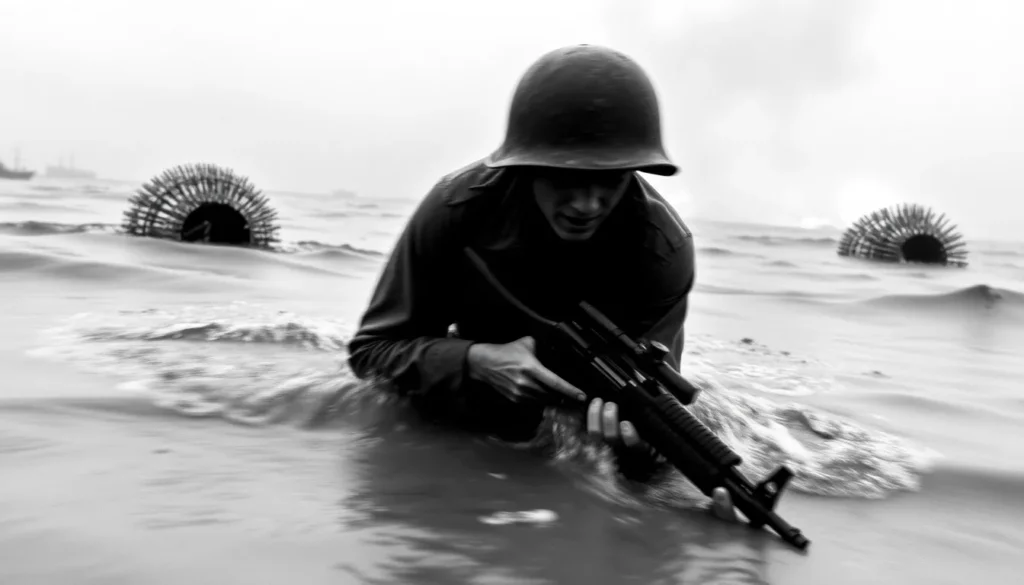
In the gray dawn of June 6, 1944, the sea off Omaha Beach churned with landing craft, vomited men into the surf, and echoed with the crack of German machine guns. Among the first wave of soldiers wading toward the shingle was a 30-year-old Hungarian photographer named Robert Capa, clutching a Contax camera and a handful of film. He was on assignment for LIFE magazine, and over the next hour he would expose himself to enemy fire to capture what became some of the most famous—and most debated—photographs of the Second World War. The images he brought back were blurry, grainy, and seemingly chaotic, yet they conveyed the terror and urgency of the assault in a way that no crisp photograph could. This article reconstructs what happened that morning, how Capa’s photographs were received at the time, and what primary sources reveal about the man behind the blurred Omaha Beach images.
What Happened?
Robert Capa (born Endre Friedmann in Budapest) was already a seasoned war photographer by 1944. He had covered the Spanish Civil War, where his partner Gerda Taro was killed in action, and had emigrated to the United States. Contracted by LIFE, he joined the Allied invasion fleet bound for Normandy. According to his memoir Slightly Out of Focus (1947), he chose to land with the first wave on Omaha Beach to be as close to the action as possible.
On the morning of June 6, Capa boarded a landing craft from the USS Samuel Chase and approached the Easy Red sector of Omaha Beach. As the ramp dropped, he jumped into waist-deep water and waded ashore under heavy fire. He later wrote: “The bullets tore holes in the water around me.” Once on the beach, he took cover behind a disabled tank and began photographing the soldiers around him—men crawling through the surf, taking shelter behind steel hedgehogs, and struggling to stay alive.
After about an hour and a half, Capa had exhausted his film and was trembling uncontrollably. He hitched a ride back to England on a landing craft. He sent his film rolls to LIFE’s London office, where picture editor John Morris awaited them. In the rush to process the negatives, a drying cabinet was allegedly overheated, melting the emulsion and destroying most of the images. Only eleven negatives survived.
LIFE published several of these photographs in its June 19, 1944 issue, under the headline “The Invasion,” with captions noting that they were taken “under fire.” The blurriness of the images—caused by Capa’s shaking hands and the motion of the scene—was accepted as a mark of authenticity. The most famous of the surviving frames shows a lone soldier crawling through the surf, his face obscured by the water and the blur, a symbol of the individual soldier’s struggle amid the massive machinery of war.
How It Was Seen at the Time
When LIFE published Capa’s photographs, American readers were hungry for any glimpse of the Normandy invasion. The images were not celebrated for their technical perfection but for their raw immediacy. The blurriness was understood as evidence of the danger under which they were taken; the magazine’s captions emphasized that Capa had been “in the water” with the troops. In an era before television brought war into living rooms, these still photographs were a primary means by which civilians grasped the reality of combat.
Capa himself was praised for his bravery, and his photographs were reprinted widely. In his memoir, he downplayed his heroism, describing his fear and the chaos of the beach. But at the time, his dispatches and images positioned him as a heroic eyewitness. The prevailing mood was one of gratitude and awe: here was visual proof of the Allies’ determination and the human cost of liberation.
“The bullets tore holes in the water around me.” — Robert Capa, Slightly Out of Focus
Historical Snapshot
| Aspect | Detail |
|---|---|
| Date | June 6, 1944 |
| Place | Omaha Beach, Normandy, France (Easy Red sector) |
| People | Robert Capa, US 16th Infantry Regiment, LIFE magazine editors |
| What Happened | Capa photographed the assault, sent film to London; most negatives were destroyed in a darkroom accident; 11 survived and were published. |
| Why It Mattered | The photographs provided civilians with an intimate, visceral view of the D-Day landings and became iconic images of the war. |
Eyewitness Accounts
Robert Capa’s own account, written three years after the event, is the most detailed eyewitness testimony. Though he admitted that his memoir was not strictly factual—he wrote in the preface that “all events and persons in this book are accidental and have something to do with the truth”—it remains a primary source for understanding his experience. He described the terror of the surf and the carnage on the beach:
“I took a picture of the men who were crouching behind the obstacles. I took a picture of the men who were crawling through the surf. I took a picture of the men who were dying.” — Robert Capa, Slightly Out of Focus
Other soldiers present on Omaha Beach that morning also left accounts, though few mention Capa by name. Their testimonies corroborate the chaotic scene: men weighed down by equipment, the roar of explosions, the difficulty of moving forward under fire. A medic from the 16th Infantry recalled, “The water was red with blood.” Such accounts confirm the environment in which Capa worked, even if they do not directly describe his actions.
John Morris, the LIFE picture editor, later gave his own account of the darkroom accident. He recalled that a technician, eager to dry the negatives quickly, had turned up the heat in the drying cabinet, causing the emulsion to melt. “The negatives were ruined,” Morris said. “We had only a few frames left.” His testimony, while secondhand, is a key source for the story of the lost photographs.
Contemporary Newspaper Coverage
LIFE magazine’s June 19, 1944 issue carried Capa’s photographs under the headline “The Invasion.” The layout presented them as a sequence, with captions that emphasized the perilous conditions. One caption read: “Photographer Capa, who took these pictures, was among the first to land on the beach. He was under fire for an hour and a half.” The magazine did not dwell on the technical imperfections; instead, it framed them as proof of authenticity. The New York Times also reported on the invasion, but its coverage was largely text-based, relying on official communiqués. Capa’s images offered a counterpoint: a human, chaotic view that official reports could not convey.
“The beach at Omaha was a scene of stark horror. The pictures on these pages were taken under fire.” — LIFE, June 19, 1944 (paraphrased from captions)
Other newspapers and magazines reprinted Capa’s photographs, often with credit to LIFE. The blurriness was occasionally noted, but it did not diminish their impact; rather, it was seen as a testament to the danger. The press uniformly praised Capa’s courage, and the images became a rallying point for civilian support of the war effort.
What the Sources Got Wrong
The most persistent error concerns the number of photographs Capa took and the nature of the darkroom accident. Capa claimed to have shot 106 frames, and the story that most were destroyed by an overheated drying cabinet has become legend. However, photography critic A.D. Coleman and others have questioned this account. They point out that no contemporaneous record confirms the accident, and that the number of surviving negatives (11) is consistent with a much shorter time on the beach. John Morris maintained that the accident occurred, but his testimony is not supported by documentation. Modern researchers suggest that Capa may have taken far fewer photographs, and that the “lost negatives” story may have been embellished.
Another discrepancy involves Capa’s landing time and unit. In his memoir, he claimed to have landed with the first wave of Easy Company, 16th Infantry Regiment, at 06:30. But documentary evidence—including the ships’ logs and the tide levels visible in the photographs—indicates that Capa likely landed around 07:40 with a later wave from the USS Samuel Chase, and stayed on the beach for only about 50 minutes before departing at 08:30. The Imperial War Museums notes that Capa’s memoir “cannot be regarded as an accurate historical source.” This revision does not diminish his courage, but it corrects the timeline.
Finally, some contemporary accounts implied that Capa was the only photographer on Omaha Beach that morning. In fact, other photographers, such as Robert F. Sargent (US Coast Guard) and Walter Rosenblum, were also present, though their photographs were taken later or from different vantage points. Capa’s images remain unique because he was among the earliest photographers on the beach, but he was not alone.
How Historians See It Today
Modern scholarship distinguishes between the contemporary reception of Capa’s photographs and their later assessment. At the time, the blurriness was seen as a virtue—a sign of authenticity. Today, historians and photography critics recognize that the blur was caused by a combination of motion, Capa’s shaking hands, and possibly the darkroom damage. The images are valued not for their technical quality but for their emotional truth and historical significance. They are among the few visual records of the first hours of the Omaha Beach assault.
Historians also debate Capa’s memoir as a source. While it provides vivid details, it is not strictly factual. The revisionist account of his landing time and the darkroom accident has led to a more nuanced understanding of his experience. Nevertheless, the photographs themselves remain powerful documents, and their influence on later representations of war—most notably Steven Spielberg’s Saving Private Ryan—is widely acknowledged. The scholarly consensus is that Capa’s D-Day images, despite their flaws, are indispensable primary sources for understanding the soldier’s experience on June 6, 1944.
Common Misconceptions
The blurred photographs of Omaha Beach remain a testament to Robert Capa’s courage and to the chaos of D-Day. They show us not a sanitized version of war but the raw, shaking reality of men fighting for their lives. The survival of only a handful of negatives—whatever the true cause—has only added to their mystique. Primary sources, from Capa’s own memoir to the accounts of editors and soldiers, reveal a complex story of bravery, error, and the fragile nature of historical evidence. These images continue to shape how we remember the invasion, reminding us that behind every iconic photograph lies a human story of fear, determination, and luck.
FAQ
Why are Robert Capa's D-Day photographs blurry?
The blurriness is primarily due to motion—both Capa's shaking hands and the movement of soldiers and water—as well as the chaotic conditions on the beach. Some blur may also have been caused by the darkroom accident that damaged the negatives. At the time, the blur was seen as a mark of authenticity.
How many of Capa's D-Day photographs survived?
Only 11 negatives survived out of the many Capa claimed to have taken. According to LIFE picture editor John Morris, most were destroyed when a drying cabinet overheated and melted the emulsion. However, some modern researchers have questioned this account.











Leave a Reply