
Short Answer
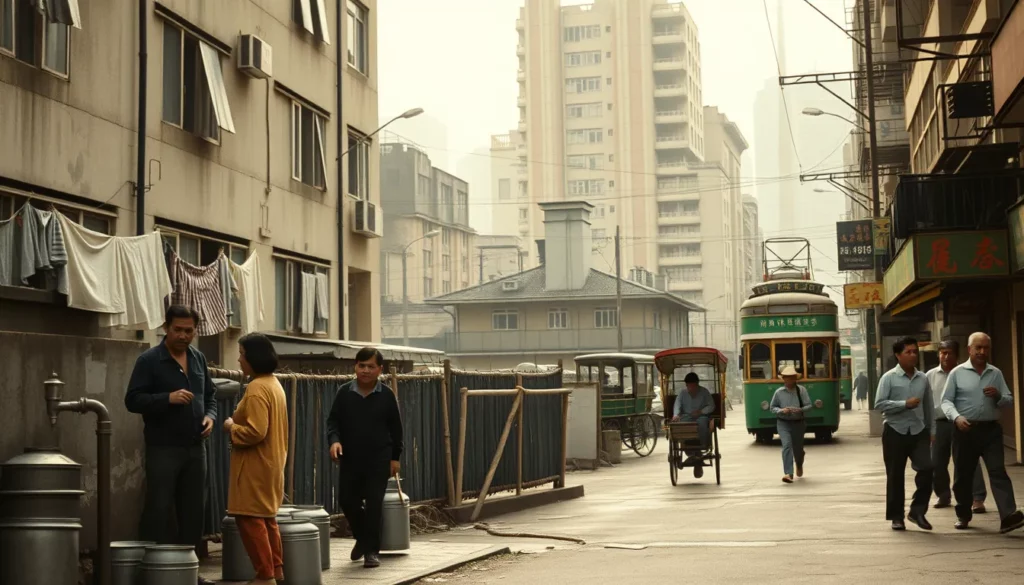
In the early 1960s, Hong Kong woke to the sound of factory whistles and the clatter of hand-carts. In Kwun Tong and San Po Kong, cotton mills and plastics works ran shifts through the night; in Shek Kip Mei and Wong Tai Sin, families queued at communal taps with buckets and kerosene tins. The 1961 census counted 3,133,131 people, nearly half under twenty-five, packed into tenements, rooftops, and resettlement blocks. Water came for only hours at a time during droughts. A ferry ride across the harbour cost a few cents. The city was a British colony on the edge of Mao’s China, a place of refugees and exporters, of squatter huts and new housing estates. Its people spoke of “resettlement” and “water restrictions” as ordinary facts of life. The decade that followed was one of rapid industrial growth, public housing construction, and political anxiety. This article reconstructs that world from contemporary reports, official papers, newspapers, and the testimony of those who lived it.
What Happened?
Hong Kong’s 1960s growth began with a crisis. After the Chinese Civil War, refugees poured into the colony; the population rose from about 600,000 in 1945 to an estimated 1.8 million by 1947 and over 3 million by the early 1960s. The United Nations embargo on trade with China during the Korean War cut into the old entrepôt business, pushing the colony toward manufacturing. Textile mills, garment factories, plastics plants, toy makers, and electronics assemblers multiplied. Official figures recorded about 3,000 registered factories in the 1950s and roughly 10,000 by the 1960s. Textiles and clothing made up about half of domestic exports by value. Wages remained low, but work was plentiful.
Housing was the most visible sign of growth and strain. On Christmas Day 1953, a squatter fire at Shek Kip Mei left some 53,000 people homeless overnight. The government responded with multi-storey resettlement estates, often built quickly with communal taps, shared toilets, and small rooms. In the 1960s these estates spread across Kowloon and the New Territories, alongside government low-cost housing and private tenements. They were intended as temporary relief, but they became permanent homes for hundreds of thousands.
The decade was punctuated by natural and financial shocks. Typhoon Mary in 1960 killed 45 people, injured 127, and destroyed about 10,000 homes. Typhoon Wanda in 1962 killed 130 and left 72,000 homeless. Droughts in 1963 and 1967 forced the government to restrict water to four hours every fourth day at the worst points. In 1961 and 1965, bank runs shook confidence; in 1965 Governor David Trench imposed a daily withdrawal limit of HK$100, and the Hongkong and Shanghai Bank took a majority stake in Hang Seng Bank to restore stability.
Politics also intruded. In 1966, a fare increase on the Star Ferry triggered riots; a petition against higher transport costs gathered 20,000 signatures, and about 1,800 people were arrested. In 1967, amid the Cultural Revolution, pro-Communist leftists mounted strikes, demonstrations, and bombings. Radio host Lam Bun was murdered. The disturbances paralysed parts of the economy until December 1967, when Premier Zhou Enlai ordered the leftist groups to stop. In the same year, TVB began free over-the-air broadcasting, and in December 1969 the first Hong Kong Festival drew more than 500,000 participants after seven months of preparation and HK$4 million in funding.
- 1949–50: Refugee influx from mainland China swells the population.
- 1953: Shek Kip Mei fire makes 53,000 homeless; resettlement programme begins.
- 1960: Typhoon Mary kills 45 and destroys about 10,000 homes.
- 1961: Census records 3,133,131 people; bank run on Liu Chong Hing Bank.
- 1962: Typhoon Wanda kills 130 and leaves 72,000 homeless.
- 1963: Severe drought; water restricted to four hours every four days.
- 1965: Banking crisis; HK$100 daily withdrawal limit imposed.
- 1966: Star Ferry riots lead to about 1,800 arrests.
- 1967: Leftist riots; Lam Bun murdered; TVB begins broadcasting.
- 1969: First Hong Kong Festival held in December.
How It Was Seen at the Time
Contemporaries did not see the 1960s as a simple success story. Officials described a race against time: housing had to be built faster than fires and typhoons could destroy squatter areas; water had to be found faster than reservoirs could fill. Newspapers used the language of emergency. The government called its housing programme “resettlement,” a word that implied temporary shelter rather than a permanent home. Industrialists spoke of export markets and cheap labour; workers spoke of long shifts and rising rents. The journalist Richard Hughes captured the mood with the phrase “borrowed place, borrowed time,” a reminder that many in Hong Kong believed the colony’s future depended on decisions made in London and Beijing.
“Borrowed place, borrowed time.” — Richard Hughes’s phrase for Hong Kong in the 1960s.
The prevailing mood was a mixture of anxiety and pragmatism. People feared Communist infiltration, bank failures, water shortages, and fires. They also expected living standards to improve. The 1961 census showed a young population; schools were expanding; factories were hiring. Official reports noted steady progress, but they also warned that population growth could outrun housing, schools, and water supply. For many families, the decade was experienced not as a boom but as a daily calculation: how many hours of water, how many shifts, how much rent, how many children could be sent to school.
Historical Snapshot
| Aspect | Detail |
| Date | 1960–1969, with roots in the 1949–50 refugee influx and the 1953 Shek Kip Mei fire. |
| Place | Hong Kong: Hong Kong Island, Kowloon, and the New Territories, especially industrial districts such as Kwun Tong, San Po Kong, and Tsuen Wan. |
| People | Refugees and squatters, factory workers, industrialists, colonial officials, leftist activists, and a young baby-boom population. |
| What Happened | Manufacturing expanded, resettlement estates were built, droughts and typhoons struck, bank runs and riots tested stability, and mass media and public festivals emerged. |
| Why It Mattered | The decade laid the foundation for Hong Kong’s export-led economy and its large public housing system, while shaping a distinct urban identity. |
Contemporary Newspaper Coverage
Hong Kong’s press in the 1960s was crowded and partisan. The English-language South China Morning Post and Hong Kong Standard served the business and colonial establishment, while Chinese-language papers such as Wah Kiu Yat Po reached a broader reading public. During the 1963 drought, newspapers printed reservoir levels and restriction schedules beside shipping news and stock prices. The tone was practical and alarmed: readers needed to know which days water would flow. During the 1965 bank crisis, papers reported queues outside banks and the governor’s emergency measures. In 1967, coverage turned sharply political, with reports of bombs, strikes, and the murder of Lam Bun.
Newspapers often adopted the government’s vocabulary. “Resettlement,” “water restriction,” and “leftist disturbance” were the standard labels. The press did not uniformly praise the colonial administration; Chinese-language papers could be critical of housing conditions and labour policies. But the dominant note was a concern for stability. Editors knew that bad news about Hong Kong’s economy or public order could frighten investors and residents alike.
“Water: four hours in four days.” — a phrase repeated in local press notices and reports during the 1963 drought.
Daily Life
For most working families, daily life revolved around water, work, and rent. In resettlement estates, families lived in small rooms and shared communal taps, toilets, and corridors. Water was carried in buckets and stored in drums. On restriction days, queues formed before dawn. Cooking was done on kerosene stoves or shared kitchens; rice was bought from small rice shops in street markets, often on credit. Children played in corridors and on rooftops. Many attended primary schools in shifts because places were scarce, even though the government had created over 300,000 new primary school places between 1954 and 1961 and by 1966 nearly all school-age children were enrolled.
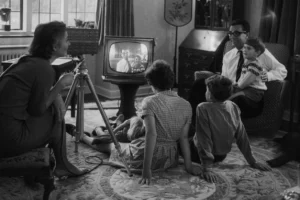
Factory work set the rhythm of the day. Women and girls made up a growing share of the labour force in textiles, garments, plastics, and electronics. Shifts were long, wages were low, and safety regulations were limited. Yet factory work offered cash in a city where cash was scarce, and the workplace often became a social centre—a “second home” where workers exchanged news and helped one another. Outside the factory, people travelled by tram, bus, and ferry; listened to radio; and after 1967 gathered around television sets as TVB began free broadcasting. The first Hong Kong Festival in 1969, with its parades and exhibitions, gave the city a rare moment of collective celebration.
Numbers at the Time
| Figure | Detail and Source |
| Population, 1961 | 3,133,131, according to the 1961 Hong Kong census. |
| Age structure | About half the population was under 25 in the 1960s (contemporary estimates). |
| Registered factories | Roughly 3,000 in the 1950s, rising to about 10,000 in the 1960s (official figures). |
| Textiles and clothing | About half of domestic exports by value during the 1960s (Hong Kong government trade figures). |
| Primary schooling | 99.8% of school-age children attending primary school by 1966; schools were not free (government education reports). |
| Typhoon Wanda, 1962 | 130 deaths and 72,000 people left homeless (contemporary reports). |
| Water restriction, 1963 | Supply limited to four hours every fourth day at the worst point (government water notices). |
| Bank withdrawal limit, 1965 | HK$100 per day, imposed by Governor David Trench (contemporary press reports). |
Different Perspectives
Colonial Officials
Officials saw themselves as managing a crisis of numbers. They worried that population growth would outstrip housing, water, schools, and hospitals. Their solution was rapid construction, low-cost resettlement, and export-led industrialisation. They also feared Communist subversion, especially after 1966–67. Governor David Trench’s administration mixed repression of leftist groups with expanded social spending, hoping to win public confidence.
Industrialists
Factory owners saw opportunity in Hong Kong’s cheap, abundant labour and its access to Western markets. Textile magnates and plastics manufacturers pressed for better roads, power, and port facilities. They tended to describe labour disputes as threats to stability rather than as legitimate grievances. Their investments helped make Hong Kong a major exporter, but their profits depended on low wages and long hours.
Factory Workers
Workers experienced the boom as a grind. Many had fled poverty in China and were willing to endure hardship for a foothold in the colony. They valued factory wages but complained of rising rents and insecure employment. Women workers in particular combined factory shifts with household duties. For them, the resettlement estate was an improvement on a squatter hut, but it was still cramped and regimented.
Squatters and Resettlement Tenants
Squatters saw the resettlement estates as safer than fire-prone hillside huts, but also as controlled spaces. Allocation was bureaucratic; rooms were small; communal facilities were often inadequate. Tenants organized through kaifong associations and mutual aid committees to press for water, lighting, and repairs. Their testimony shows that public housing was experienced as both a gain and a constraint.
Leftists and Beijing
Pro-Communist groups in 1967 portrayed British rule as colonial exploitation and called for strikes and protests. They carried copies of Mao Zedong’s Quotations from Chairman Mao and used the language of anti-imperialist struggle. Beijing’s support was cautious; when Zhou Enlai ordered the disturbances to stop in December 1967, it showed that the People’s Republic was not prepared to risk a direct confrontation over Hong Kong at that moment.
What People Feared
Fear was a constant companion in 1960s Hong Kong. The most rational fears were environmental and financial. Squatter fires could destroy thousands of homes in hours; typhoons could flatten waterfront shacks; droughts could empty reservoirs; bank runs could wipe out savings. The 1963 water restrictions and the 1965 banking crisis confirmed these fears. People stored water in every available container and queued outside banks to withdraw cash.
Political fears were equally intense. During the 1967 riots, rumours spread that China was preparing to take over the colony. Bombs exploded in streets; workers were pressured to join strikes; schools and factories were divided. Many residents feared that the British would abandon Hong Kong or that the People’s Liberation Army would cross the border. These fears were partly rational—Beijing did support the leftists rhetorically—but the feared invasion did not happen. Zhou Enlai’s order to stop the disturbances showed that the leadership in Beijing preferred to keep Hong Kong as a useful window on China rather than to seize it by force.
Other fears were more personal: fear of unemployment, of eviction, of children falling behind in school, of crime in crowded corridors. The government’s public information campaigns urged calm and cleanliness. Newspapers warned against panic. But the underlying anxiety—that Hong Kong’s prosperity was fragile and could be undone by a drought, a bank failure, or a political crisis—shaped how people planned their lives.
The 1960s transformed Hong Kong from a refugee entrepôt into an industrial city of resettlement estates and export factories. The primary sources—census reports, water notices, newspaper columns, official statements, and the memories of workers and tenants—show a society that was neither simply booming nor simply suffering. It was a place where families carried water in buckets, children studied in shifts, women sold their labour in textile mills, and politicians in London and Beijing cast long shadows. The decade’s housing estates and factories became the foundation of later prosperity, but they also left a legacy of crowded living and insecure work. To read the sources is to understand how ordinary people made a modern city under conditions of extraordinary pressure.
FAQ
What caused Hong Kong’s industrial growth in the 1960s?
The growth was driven by the refugee influx, the United Nations embargo on trade with China, and a shift from entrepôt trade to export manufacturing. Textile and garment factories led the way, and registered factories rose from roughly 3,000 in the 1950s to about 10,000 in the 1960s.
What were resettlement estates?
Resettlement estates were multi-storey public housing blocks built after the 1953 Shek Kip Mei fire, which left about 53,000 people homeless. They provided small rooms with communal taps and toilets and were intended as temporary relief, but they became permanent homes for hundreds of thousands.
How severe was the 1963 drought?
The 1963 drought was severe enough that the government restricted water to four hours every fourth day at the worst point. Reservoirs could not keep up with rapid population growth, and families stored water in buckets and drums.
What were the 1967 riots?
The 1967 riots were leftist disturbances during the Cultural Revolution, involving strikes, demonstrations, and bombings. Radio host Lam Bun was murdered. The disturbances ended in December 1967 after Premier Zhou Enlai ordered the leftist groups to stop.











Leave a Reply