
Short Answer
On the night of 10 May 1940, Amsterdammers heard aircraft passing overhead and saw smoke rising from the direction of Schiphol. The city had not yet been bombed into submission, but the war had arrived. Within days the Netherlands capitulated, German troops entered Amsterdam, and ordinary life began to be reorganized around occupation. This article focuses on Amsterdam city life under German occupation from 1940 to 1945: how people ate, worked, travelled, hid, queued, read, feared, and celebrated. It is not a military history of the campaign, nor a general history of the Netherlands at war. The scope is the occupied city as contemporaries experienced it, reconstructed from city archives, period journalism, photographs, and eyewitness testimony.
What Happened?
The German invasion of the Netherlands began on 10 May 1940. Amsterdam was largely spared immediate violence, but German bombers passed over the city toward Schiphol, and residents saw clouds of smoke above the burning airport. On 11 May a stray bomb fell on the Blauwburgwal, killing 44 people. After the bombing of Rotterdam, the Dutch forces capitulated on 14 May. On 15 May German troops entered Amsterdam via the Berlagebrug, watched by crowds that included cheering members of the Dutch Nazi movement, the NSB.
At first, daily life appeared to continue with unsettling normality. German soldiers were billeted in the city, propaganda appeared on squares and public buildings, and some economic activity improved as German orders reduced unemployment. But the occupation tightened step by step. In October 1940 municipal officials were required to sign the so-called Aryan Declaration, after which Jewish employees were expelled from public service. From 1941 Jewish residents faced registration, isolation, dismissal, and increasingly severe restrictions on movement, work, schooling, and public space.

- 10 May 1940: German invasion; aircraft pass over Amsterdam toward Schiphol.
- 11 May 1940: stray bomb on Blauwburgwal kills 44.
- 14 May 1940: Dutch capitulation after the bombing of Rotterdam.
- 15 May 1940: German troops enter Amsterdam via the Berlagebrug.
- October 1940: Aryan Declaration; Jews removed from public employment.
- February 1941: the February Strike protests the first Jewish roundups.
- 1942: deportations to Westerbork and thence to extermination camps; forced-labour roundups increase.
- 1943: resistance attack on the population register.
- September 1944: railway strike and stalled Allied advance bring the Hunger Winter.
- 5–8 May 1945: German capitulation, the Dam Square shooting, and the arrival of Canadian troops.
How It Was Seen at the Time
Contemporaries did not experience the occupation as a single event but as a series of unsettling adjustments. The first days mixed fear with a strange calm. Journalist Jan Campert described the darkened city in May 1940:
“Never was Amsterdam so beautiful and so peaceful as on this first night of war. And so quiet. But it is a silence filled with an ominous mystery. Because for the first time, the Netherlands’ largest city has darkened.” — Jan Campert, journalist, May 1940
For many Amsterdammers, the occupation was first encountered through small humiliations and bureaucratic demands: identity papers, ration cards, notices, curfews, and restrictions. For Jewish residents, the language of decrees and registration quickly became a language of exclusion. Some chose adaptation; some collaborated; some resisted. The cellist Frieda Belinfante, who was half-Jewish and lived openly as a lesbian, joined the artists’ resistance and helped forge identity cards. She later recalled her determination:
“If the Germans get me and they want to kill me, then they can go right ahead, but I’m going to fight.” — Frieda Belinfante, cellist and resistance member
The prevailing mood was not uniform. There was shock, disbelief, opportunism, fear, and defiance. The illegal newspapers Het Parool and Vrij Nederland began to circulate, offering alternative information to the controlled press. Yet the everyday language of the city also included rumour, euphemism, and caution: people spoke of “going into hiding,” of “safe addresses,” of “trustworthy” neighbours, and of “measures” that might pass.
Historical Snapshot
| Aspect | Detail |
|---|---|
| Date | May 1940–May 1945 |
| Place | Amsterdam, German-occupied Netherlands |
| People | Amsterdam civilians, Jewish residents, German occupation authorities, NSB collaborators, resistance members, forced labourers, refugees, and Allied liberators |
| What Happened | German occupation, anti-Jewish persecution and deportation, rationing, resistance, the February Strike, the Hunger Winter, and liberation |
| Why It Mattered | It transformed daily life, exposed the range of human choices under terror, and produced a documentary record of suffering, courage, and complicity |
What People Knew at the Time
| What People Knew Then | What We Know Now |
|---|---|
| Amsterdammers knew that Germany had invaded and occupied the Netherlands, that anti-Jewish decrees were being enforced, that Jewish neighbours were being rounded up and deported, and that food and fuel were becoming scarce. | Historians now document the systematic nature of the Holocaust, the bureaucracy of deportation, the extent of collaboration and rescue, and the precise mortality patterns of the Hunger Winter. |
| Many knew or suspected that deportation meant extreme danger, though knowledge of the extermination camps was uneven and often filtered through rumour, illegal newspapers, and personal contacts. | We know the scale of the genocide and the role of camps such as Westerbork as a transit site, as well as the detailed records kept by occupation authorities and relief organizations. |
| People experienced rationing, black-market trade, raids, forced-labour roundups, and the fear of betrayal. | We can reconstruct prices, ration levels, mortality rates, and the geography of hiding and resistance from archives and survivor testimony. |
Daily Life
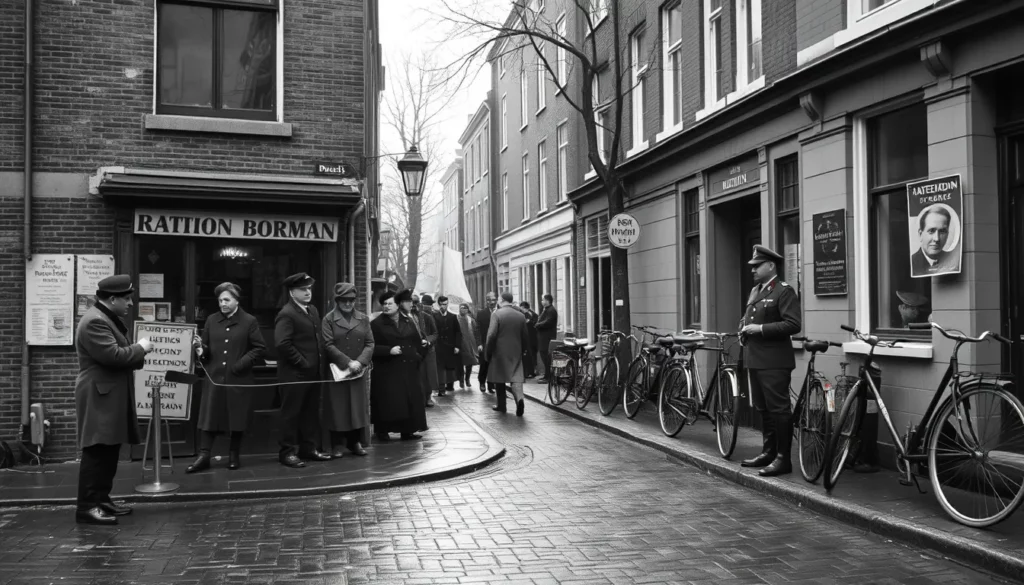
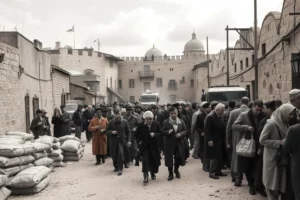
Daily life in occupied Amsterdam was governed by scarcity and paperwork. Ration cards, known as distributiebewijzen, controlled access to bread, meat, fat, sugar, coffee, fuel, and clothing. Queues formed early outside shops, and what was available changed from week to week. As the war lengthened, people relied on soup kitchens, substitutes, and the black market. In neighbourhoods such as the Jordaan and around the Zeedijk, illegal trade flourished despite penalties. In the Hunger Winter of 1944–1945, food barely reached the city; shops ran empty, and the frozen canals and IJsselmeer made transport even harder.
Work, School, and Movement
In the first years of occupation, German orders brought employment to some workshops and factories, and wages rose for those in work. But forced-labour roundups increasingly threatened men, and curfews and travel restrictions made movement uncertain. Schools continued when possible, but Jewish children were progressively excluded. Public transport was restricted, bicycles were coveted and sometimes confiscated, and walking long distances became routine. People learned to carry identity papers and to avoid streets where raids were rumoured.
Jewish Amsterdam
For Jewish Amsterdammers, daily life was narrowed by decree. Registration, dismissal from jobs, bans from parks, cafés, theatres, and public transport, and the compulsory yellow star marked a steady exclusion from city life. The Jewish Council, or Joodse Raad, became an ambiguous intermediary between the community and the occupier. From 1942 deportations moved through Westerbork toward the extermination camps. Some Jews went into hiding with the help of resistance networks, neighbours, and institutions; others were betrayed. The Amsterdam City Archives notes that institutions such as Artis and the Colonial Institute provided hiding places, while some police officers and municipal officials cooperated in arrests and transports.
Hiding, Raids, and Information
Onderduiken—going into hiding—became a daily strategy for Jews, forced labourers, and resistance members. It required false papers, food coupons, silence, and trusted contacts. Raids, or razzia’s, could empty a street or a square within minutes. At the same time, illegal newspapers and photographs circulated. Resistance photographers from De Ondergedoken Camera recorded the Hunger Winter, including the iconic image of a boy with an empty pan. Radios were banned and hidden; news from the BBC or illegal presses became a dangerous but vital link to the outside world.
Everyday Social Life
Amsterdammers still fell in love, celebrated births, buried relatives, and told jokes about the occupier. Cinemas and cafés operated under restrictions; music and theatre continued where permitted. But social life was shadowed by suspicion. Neighbours might help, inform, or look away. NSB members and collaborators were visible, and after the war the question of what people had done during the occupation would divide families and communities.
Contemporary Terminology
- Arische verklaring — “Aryan Declaration”; a bureaucratic loyalty form signed by officials from October 1940, used to exclude Jews from public employment.
- Jodenster — the yellow Star of David imposed on Jews; a visible marker of persecution and segregation.
- Onderduiken — “to dive under,” meaning to go into hiding from German authorities or deportation.
- Razzia — a roundup or raid by police or occupation forces, often targeting Jews or forced labourers.
- Hongerwinter — the “Hunger Winter” of 1944–1945, when food and fuel shortages caused mass suffering and death.
- NSB — the Dutch National Socialist Movement, a collaborationist party whose members often welcomed German troops.
- Distributiebewijs — a ration card or distribution coupon required for essential goods.
- Verzetskrant — an illegal resistance newspaper such as Het Parool or Vrij Nederland.
Numbers at the Time
| Figure | Recorded detail and source |
|---|---|
| Blauwburgwal bomb casualties | 44 dead after a stray bomb on 11 May 1940 (Amsterdam City Archives). |
| Suicides in the first days | Around 400 suicides in the first days after the invasion, many in Amsterdam; over half were Jews (Amsterdam City Archives). |
| Dam Square shooting | 32 killed and more than 100 injured when German troops opened fire on 7 May 1945 (Amsterdam City Archives). |
| Hunger Winter mortality, January 1945 | Three times as many people died in Amsterdam as normal in January 1945 (Amsterdam City Archives). |
| Liberation entry | Canadian troops entered Amsterdam via the Berlagebrug on 8 May 1945 (Amsterdam City Archives). |
The occupation left a city changed in its streets, its institutions, and its memory. The sources that survive—ration books, raid notices, illegal newspapers, photographs, diaries, and municipal records—do not merely record events; they show how ordinary people negotiated extreme circumstances. They reveal that daily life under occupation was made of small decisions: whether to queue, to hide, to inform, to resist, or to remain silent. Those decisions, taken in kitchens and stairwells and on street corners, are the substance of Amsterdam’s war.
FAQ
What was daily life like in Amsterdam under German occupation?
Daily life was shaped by rationing, queues, curfews, identity checks, raids, and fear. Amsterdammers relied on distribution cards and black-market trade, while Jewish residents faced escalating restrictions, deportation, and the need to hide. Illegal newspapers, soup kitchens, and resistance networks became part of ordinary survival.
What was the Hunger Winter?
The Hunger Winter was the severe food and fuel crisis of 1944–1945. After the Allied advance stalled and a railway strike disrupted transport, food barely reached Amsterdam. Soup kitchens became essential, and in January 1945 three times as many people died in Amsterdam as normal, according to the Amsterdam City Archives.
How did Amsterdam experience liberation?
German capitulation was signed on 5 May 1945, but the withdrawal was chaotic. On 7 May German troops opened fire on a celebrating crowd in Dam Square, killing 32 and injuring more than 100. Canadian troops entered Amsterdam via the Berlagebrug on 8 May, and the city celebrated despite the tragedy.










Leave a Reply