
Short Answer
Quick Snapshot
Jerusalem in 1948 was a city of about 165,000 people, poised between the end of British Mandate rule and the first Arab-Israeli war. The phrase Jerusalem in 1948 refers here to the whole city as it existed under the Mandate and then as it was divided between Israel and Jordan after the fighting, not to a single neighborhood or to the later 1967 unification. The year opened with the United Nations partition plan of November 1947 still unresolved and with Jerusalem designated as a separate international city, a corpus separatum that was never implemented.
By the time the British withdrew on 14 May 1948 and Israel declared independence, Jerusalem had already become a front line. Jewish neighborhoods in the west and south were besieged and supplied by convoys; Arab neighborhoods and the Old City were drawn into the fighting; and the city’s mixed population faced fear, displacement, and shortages. The Deir Yassin massacre in April, the attack on the Hadassah medical convoy, the fall of the Jewish Quarter in May, and the uneven ceasefires of June and July marked the year as one of violence and uncertainty.
The city ended 1948 effectively divided: West Jerusalem under Israeli control and East Jerusalem, including the Old City, under Jordanian control. This division would endure until 1967. The year is documented in newspapers such as The Palestine Post, in Arabic-language papers, in United Nations records, in military archives, and in letters and diaries that describe how civilians and fighters experienced the siege and the birth of Israel.
Jerusalem in 1948
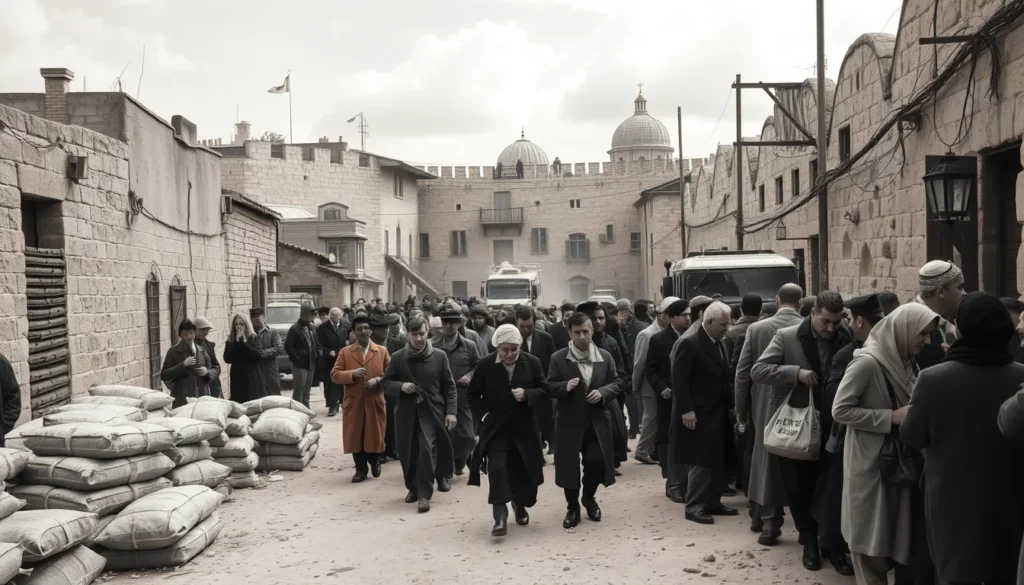
Jerusalem lies in the Judaean hills, a city of stone terraces, walled enclosures, and crowded neighborhoods built around holy sites sacred to Jews, Christians, and Muslims. In 1948 the British Mandate administration governed the city from the new western neighborhoods, while the Old City remained a dense maze of quarters, markets, and religious institutions. The winter was cold and rainy, and the weather worsened the already difficult convoy routes and the living conditions of besieged neighborhoods.
The atmosphere was one of emergency. Roadblocks, barbed wire, military vehicles, and armed guards became ordinary sights. The city’s holy places and civilian institutions were drawn into a conflict that was at once local, national, and international. Jerusalem was not simply a battlefield; it was a symbol of competing national claims and a place where ordinary routines of work, school, worship, and family life continued under conditions of acute insecurity.
Population & Economy
Before the war, Mandate Jerusalem had roughly 100,000 Jews, about 65,000 Arabs, and a small number of others, making a total of approximately 165,000. Jewish neighborhoods had expanded westward and southward, while Arab neighborhoods and the Old City remained central to Palestinian urban life. The war brought displacement: some residents fled, some were expelled, and others moved to safer quarters within the city or beyond it.
Jerusalem’s economy rested on government service, religious institutions, pilgrimage, trade, printing and publishing, food processing, construction, and light manufacturing. The British Mandate administration, hospitals, schools, hotels, and religious endowments provided employment. War disrupted markets, transport, and construction; rationing and scarcity affected bread, fuel, and water; and the city’s commercial life was repeatedly paralyzed by curfews, road closures, and fighting.
Government & Politics
Under the British Mandate, Jerusalem had a municipal council and a Jewish mayor, Daniel Auster, but real authority lay with the British administration. The United Nations partition plan of 1947 proposed Jerusalem as a separate international entity, but neither the British nor the emerging Israeli and Arab authorities accepted that arrangement in practice. After 14 May 1948, Israeli authorities controlled West Jerusalem, while Jordanian and Arab Legion forces controlled East Jerusalem and the Old City.
Political life was fractured. Jewish institutions such as the Jewish Agency, the Haganah, the Irgun, and Lehi operated under emergency conditions; Arab leadership included local committees, the Arab Higher Committee, and the Arab Liberation Army, while Transjordan’s Arab Legion played a decisive role in the eastern sector. Security concerns overshadowed civil administration, and martial law, censorship, and emergency regulations shaped public life.
Industry
Jerusalem had no large-scale heavy industry in 1948. Its productive life lay in workshops, printing presses, bakeries, food processing, building trades, transport, and services linked to pilgrimage and religious institutions. The war created clandestine arms workshops and repair shops, while British military installations and supply depots formed part of the city’s wartime landscape.
Small businesses suffered from the siege and from the interruption of trade with the coast. Arab and Jewish commercial districts were separated by front lines, and many shops closed or changed hands. The city’s economy became increasingly dependent on emergency supply, military needs, and external aid rather than normal market exchange.
Education
Jerusalem was a major educational center. The Hebrew University on Mount Scopus had opened in 1925, and Hadassah Hospital stood nearby; Arab and Jewish schools, religious academies, and mission schools served different communities. In 1948 Mount Scopus became an isolated enclave, and convoys to the university and hospital were attacked. Academic life was suspended or relocated, and schools were often closed, damaged, or used as shelters.
Literacy and schooling varied by community and class, but the war interrupted education for thousands of children. Teachers and students were drawn into defense, relief work, or displacement, and the city’s educational institutions became part of the wider struggle over sovereignty and survival.
Transportation
People moved through Jerusalem by bus, taxi, private car, donkey, and on foot. The Jaffa–Jerusalem railway linked the city to the coast, but road transport was more important for daily supply. The main road from Tel Aviv and the coastal plain became a lifeline, and Jewish convoys carrying food, fuel, and arms were repeatedly attacked.
Operation Nachshon in April 1948 briefly opened the road, and later the improvised Burma Road helped bypass Arab positions. Within the city, barbed wire, roadblocks, and sniper fire made movement dangerous. British military vehicles withdrew in May, and the new front lines cut streets and neighborhoods apart.
Everyday Life
Daily life in Jerusalem in 1948 was dominated by scarcity and danger. Families queued for bread, water, and fuel; neighborhoods organized rationing and relief; and people sheltered from shelling and gunfire. Housing became crowded as residents moved toward safer areas, and the separation of front-line neighborhoods divided families and communities.
Food was simple and often insufficient: bread, olive oil, legumes, and whatever could be supplied by convoys or local markets. Clothing was practical and patched, and religious observance continued where possible. Radio broadcasts, rumors, and newspaper reports shaped public mood. Funerals, weddings, and religious festivals took place under emergency conditions, and women often took on nursing, relief, and administrative roles as men were mobilized.
Major Events
The year’s violence was prepared by the United Nations partition vote of 29 November 1947, which called for independent Arab and Jewish states and a special international regime for Jerusalem. In January and February 1948, attacks on Jewish neighborhoods and road convoys intensified. On 9 April 1948, Irgun and Lehi forces killed more than 100 Palestinian civilians at Deir Yassin, an event that spread fear and contributed to Palestinian flight. On 13 April, the Hadassah medical convoy was attacked, killing dozens of Jewish doctors, nurses, and guards.
On 14 May 1948, the British Mandate ended and Israel declared independence. Arab states intervened, and fighting in Jerusalem intensified. On 28 May, the Jewish Quarter of the Old City surrendered to Transjordan’s Arab Legion. A first UN ceasefire began on 11 June, fighting resumed in July, and a second ceasefire followed on 18 July. On 17 September, UN mediator Folke Bernadotte was assassinated in Jerusalem by Lehi members.
O Jerusalem! observes that Arabs saw the handover of over half of Palestine to Zionists who were only a third of the population as a monstrous injustice thrust upon them by white Western imperialism.
What Newspapers Were Reporting
The Palestine Post, later The Jerusalem Post, reported on convoy attacks, the siege of Jewish neighborhoods, casualties, and the political crisis surrounding the end of the Mandate. Arabic-language papers such as Falastin and Al-Difa’ carried reports on Arab casualties, displacement, and the fighting in and around Jerusalem. Newspapers also covered the United Nations debates, ceasefires, and the arrival of Arab forces.
Distribution was disrupted by fighting and censorship, and reports were often incomplete or shaped by the needs of each side. Readers looked to papers for lists of casualties, supply information, and official statements, while rumors spread more quickly than print in besieged neighborhoods.
What People Were Talking About
Letters and diaries from the period, studied by Anita Shapira, show Jewish civilians and fighters discussing fear, casualties, the fragility of Jewish society, and the behavior of the enemy. People argued about whether to stay or leave, how to organize relief, and whether leaders understood the severity of the siege. Social tensions surfaced between longtime residents and newcomers, and Holocaust survivors described the war through the memory of recent catastrophe.
Women’s roles became a subject of debate as women took on nursing, office work, and relief duties while also bearing the burden of household survival. Public concerns included food, water, shelter, the fate of prisoners, and the mounting number of dead. Similar conversations took place among Palestinians, where displacement, security, and the loss of homes and livelihoods dominated daily discussion.
Historical Photographs
Photographs of Jerusalem in 1948 show convoys of armored buses and trucks, soldiers at roadblocks, damaged buildings, refugees moving with bundles, and the Old City’s narrow streets. British, Jewish, Arab, and United Nations photographers documented the city, and collections survive in archives such as the Library of Congress, the Imperial War Museum, the IDF and Haganah archives, UNRWA collections, and Palestinian refugee archives.
These images are significant because they record both the material destruction and the human routines of the siege: queues for water, children in courtyards, religious services, and the movement of fighters through ordinary streets. They also reflect the perspectives of their makers and must be read with attention to propaganda, censorship, and the conditions under which they were taken.
Documents & Primary Sources
Key documents include United Nations General Assembly Resolution 181 of 29 November 1947, British Mandate administrative records, Jerusalem municipal papers, military orders and reports from the Haganah, the Arab Legion, and other forces, and the armistice agreements of 1949. Newspapers such as The Palestine Post, Falastin, and Al-Difa’ provide contemporaneous reporting, while maps and censuses show demographic and territorial change.
Letters and diaries are especially valuable for social and cultural history. Anita Shapira’s study of Jewish letters and diaries from November 1947 to July 1948 shows how civilians and fighters perceived the siege, casualties, gender roles, and the Holocaust. Photographs, posters, and official proclamations add visual and political evidence. These sources must be read critically because they were produced under emergency conditions and often reflect the aims of their authors.
1948 Timeline
| Date | Event |
|---|---|
| January–March 1948 | Attacks on Jewish neighborhoods and road convoys intensify; British authority declines. |
| 9 April 1948 | Deir Yassin massacre kills more than 100 Palestinian civilians. |
| 13 April 1948 | Hadassah medical convoy attacked, killing dozens of Jewish doctors, nurses, and guards. |
| 14 May 1948 | British Mandate ends; Israel declares independence; Arab states intervene. |
| 28 May 1948 | Jewish Quarter of the Old City surrenders to Transjordan’s Arab Legion. |
| 11 June 1948 | First United Nations ceasefire begins. |
| 9–18 July 1948 | Fighting resumes; second ceasefire follows on 18 July. |
| 17 September 1948 | UN mediator Folke Bernadotte assassinated in Jerusalem. |
| December 1948 | City effectively divided; armistice talks continue into 1949. |
What Changed Next
The 1949 armistice agreements confirmed the division of Jerusalem. Israel controlled West Jerusalem, Jordan controlled East Jerusalem and the Old City, and a no man’s land separated the two sectors. The city’s population was transformed by displacement and immigration, and institutions such as the Hebrew University were forced to relocate or rebuild.
The divided city remained a focal point of the Arab-Israeli conflict until 1967, when Israel captured East Jerusalem in the Six-Day War. The events of 1948 thus set the political and physical geography of Jerusalem for two decades and shaped the memories of both Israelis and Palestinians.
Sources
- Lapierre, Dominique, and Larry Collins. O Jerusalem! New York: Simon and Schuster, 1972. https://www.palestine-studies.org/en/node/78195
- Shapira, Anita. Jerusalem in 1948: A Contemporary Perspective. Project Muse, 2012. https://muse.jhu.edu/pub/3/article/479924
- Morris, Benny. Righteous Victims: A History of the Zionist-Arab Conflict, 1881-1999. New York: Knopf, 1999.
- Benvenisti, Meron. Jerusalem: The Torn City. Minneapolis: University of Minnesota Press, 1976.
- United Nations General Assembly. Resolution 181 (II): Future Government of Palestine. 29 November 1947.
FAQ
What was the population of Jerusalem in 1948?
About 165,000 before the war, with roughly 100,000 Jews, 65,000 Arabs, and a small number of others; displacement and fighting changed the population during the year.
What major events happened in Jerusalem in 1948?
The year included the Deir Yassin massacre, the Hadassah convoy attack, the end of the British Mandate and Israeli declaration of independence, the fall of the Jewish Quarter, UN ceasefires, and the assassination of Folke Bernadotte.
What primary sources are available for studying Jerusalem in 1948?
Sources include UN Resolution 181, British Mandate records, Jerusalem municipal papers, newspapers such as The Palestine Post and Arabic-language papers, diaries and letters, military archives, photographs, and maps.
How did daily life in Jerusalem in 1948 differ from today?
Daily life was marked by siege, rationing, military checkpoints, divided neighborhoods, disrupted schools and transport, and the constant threat of violence, unlike the more open and technologically connected city of today.










Leave a Reply