
Short Answer
Quick Snapshot
New York entered 1898 as a city that had just become a different thing. At midnight on 1 January the Greater New York Charter took effect, and the separate municipalities of Manhattan, Brooklyn, Queens, Richmond (Staten Island) and the annexed towns of the Bronx were fused into one metropolis of roughly 3.4 million people — the largest city in the United States and, after London, the second largest in the world. (Unless otherwise qualified, “New York” in this article means that consolidated City of Greater New York, not the State of New York or the older Manhattan-only city.)
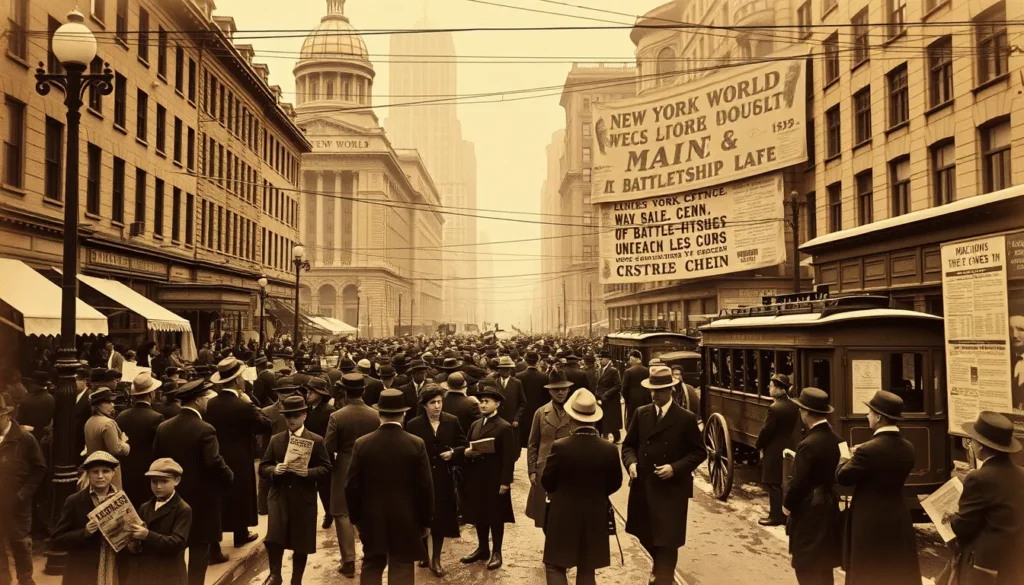
Eleven weeks later the battleship USS Maine exploded in Havana harbor. The newspapers clustered along Park Row — Joseph Pulitzer’s World and William Randolph Hearst’s Journal above all — had spent three years perfecting a belligerent, sensation-driven style that contemporaries were already calling “yellow journalism,” and in February 1898 they had the story they were built for. Recruiting depots filled, regiments drilled in armories, and by early May the United States was at war with Spain.
By December the city had sent its sons to Cuba, Puerto Rico and the Philippines, buried some of them at Montauk Point, and watched as a peace treaty signed in Paris turned the republic into an overseas empire. New York’s year was therefore two stories at once: the administrative birth of the modern city, and the moment its press helped push a nation into the wider world.
New York in 1898
The consolidated city was an archipelago stitched together by water. Manhattan’s grid pressed north past 155th Street; Brooklyn’s brownstone wards and waterfront flats already held over a million people; Queens was still largely farmland and market gardens with a few industrial villages; Staten Island was rural and ferry-dependent. The harbor was the city’s reason for existing — a deep, sheltered basin crossed constantly by ferries, barges, tugs and liners.
The climate was humid and continental: snow-blocked winters that made the elevated railways smoke and stall, and long, sticky summers. Newspapers printed daily “prostrations” lists during July and August heat, and the condition of the streets after rain — mud, manure, ash — was a permanent civic complaint despite Colonel George Waring’s celebrated white-uniformed street cleaners.
Population & Economy
The 1900 federal census, the first reliable count of the consolidated city, recorded 3,437,202 inhabitants. Of these, Manhattan (New York County) held 1,850,093; Brooklyn, 1,166,582; the Bronx, 200,507; Queens, 152,999; and Richmond, 67,021. Roughly two in five New Yorkers were foreign-born, with the largest groups from Ireland, Germany, Italy, Russia and Austria-Hungary; the Lower East Side was by some measures the most densely populated place on earth.
| Borough (1900 census) | Population |
|---|---|
| Manhattan | 1,850,093 |
| Brooklyn | 1,166,582 |
| Bronx | 200,507 |
| Queens | 152,999 |
| Richmond | 67,021 |
| Total | 3,437,202 |
The city was emerging from the long depression that followed the Panic of 1893; work was steadier in 1898 than in 1894, though employment remained seasonal and brutal in the dockside trades. Contemporaries reckoned a day labourer’s wage at about $1.25 to $1.50 for a ten-hour day, a clerk’s at $8 to $12 a week, and a woman in a garment shop at $4 to $6. A tenement flat of three or four rooms rented for $8 to $14 a month; a loaf of bread cost about five cents, a glass of beer five cents, a pail of beer ten.
Government & Politics
The new city’s first mayor was Robert Anderson Van Wyck, a Tammany Hall Democrat elected in November 1897 over the Fusion reform candidate, Seth Low, and inaugurated with the charter on 1 January 1898. Behind him stood Richard Croker, the Tammany boss whose control of patronage shaped every borough office. The charter created five borough presidents, a powerful Board of Estimate and a Board of Aldermen; Republicans and independents denounced the arrangement as a machine’s charter, and the corruption scandals that would engulf Van Wyck’s administration were already forming.
At state level, Republican Governor Frank S. Black held office through 1898. In November the voters chose Theodore Roosevelt — the former police commissioner and, by then, a celebrated Rough Rider — as governor by a narrow margin over Augustus Van Wyck, the mayor’s brother. National politics were dominated by President William McKinley, whose caution was under constant assault from the jingo press; the city’s police force, consolidated that year, was still reorganising the ward-based forces of the old municipalities.
Industry
New York’s economy rested on four pillars: the port, finance, manufacture and the printed word. The waterfronts of Manhattan and Brooklyn handled the largest share of the nation’s foreign trade; the Brooklyn Navy Yard and the Bush Terminal employed thousands. Sugar refining, dominated by the Havemeyer family’s American Sugar Refining Company, ran day and night along the Brooklyn shore, while Standard Oil’s offices and the bankers of Wall Street — J. P. Morgan chief among them — directed capital nationwide.
Manufacturing was small-scale and immigrant-run: garment sweatshops in the Tenth Ward, cigar rolling, furniture, printing and brewing. Park Row itself was an industry, with the gold-domed World building, the Journal, the Sun, the Tribune and the Times all within a few blocks, and the great department stores — Siegel-Cooper on Sixth Avenue, Wanamaker’s, Macy’s at 14th Street — teaching the city to shop.
Education
Consolidation created a single Board of Education for Greater New York in 1898, absorbing the separate systems of the old cities. Schools were overcrowded and ran on half-day shifts in the poorest districts; evening schools taught English to adults, and the free lecture system drew large crowds. Compulsory attendance was on the statute book but unevenly enforced, especially where children’s wages were needed at home.
Higher education was flourishing: Columbia University had just opened its Morningside Heights campus in 1897 under Nicholas Murray Butler’s rising influence; the College of the City of New York offered free instruction to thousands; Cooper Union, New York University, Barnard College and the Pratt Institute in Brooklyn served a widening public, while Catholic parochial schools enrolled a large share of the city’s children.
Transportation
New Yorkers moved vertically as much as horizontally. The elevated railways — Second, Third, Sixth and Ninth Avenues in Manhattan, and the Brooklyn elevated lines — rumbled above the streets for a nickel fare, while electric trolleys were fast replacing horsecars in Brooklyn and Queens. The Brooklyn Bridge carried an immense traffic of foot passengers, wagons and cars. Ferries remained essential: to Staten Island, to Jersey City, to Fulton Ferry, and to the railroad terminals across the Hudson.
Steamboats crowded the rivers, and the great railroads — New York Central at the Grand Central Depot, the Pennsylvania at its Jersey City terminus — fed the port. The bicycle craze of the 1890s was at its height, with riders in bloomers and caps crowding Riverside Drive and Ocean Parkway. The subway was still six years away, its contract not yet let; hansom cabs and horse-drawn omnibuses remained the fallback for the well-to-do, and a handful of “horseless carriages” coughed their way up Fifth Avenue.
Everyday Life
Most New Yorkers lived in tenements: five- and six-storey “dumbbell” buildings with dark inner rooms, shared water closets in the hall and fire escapes used as summer bedrooms. Rents were paid weekly; boarders were common. Food came from pushcarts and corner groceries — corned beef, herring, potatoes, bread, and, on the Lower East Side, kosher shops and Italian stalls. Clothing followed respectability: bowler hats and derbies for men, shirtwaists and long skirts for women, boots in all weather.
Entertainment was cheap and loud: vaudeville at Tony Pastor’s and Koster & Bial’s, melodrama on the Bowery, the Metropolitan Opera for the wealthy, Barnum & Bailey’s shows, bicycle races at Madison Square Garden and, in summer, the amusements of Coney Island — Steeplechase Park had opened in 1897. Baseball drew huge crowds to the Giants’ Polo Grounds and Brooklyn’s Washington Park. Sunday blue laws were contested, saloons were everywhere, and the church, the union hall and the political club each claimed a share of working-class loyalty.
Major Events
The year’s defining sequence began on 9 February, when Hearst’s Journal printed the intercepted letter of the Spanish minister, Enrique Dupuy de Lôme, calling McKinley “weak and a bidder for the admiration of the crowd.” On 15 February the Maine blew up with the loss of more than 260 of her crew; on 17 February the city’s press was unanimous in suspicion and largely unrestrained in language. On 25 April Congress declared war.
New York mustered its regiments — the 71st, the 69th, the 7th — at armories and at Camp Black on the Hempstead Plains of Long Island; volunteers drilled in city parks; women’s committees rolled bandages; and yachts were offered for auxiliary naval service. Fears of a Spanish descent on the East Coast gripped the city in May. In August and September returning soldiers, many sick with typhoid and malaria, were quarantined at Camp Wikoff, Montauk Point, where Theodore Roosevelt and his Rough Riders landed to enormous publicity. In November Roosevelt was elected governor; in December the Treaty of Paris was signed, ceding the Philippines, Puerto Rico and Guam and ending Spanish rule in Cuba.
What Newspapers Were Reporting
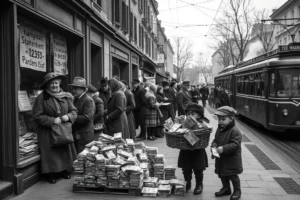
Park Row was the loudest square mile in America. The World, selling for a penny, claimed a Sunday circulation above 600,000; the Journal fought it headline for headline. On 17 February the World asked on its front page whether the “Maine Explosion” had been “Caused by Bomb or Torpedo?”, while the Journal declared the ship destroyed “by treachery” and offered a reward for the detection of the perpetrators. Hearst’s famous instruction to the artist Frederic Remington — “You furnish the pictures, I’ll furnish the war” — is often quoted and probably apocryphal, but it captured a real dynamic: the papers did not invent the Cuban crisis, yet they amplified it relentlessly.
Not everyone followed. Adolph Ochs, who had bought the New York Times in 1896, adopted the motto “All the News That’s Fit to Print” as a direct rebuke to the yellow press, and E. L. Godkin’s Evening Post denounced the war fever as jingoism. Yet even the sceptical country papers reprinted World and Journal dispatches. The Herald and the Tribune competed with soberer reporting and their own correspondents, while Stephen Crane wrote from Cuba for the World.
What People Were Talking About
Conversation in 1898 turned on the war and its costs. Was the Maine mined, or had her magazines exploded? Should the United States keep the Philippines — and if so, by what right? Anti-imperialists in the city, including veteran reformers and clergymen, warned against “criminal aggression,” while others argued that the flag could not be hauled down. On street corners the rhyme “Remember the Maine, to hell with Spain” was chalked on walls and shouted by newsboys.
Other talk was domestic: the cost of coal and ice, the greed of the ice companies, the crowding of the schools, the new charter’s waste, the streetcar franchises, and the consolidation itself — whether Brooklyn had been swallowed or magnified. Labour unrest, the Wilmington, North Carolina, racial massacre of November 1898, and the question of women’s suffrage all appeared in letters and diaries alongside war news.
Historical Photographs
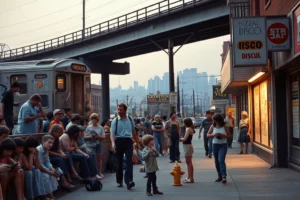
The visual record of 1898 New York is substantial. Newspaper half-tone reproduction was spreading, so photographs and dramatic drawings shared the front pages. George Grantham Bain founded his news photograph service in New York in 1898, and its glass negatives, now at the Library of Congress, document street scenes, ships and public figures. Jacob Riis’s lantern slides and prints of tenement interiors and Mulberry Street were already circulating as lectures and books.
Surviving images show recruiting queues outside armories, the 71st Regiment marching down Broadway, the Maine’s survivors, crowds reading bulletins projected or posted outside newspaper offices, the tents of Camp Wikoff at Montauk, and the harbour crowded with auxiliaries. The Detroit Photographic Company and the Museum of the City of New York hold streetscapes from the consolidation year, and the New York Public Library’s photographic collections preserve thousands of views of the newly unified city.
Documents & Primary Sources
- The Greater New York Charter (Laws of 1897, chapter 378), effective 1 January 1898, with the enabling legislation and the 1894 consolidation referendum returns.
- Annual reports of the Police Department, the Department of Health, the Department of Street Cleaning and the Board of Education for 1898.
- Federal census schedules for 1900 and New York State census records, with city directories such as Trow’s New York City Directory for 1898.
- Newspapers: the New York World, New York Journal, New York Times, Sun, Tribune and Brooklyn Daily Eagle for 1898, digitised in Chronicling America and the Library of Congress.
- Maps and atlases: Sanborn fire insurance maps and the Bromley and Robinson ward atlases of 1897–1898, plus military records of New York volunteer regiments.
- Personal papers: the Jacob Riis papers, the papers of Theodore Roosevelt and of press figures such as Pulitzer and Hearst, held at the Library of Congress and state repositories.
1898 Timeline
| Date | Event |
|---|---|
| 1 January | Greater New York Charter takes effect; Van Wyck inaugurated as first mayor of the consolidated city |
| 9 February | Hearst’s Journal publishes the De Lôme letter |
| 15 February | USS Maine explodes in Havana harbor |
| 17 February | New York papers demand investigation and print sensational speculation |
| April | Recruiting and militia mobilisation; Camp Black established at Hempstead Plains |
| 25 April | United States declares war on Spain |
| 1 May | Dewey destroys the Spanish fleet at Manila Bay |
| July | Santiago campaign; New York regiments in action; heat and casualty lists fill the papers |
| 12 August | Peace protocol signed; celebrations in the city |
| August–September | Returning troops quarantined at Camp Wikoff, Montauk Point |
| 8 November | Theodore Roosevelt elected governor of New York |
| 10 December | Treaty of Paris signed, ending the war |
What Changed Next
The consolidation proved permanent, though Brooklyn’s separate civic identity survived for generations. Van Wyck’s administration sank into the ice-trust and franchise scandals that helped elect Seth Low in 1901. Roosevelt’s governorship led to the vice-presidency in 1900 and the presidency on McKinley’s assassination in September 1901 — an act that commentators, including the new president himself, blamed partly on the inflammatory tone of the yellow press.
The war’s consequences reshaped the city: the Platt Amendment of 1901 bound Cuba to American oversight, the Philippines became a colonial war, and New York’s harbour and banks became the clearing-house of an overseas empire. Reform followed too — a new state Tenement House Law in 1901 and the opening of the first subway line in 1904 gave the consolidated city the shape it would keep for the next half-century.
Sources
- Burrows, Edwin G., and Mike Wallace, Gotham: A History of New York City to 1898 (Oxford University Press, 1999).
- Campbell, W. Joseph, Yellow Journalism: Puncturing the Myths, Defining the Legacies (Praeger, 2001).
- Jackson, Kenneth T., ed., The Encyclopedia of New York City (Yale University Press).
- Office of the Historian, U.S. Department of State, “U.S. Diplomacy and Yellow Journalism, 1895–1898,” https://history.state.gov/milestones/1866-1898/yellow-journalism
- Library of Congress, “Yellow Journalism: Topics in Chronicling America,” https://guides.loc.gov/chronicling-america-yellow-journalism
FAQ
What was the population of New York in 1898?
The consolidated City of Greater New York created on 1 January 1898 contained roughly 3.4 million people; the 1900 federal census, the first full count, recorded 3,437,202 across the five boroughs.
What major events happened in New York in 1898?
The Greater New York Charter took effect on 1 January and Robert A. Van Wyck became the first mayor; the De Lôme letter was published on 9 February and the USS Maine exploded on 15 February; war with Spain was declared on 25 April; regiments mustered at Camp Black and returned through Camp Wikoff at Montauk; Theodore Roosevelt was elected governor in November; and the Treaty of Paris was signed in December.
What primary sources are available for studying New York in 1898?
The Greater New York Charter and municipal department annual reports, the 1900 federal census and city directories, Sanborn and ward atlases, the digitised runs of the World, Journal, Times, Sun, Tribune and Brooklyn Daily Eagle in Chronicling America, and photograph and manuscript collections at the Library of Congress, the New York Public Library, the Museum of the City of New York and the NYC Municipal Archives.
How did daily life in New York in 1898 differ from today?
Most residents rented tenement flats without central heat or private baths and walked, took nickel elevated trains or ferries rather than driving; there was no subway, no radio, no motor traffic of consequence, and news arrived through competing penny newspapers whose sensational war coverage shaped public opinion in ways now associated with mass media and propaganda.










Leave a Reply