
Short Answer
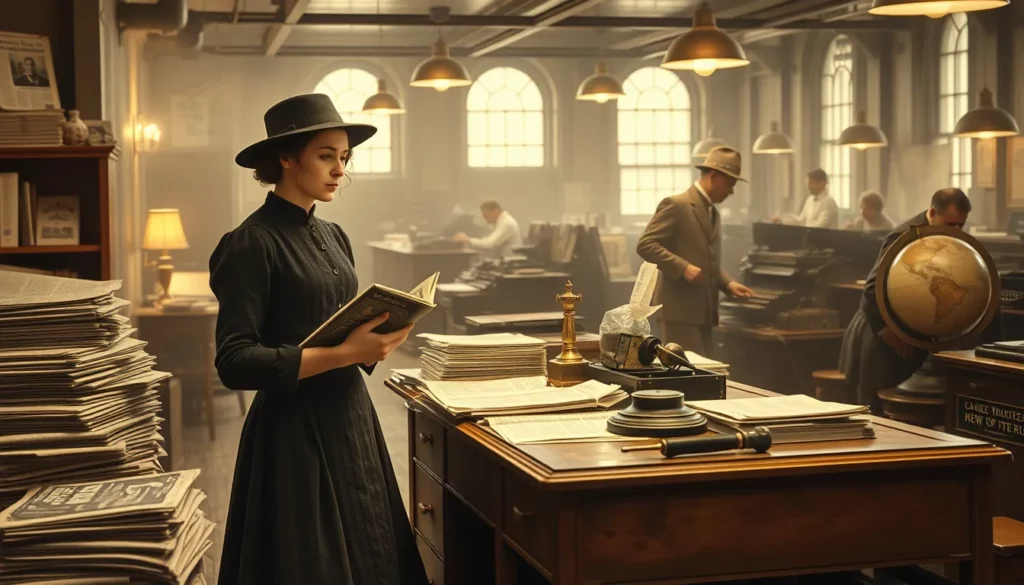
New York in the autumn of 1887 was a city of glaring contrasts: electric arc lights over Broadway, horse cars jammed with clerks and seamstresses, tenements packed with immigrants, and newspapers shouting from every corner. In the newsroom of Joseph Pulitzer’s New York World, a young woman from Pennsylvania was preparing to commit herself to an insane asylum. She was Elizabeth Jane Cochran, writing under the pen name Nellie Bly, and her assignment would become one of the defining feats of Gilded Age journalism. This article examines Nellie Bly—the reporter, not the legend—as a first-person investigator whose work gave ordinary readers a vivid, often shocking view of institutions and spectacles they could otherwise only imagine. Her stories were read as reform, as sensation, and as proof that a woman could compete in the fiercely commercial New York press.
What Happened?
Elizabeth Jane Cochran was born on May 5, 1864, in Cochran’s Mills, Pennsylvania. After a brief career as a schoolteacher, she wrote a spirited letter to the Pittsburg Dispatch in 1885 and was hired by the paper; there she adopted the pen name Nellie Bly. In 1887 she moved to New York and persuaded the New York World, then the city’s most aggressive mass-circulation daily, to take her on. Her first major assignment for the World was an undercover investigation of the Blackwell’s Island Insane Asylum for Women.
- September 24, 1887: Bly feigns insanity in New York and is committed to the asylum on Blackwell’s Island, where she spends more than a week observing conditions.
- October 9, 1887: The New York World publishes her first-person exposé, headlined “Behind Asylum Bars,” describing neglect, rough treatment, and inadequate care.
- 1887: The series is reprinted as Ten Days in a Mad-House, spreading her account to readers far beyond New York.
- November 14, 1889: Bly departs New York for a record-breaking attempt to circle the globe faster than Jules Verne’s fictional Phileas Fogg.
- January 25, 1890: She arrives in Jersey City to a large public reception, having completed the journey in just over seventy-two days.
The asylum story made Bly famous and helped prompt official scrutiny of conditions on Blackwell’s Island. The world trip made her a celebrity. Later in life she married millionaire manufacturer Robert Seaman, took over the Iron Clad Manufacturing Company after his death, patented a steel barrel, reported from Austria during World War I, and died in New York on January 27, 1922.
How It Was Seen at the Time
Contemporary readers encountered Bly as both crusader and spectacle. The World presented her asylum story as a moral service to the city: a plain woman had gone where respectable readers could not, or would not, go. The language of the day emphasized her “pluck” and “fearlessness,” words that could express admiration while still marking her as an exception in a man’s profession. The story’s power came from its first-person detail. Bly did not write as a distant reformer but as a witness who had smelled the wards, heard the locked doors, and spoken with patients.
“The insane asylum on Blackwell’s Island is a human rat-trap. It is easy to get in, but once there it is impossible to get out.” — Nellie Bly, Ten Days in a Mad-House (1887)
That line, blunt and memorable, captured the mood of outrage that followed publication. At the same time, the World sold the story as a sensation, and rival papers watched closely to see whether the “girl reporter” was a serious investigator or a circulation stunt. When Bly set out around the world in 1889, the public followed her progress through telegraph bulletins and newspaper maps; crowds gathered at stops, and readers debated whether she would beat the eighty-day mark. The trip was understood as a real-life adventure story, but it was also a commercial contest in which the World’s ingenuity and Bly’s nerve were on display.
Historical Snapshot
| Aspect | Detail |
|---|---|
| Date | 1887–1890, with the asylum exposé in 1887 and the world trip in 1889–1890 |
| Place | New York City; Blackwell’s Island; Jersey City; global travel route |
| People | Elizabeth Jane Cochran (“Nellie Bly”); Joseph Pulitzer and the New York World; asylum staff and patients; newspaper readers |
| What Happened | Bly went undercover in an asylum, published a first-person exposé, and later raced around the world in just over seventy-two days |
| Why It Mattered | It helped define investigative reporting, dramatized Gilded Age reform, and made a woman reporter a national celebrity |
Contemporary Newspaper Coverage
The New York World made Bly’s asylum story a front-page event. On October 9, 1887, it published her account under the headline “Behind Asylum Bars,” presenting her as a reporter who had risked her own freedom to document the treatment of the insane. The paper then issued Ten Days in a Mad-House, and the story circulated in other papers and in pamphlet form. Coverage emphasized the contrast between Bly’s ordinary appearance and the horror of her revelations; readers were invited to see the asylum through her eyes.
“On the 22d of September I was asked by the World if I could have myself committed to one of the asylums for the insane in New York, with a view to writing a plain and unvarnished narrative of the treatment of patients therein and the conditions existing.” — Nellie Bly, Ten Days in a Mad-House
By the time Bly returned from her world trip, newspaper coverage had become a daily serial. The Pittsburg Dispatch devoted its front page of January 26, 1890, to her reception in New Jersey, reflecting how thoroughly the local reporter had become a national story. The tone mixed boosterism, amazement, and commercial pride: here was an American woman, backed by a New York paper, beating a fictional English record.
Eyewitness Accounts
Bly’s method was to become the eyewitness. In Ten Days in a Mad-House she describes not a distant investigation but a deliberate performance of insanity that carried her through the asylum gates. Her account is both reporting and personal testimony, and its credibility rested on the details she could observe from inside.
“I was pleased with the idea, and, although it was not without its difficulties, I succeeded in accomplishing it.” — Nellie Bly, Ten Days in a Mad-House
Once inside, she recorded the routines of the wards, the behavior of attendants, and the stories of women who had no other public voice. Her eyewitness status gave the World’s campaign its emotional force: readers were not simply told that conditions were bad; they were taken into the ward with her. The same first-person style later carried readers onto steamships and railway cars as Bly raced around the globe, turning a circulation stunt into a travel narrative of endurance and curiosity.
Different Perspectives
The New York World and Its Readers
Pulitzer’s paper framed Bly as a moral investigator whose courage served the public. For readers, her stories combined reform with adventure; they could feel indignant about the asylum and thrilled by the globe-trotting race in the same newspaper. The World benefited from both the reform reputation and the circulation boom.
Nellie Bly
Bly presented herself as a plain narrator of facts. She wrote that she wanted “a plain and unvarnished narrative” of treatment and conditions, and her voice mixed indignation with close observation. She was also a career woman in a competitive industry, aware that daring assignments brought bylines, fame, and leverage.
Asylum Authorities and Medical Staff
The physicians who examined Bly while she was under cover judged her insane. When her ruse was exposed, that diagnosis became a public embarrassment and helped turn her account into a scandal. The asylum’s defenders were forced to answer her specific charges, and official inquiry followed.
Rival Newspapers
Competing papers treated the “girl reporter” as both rival and spectacle. The phrase “stunt girl” captured the era’s ambivalence: admiration for her nerve mixed with skepticism about whether a woman’s daring assignments were serious journalism or merely circulation tricks.
Common Misconceptions
How Historians See It Today
At the time, Bly’s work was understood through the era’s language of reform and sensation: a brave “girl reporter” had exposed a shameful institution and then turned a fictional challenge into a real race. Modern historians place her more firmly inside the commercial press of the Gilded Age. They emphasize that Pulitzer’s World used her stunts to build circulation, and that the same sensationalism that sold papers also generated public pressure for asylum reform. Scholars also treat Bly as a case study in women’s entry into journalism, noting how she used the era’s assumptions about female vulnerability while demonstrating professional daring.
The historiographical shift has been from a heroic, solitary-genius view of Bly to a broader account of editors, telegraph operators, agents, and readers who made her journeys possible. That does not diminish her achievement; it explains how a first-person reporter became a national event in an age of mass print.
Nellie Bly’s enduring significance lies in the way she made the Gilded Age visible to its own readers. Her asylum narrative turned a hidden institution into a public problem, and her world trip turned a newspaper stunt into a shared adventure. The primary sources—her own dispatches, the World’s headlines, the Pittsburg Dispatch’s front page—show a reporter who understood that firsthand observation could be both evidence and entertainment. They also show a society fascinated by speed, spectacle, and reform, and willing to follow a woman who went where its conventions said she should not. To read Bly today is to see the Gilded Age through the eyes of a reporter who refused to stay at a safe distance.
FAQ
Who was Nellie Bly?
Nellie Bly was the pen name of Elizabeth Jane Cochran, an American investigative journalist best known for her 1887 undercover exposé of Blackwell’s Island asylum and her 1889–1890 trip around the world in just over seventy-two days.
What did Nellie Bly expose at Blackwell’s Island?
In Ten Days in a Mad-House, Bly described neglect, rough treatment, inadequate food and heat, and the helpless condition of patients. Her first-person account prompted public outrage and official scrutiny of the asylum.
How long did Nellie Bly’s trip around the world take?
Bly completed the journey in just over seventy-two days, arriving in Jersey City on January 25, 1890. The eighty-day figure came from Jules Verne’s novel Around the World in Eighty Days, which inspired the challenge.
Was Nellie Bly her real name?
No. Nellie Bly was a pen name. She was born Elizabeth Jane Cochran and later became Elizabeth Cochrane Seaman after her marriage to Robert Seaman.






Leave a Reply