
Short Answer
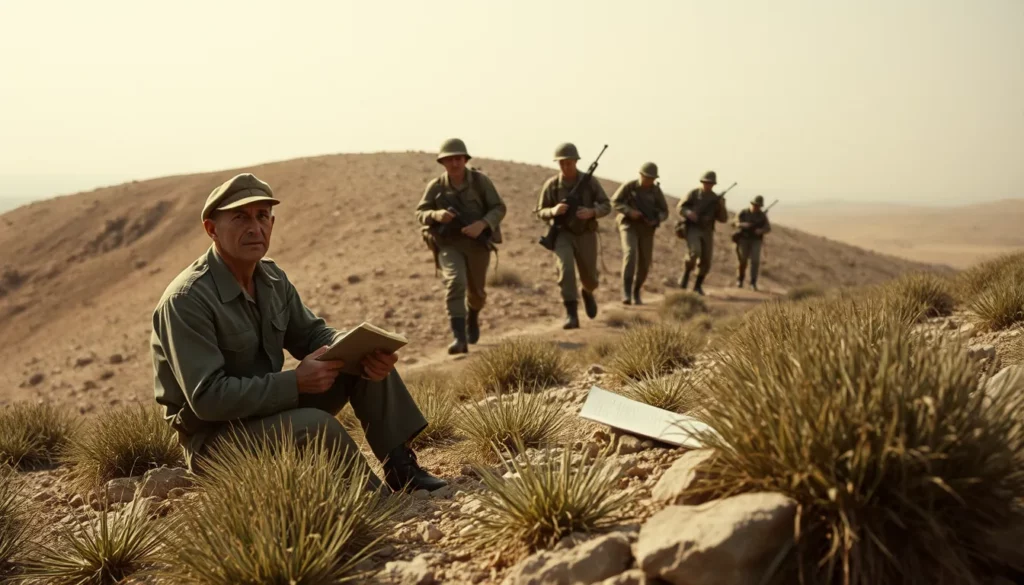
On May 2, 1943, on a rocky hillside before Mateur in northern Tunisia, Ernie Pyle sat among clumps of sword-grass and watched a thin line of American infantrymen come over a distant hill. They were fifty feet apart, loaded with machine-gun tripods and ammunition boxes, too tired to slouch. Pyle was not a soldier. He was a forty-two-year-old Scripps-Howard columnist from Dana, Indiana, wearing a correspondent’s uniform and carrying a notebook instead of a rifle. Yet the men he described were the war he had come to report. His dispatch from that hillside, later known as The God-Damned Infantry, fixed the image of Pyle as the American public’s eyewitness to the infantry’s war: the mud, the exhaustion, the unglamorous labor of men from Broadway and Main Street. For readers at kitchen tables and factory workers on lunch breaks, Pyle’s column made the distant war feel close, ordinary, and unbearable. This article follows Pyle from his prewar newspaper career to his death on Ie Shima in 1945, using his own dispatches and contemporary reporting to show how one correspondent taught Americans to see World War II through the eyes of an infantryman.
What Happened?
Ernest Taylor Pyle was born on August 3, 1900, on a rented grain farm near Dana, Indiana. He enlisted in the United States Naval Reserve in October 1918, but the armistice ended the First World War before he saw overseas service. After entering Indiana University in 1919, he worked on the campus newspaper and left before graduation to become a reporter for the LaPorte Herald-Argus. By the 1920s he had moved to the Washington Daily News, a Scripps-Howard tabloid, where he wrote an aviation column and later became managing editor. Restless by temperament, Pyle eventually returned to daily writing as a roving columnist for the Scripps-Howard chain.
When the United States entered the Second World War, Pyle became a war correspondent. He reported from England, North Africa, Italy, France, and the Pacific. His method was unusual: instead of concentrating on generals and strategy, he lived with infantrymen, engineers, medics, and truck drivers, recording their speech, food, fear, and fatigue. The May 2, 1943, column from Tunisia made his reputation. In 1944 he received the Pulitzer Prize for telegraphic reporting. He was killed by Japanese machine-gun fire on April 18, 1945, on Ie Shima, a small island near Okinawa, while accompanying American troops.
- August 3, 1900: Ernie Pyle is born near Dana, Indiana.
- October 1918: He enlists in the U.S. Naval Reserve but does not serve overseas before the armistice.
- 1919–1930s: He works as a reporter and editor for Indiana and Washington newspapers and becomes a Scripps-Howard aviation columnist.
- 1942–1943: He reports from North Africa; his May 2, 1943, infantry column becomes one of his most famous dispatches.
- 1944: He covers Italy, the Normandy campaign, and France; he wins the Pulitzer Prize for telegraphic reporting.
- April 18, 1945: He is killed on Ie Shima while reporting among front-line troops.
How It Was Seen at the Time
Contemporary readers encountered Pyle not as a strategist but as a companion. His column was syndicated by Scripps-Howard and carried in daily newspapers across the country, and his plain, self-deprecating voice seemed to bring the war home without official pomp. Pyle used the soldiers’ own language, including their bitter nickname for themselves, and he made their endurance the center of the story. His admiration was explicit:
I love the infantry because they are the underdogs. They are the mud-rain-frost-and-wind boys.
At the time, this language was praised as democratic and humane. It also carried a warning: the men who did the war’s hardest physical work were often the least visible in official communiqués. Pyle’s readers believed they were learning what the war actually felt like, even if censorship kept them from knowing exact unit locations, strengths, and casualty figures. His columns were read as letters from the front, and his byline became a guarantee of ordinary-soldier authenticity.
Historical Snapshot
| Aspect | Detail |
|---|---|
| Date | May 2, 1943, for the Tunisian infantry column; Pyle’s wartime reporting ran from 1942 to 1945. |
| Place | Northern Tunisia before Mateur; later Italy, France, and the Pacific. |
| People | Ernie Pyle, American infantrymen, Scripps-Howard editors, and a national readership. |
| What Happened | Pyle filed an eyewitness column on exhausted American infantrymen after days of fighting in the Tunisian hills. |
| Why It Mattered | The column cemented Pyle’s reputation as the voice of the ordinary soldier and shaped how Americans imagined infantry combat. |
Contemporary Newspaper Coverage
Pyle’s dispatches moved on the Scripps-Howard wire and were syndicated to papers across the United States. The May 2, 1943, column opened with a dateline that placed readers immediately in the field:
IN THE FRONT LINES BEFORE MATEUR, NORTHERN TUNISIA, May 2, 1943 — We’re now with an infantry outfit that has battled ceaselessly for four days and nights.
Editors did not need a battle map; Pyle gave them a soldier’s body. The tone was admiring but not triumphal. He described artillery as a “cauldron of fire and smoke and dirt,” then turned to the men who walked behind it. Newspaper readers met the column under Pyle’s byline in daily papers, often with simple headlines that emphasized the human cost rather than tactical gain. The soldiers’ phrase God-damned infantry became the dispatch’s remembered title, a sign of how closely Pyle’s reporting was identified with the rank and file.
Eyewitness Accounts
Pyle was an eyewitness, but he was not a neutral one. He watched the infantry from a hillside and recorded what he saw with the selective intensity of a reporter who knew his readers could not see it for themselves. In the same Tunisian dispatch he wrote:
All afternoon men keep coming round the hill and vanishing eventually over the horizon. It is one long tired line of antlike men.
He added that their faces were “black and unshaven,” and that although they were young men, “the grime and whiskers and exhaustion make them look middle-aged.” The passage was not a statistical account of troop strength. It was a deliberate attempt to make distant readers feel the weight of equipment, the rhythm of exhaustion, and the anonymity of the infantry line. Pyle’s authority came from presence: he had been there, and he reported what the men looked like as they walked.
What the Sources Got Wrong
- Place of death: Early reports and later popular retellings sometimes placed Pyle’s death on Okinawa. He was killed on Ie Shima, a small island near Okinawa, while with American troops in April 1945.
- Civilian status: Popular memory often turns Pyle into an infantryman. He was a civilian correspondent; his authority came from living with infantrymen, not from carrying a rifle.
- Completeness: Wartime censorship meant Pyle could not disclose precise unit locations, strengths, or full casualty figures. Readers received a soldier’s-eye view, not a complete operational account.
- Literary compression: Pyle’s “long tired line” was an eyewitness impression, not a census. His columns used selected detail and emotional pacing to convey truth rather than tabulate it.
Aftermath
Pyle was killed on April 18, 1945, by Japanese machine-gun fire on Ie Shima. He was buried there, and his remains were later moved to the National Memorial Cemetery of the Pacific in Honolulu. His death was reported to a public that had come to regard him as a trusted interpreter of the war. For many readers, the loss was personal: the man who had explained the infantry to them had now died among infantrymen. His books Here Is Your War and Brave Men kept his dispatches in circulation, and his name became attached to memorials, scholarships, and later journalism awards.
How Historians See It Today
Contemporaries saw Pyle as a folk hero and the ordinary soldier’s spokesman. Modern historians treat his columns as both primary evidence and crafted journalism. They are valuable for studying morale, combat fatigue, small-unit life, and the relationship between the press and the military. But scholars also note Pyle’s selectivity, his sentimental streak, and his dependence on censorship and unit escorts. He did not write operational history, and his soldier’s-eye view could not represent the whole war. His reputation has survived because he wrote about the men who fought rather than the generals who directed them, and because his dispatches preserve the texture of infantry experience in language that contemporaries recognized as true.
Pyle’s columns remain powerful because they do not pretend to be complete. They show a war filtered through exhaustion, friendship, and grief, and they remind us that the most durable wartime reporting often comes from close observation rather than grand explanation. The primary sources he left behind—syndicated dispatches, books, and the memories of the soldiers who read him—teach that the infantry’s war was won by ordinary men whose world was often invisible to those at home.
FAQ
Who was Ernie Pyle?
Ernie Pyle was an American newspaper columnist and World War II correspondent for the Scripps-Howard chain. He became famous for reporting on ordinary infantrymen rather than generals and strategy, and he won the Pulitzer Prize for telegraphic reporting in 1944.
What made Ernie Pyle’s reporting distinctive?
Pyle lived with front-line troops and wrote about their daily experience: exhaustion, food, fear, equipment, and grief. His plain, sympathetic style made the war feel immediate to readers at home, and his columns were syndicated in newspapers across the United States.
How did Ernie Pyle die?
Pyle was killed on April 18, 1945, by Japanese machine-gun fire on Ie Shima, a small island near Okinawa, while accompanying American troops. He was buried there and later reinterred at the National Memorial Cemetery of the Pacific in Honolulu.




Leave a Reply