
Short Answer
Quick Snapshot
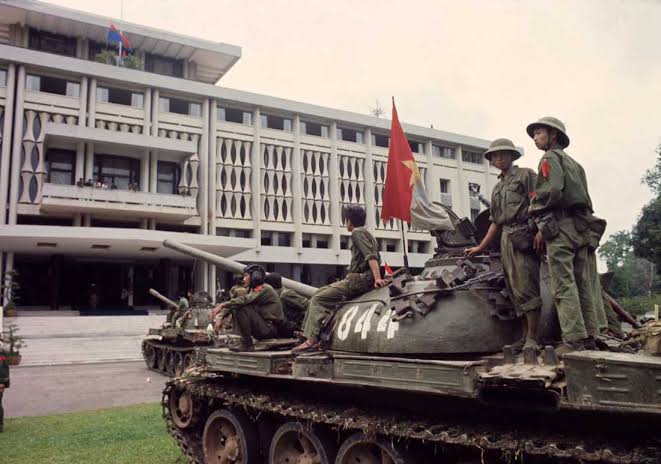
In 1975, Saigon—the capital of the Republic of Vietnam (South Vietnam)—stood at the precipice of annihilation. For two decades, the city had been the political, economic, and cultural heart of a nation locked in a bitter Cold War struggle. By the spring of that year, the North Vietnamese People’s Army of Vietnam (PAVN) had launched its final, decisive offensive, and the city’s fate was sealed. On April 30, 1975, North Vietnamese tanks crashed through the gates of the Presidential Palace, and President Dương Văn Minh surrendered unconditionally, ending the Vietnam War and bringing the existence of South Vietnam to a close.
The year was defined by chaos, desperation, and the largest helicopter evacuation in history. Operation Frequent Wind, conducted on April 29–30, airlifted nearly all American civilian and military personnel out of the city, along with more than 130,000 Vietnamese who had allied themselves with the United States. The iconic photograph of evacuees scrambling up a ladder to a helicopter on the roof of the Pittman Apartments at 22 Gia Long Street came to symbolize the desperate final hours of a city—and a nation—on the brink of collapse.
Saigon in 1975
Saigon, situated on the banks of the Saigon River in the Mekong Delta region, was a bustling metropolis of wide boulevards, French colonial architecture, and a tropical climate that saw temperatures hover in the 80s and 90s Fahrenheit year-round. The city’s atmosphere in early 1975 was one of uneasy tension. The Paris Peace Accords of January 1973 had formally ended U.S. military involvement, but the war had never truly stopped. By the beginning of 1975, the balance of forces had shifted decisively: North Vietnam fielded approximately 305,000 soldiers, 600 armored vehicles, and 490 heavy artillery pieces in the South, while the Army of the Republic of Vietnam (ARVN) boasted a nominal strength of 1.0 million soldiers, 1,200 to 1,400 tanks, and more than 1,000 heavy artillery pieces. Yet the ARVN’s numerical advantage masked deep problems of morale, leadership, and supply.
The city itself was a paradox—gleaming high-rises and luxury hotels stood alongside sprawling slums, and the streets teemed with motorbikes, bicycles, and pedicabs. Cafés, bars, and markets hummed with activity even as the war crept closer. By late April, refugees from the Central Highlands and northern provinces flooded the city, doubling its population almost overnight and straining every resource to the breaking point.
Population & Economy
Saigon’s pre-offensive population was estimated at roughly 2 to 3 million, but by late April 1975, that number had swelled dramatically as hundreds of thousands of refugees fled the advancing PAVN forces. The city’s economy, long dependent on U.S. military spending and aid, was in a state of collapse. The American withdrawal in 1973 had already gutted the service sector, and by 1975, inflation was rampant, the South Vietnamese đồng had lost most of its value, and unemployment had soared. Black markets flourished, and the gap between the wealthy elite—who lived in villas with servants—and the urban poor was stark.
Key economic drivers included the port of Saigon, which handled most of the country’s imports and exports, and a modest industrial base of textile mills, breweries, and food-processing plants. The war economy, however, dominated everything: U.S. dollars, military contracts, and the black market in goods and currency were the lifeblood of the city.
Government & Politics
In 1975, the government of South Vietnam was in a terminal crisis. President Nguyễn Văn Thiệu had ruled since 1967, but his authority crumbled as the military situation deteriorated. After the fall of Buôn Ma Thuột on March 18, Thiệu ordered a disastrous strategic withdrawal from the Central Highlands, which turned into a rout. By April 21, Thiệu resigned, fleeing to Taiwan, and was replaced by Vice President Trần Văn Hương. Hương lasted only days before handing power to General Dương Văn Minh, who was seen as a potential figurehead for a negotiated settlement. Minh’s surrender on April 30 marked the definitive end of the Republic of Vietnam.
On the other side, the Provisional Revolutionary Government (PRG) of the Republic of South Vietnam, the political arm of the Viet Cong, was poised to take over. In the final days, the U.S. Embassy in Saigon became the focal point of American diplomatic efforts, as Ambassador Graham Martin oversaw the evacuation.
Industry
Saigon’s industrial sector was small but significant in the context of Southeast Asia. The city was home to breweries (including the famous Bia 33), cigarette factories, textile mills, and assembly plants for consumer goods. The port of Saigon was the nation’s commercial gateway, handling rice exports, rubber, and other agricultural products from the Mekong Delta. The war economy, however, had created a vast service industry catering to American soldiers and civilians: bars, restaurants, hotels, and entertainment venues proliferated. The departure of U.S. forces in 1973 had already caused a severe contraction, and by 1975 many businesses were shuttered or operating at a fraction of their capacity.
Education
Saigon was home to the University of Saigon, the nation’s largest institution of higher learning, along with numerous secondary schools, technical institutes, and private academies. The war had disrupted education for years, with many students conscripted into the military or forced to flee the countryside. Literacy rates in South Vietnam were relatively high compared to the North, but the chaos of 1975 brought the academic year to an abrupt halt. Schools closed in late April as the fighting reached the city’s outskirts, and many teachers and students joined the exodus of refugees.
Transportation
Saigon’s transportation network was a mix of modern and traditional. The city had a network of paved boulevards, including the famous Đồng Khởi Street (formerly Rue Catinat), and a busy port that connected it to the rest of the world. Tan Son Nhut Airport, just north of the city, was one of the busiest airports in Southeast Asia and became the focal point of the American evacuation. Within the city, motorbikes and bicycles were the primary means of personal transport, alongside buses, taxis, and the ubiquitous cyclos (pedicabs). The roads were clogged with refugees in the final weeks of April, and the highway to the coast became a scene of horror as the ARVN’s retreat turned into a massacre.
Everyday Life
Daily life in Saigon in 1975 was a study in contrasts. The wealthy dined in French restaurants and shopped in air-conditioned boutiques, while the poor struggled to find food and shelter. The city’s famous street markets—like Ben Thanh Market—remained open, though prices soared and goods grew scarce. Clothing was a mix of Western styles (jeans, t-shirts, and dresses) and traditional Vietnamese attire (the áo dài). Entertainment included cinemas showing American and French films, nightclubs with live music, and the ever-present street food stalls selling phở, bánh mì, and other staples. Family life was deeply traditional, with extended families often living together in the same household, but the war had torn millions of families apart. As the North Vietnamese forces closed in, the city descended into panic, with looting, gunfire, and desperate scenes at the airport and embassy.
Major Events
- December 1974 – January 1975: PAVN forces crossed from Cambodia and captured Phước Long Province, the first provincial capital to fall.
- March 1975: The Spring Offensive began in earnest; PAVN forces attacked the Central Highlands.
- March 18: The city of Buôn Ma Thuột fell to the PAVN.
- April 17: Phnom Penh, the capital of Cambodia, fell to the Khmer Rouge.
- April 21: President Thiệu resigned and fled the country.
- April 29–30: Operation Frequent Wind evacuated American personnel and Vietnamese allies; the PAVN launched the final assault on Saigon.
- April 30: President Dương Văn Minh surrendered; PAVN tanks entered the Presidential Palace; the VC flag was raised.
- December 2: The Pathet Lao took over the government of Laos, completing the communist conquest of Indochina.
What Newspapers Were Reporting
In the final weeks of April 1975, Saigon’s newspapers—including the English-language Saigon Post and the Vietnamese-language dailies—were filled with contradictory reports. Official communiqués insisted that the ARVN was holding the line, but the headlines told a different story. The Saigon Post reported on the fall of provincial capitals and the growing refugee crisis. American newspapers, including The New York Times and The Washington Post, carried front-page stories on the collapse of South Vietnam, with correspondents like Malcolm Browne and Peter Arnett filing dispatches from the besieged city. The famous photograph taken by Hubert van Es, showing evacuees on the roof of the Pittman Apartments, was published worldwide and became one of the defining images of the era.
What People Were Talking About
In the streets of Saigon, the talk was of escape. Families debated whether to flee by boat, by plane, or overland to the coast. Many sought the help of American friends or employers to secure a place on an evacuation flight. Others, believing the rumors of a “bloodbath” to come, chose to stay. Among the American community, there was a sense of betrayal and abandonment. CIA operatives and embassy staff worked frantically to destroy documents and evacuate their Vietnamese contacts. The atmosphere was one of fear, uncertainty, and, for some, resignation.
Historical Photographs
The visual record of Saigon in 1975 is dominated by the evacuation. Hubert van Es’s photograph of evacuees on the roof of the Pittman Apartments is the most famous, but there are many others: U.S. Marines guarding the embassy compound, helicopters hovering over the city, crowds of Vietnamese pressing against the embassy gates, and the final image of North Vietnamese tanks rolling through the gates of the Presidential Palace. These photographs, taken by journalists and military personnel, capture the chaos, desperation, and ultimate triumph of the North Vietnamese forces.
Documents & Primary Sources
Historians studying Saigon in 1975 rely on a range of primary sources: the daily reports and cables of the U.S. Embassy, which are housed in the National Archives; the personal papers of Ambassador Graham Martin and other officials; the photographs and films of the evacuation; the transcripts of radio broadcasts from the final days; and the memoirs of participants, including General Văn Tiến Dũng’s account of the Spring Offensive. The Vietnamese side is documented in the archives of the People’s Army of Vietnam and the Provisional Revolutionary Government, which are gradually being opened to researchers.
1975 Timeline
| Date | Event |
|---|---|
| January 6, 1975 | Phước Long Province falls to the PAVN. |
| March 10–18 | Spring Offensive: Buôn Ma Thuột falls; ARVN begins disastrous retreat. |
| April 17 | Phnom Penh falls to the Khmer Rouge. |
| April 21 | President Thiệu resigns and flees. |
| April 29 | Operation Frequent Wind begins; PAVN shelling of Saigon. |
| April 30 | President Minh surrenders; PAVN occupies Saigon. |
| December 2 | Pathet Lao takes power in Laos. |
What Changed Next
The fall of Saigon on April 30, 1975, marked the end of the Vietnam War and the beginning of a new era. The city was renamed Ho Chi Minh City in 1976, and the country was formally reunified under communist rule. The transition was brutal: hundreds of thousands of South Vietnamese were sent to “re-education camps,” and millions fled the country as “boat people” in the years that followed. The economy was centralized, and private enterprise was suppressed. The United States, humiliated by its defeat, entered a period of introspection, and the war’s legacy continues to shape American foreign policy to this day.
FAQ
What was the population of Saigon in 1975?
Saigon's pre-offensive population was estimated at roughly 2 to 3 million, but by late April 1975 it swelled dramatically as hundreds of thousands of refugees fled the advancing North Vietnamese forces.
What major events happened in Saigon in 1975?
The most significant events were the PAVN's Spring Offensive (March), the fall of Buôn Ma Thuột (March 18), Operation Frequent Wind evacuation (April 29–30), and the surrender of President Dương Văn Minh on April 30, which ended the Vietnam War.
What primary sources are available for studying Saigon in 1975?
Key primary sources include U.S. Embassy cables and reports (National Archives), photographs by Hubert van Es and others, radio broadcast transcripts, personal memoirs of participants, and archives of the People's Army of Vietnam and the Provisional Revolutionary Government.
How did daily life in Saigon in 1975 differ from today?
Daily life was dominated by the war: food and goods were scarce, inflation was rampant, and the city was flooded with refugees. Entertainment was limited to cinemas, nightclubs, and street markets, and the constant threat of violence overshadowed everything. Today, Ho Chi Minh City is a thriving economic hub with a much more stable and prosperous daily life.







Leave a Reply