
Short Answer
Quick Snapshot
In 1961, Berlin stood as the most volatile flashpoint of the Cold War. The city, still bearing the scars of World War II, was divided into four sectors controlled by the Allied powers—the United States, Britain, France, and the Soviet Union. The year began with escalating tensions as Soviet Premier Nikita Khrushchev renewed demands for the withdrawal of Western troops from West Berlin. By August, the East German government, backed by Moscow, sealed the border between East and West Berlin with barbed wire and concrete, erecting the Berlin Wall. This physical division would last 28 years and reshape the city’s identity.
For Berliners, 1961 was a year of fear, uncertainty, and dramatic change. West Berlin, a capitalist enclave surrounded by communist East Germany, experienced a booming economy and cultural vitality, while East Berlin languished under Soviet-style socialism. The refugee crisis—thousands of East Germans fleeing to the West daily—triggered the construction of the Wall, which turned a permeable border into a fortified frontier. The world watched as tanks faced off at Checkpoint Charlie in October, bringing the superpowers to the brink of war.
Berlin in 1961
Berlin lies in northeastern Germany, straddling the River Spree. In 1961, the city was a sprawling urban landscape of rebuilt structures and war-torn ruins, with a stark contrast between the gleaming new buildings of West Berlin and the gray, neglected facades of East Berlin. The climate was temperate, with cold winters and mild summers; August 1961 saw warm days that turned into a fateful night of military maneuvers.
The atmosphere was charged with political tension. The city was a microcosm of the Cold War, where spies, diplomats, and soldiers coexisted with ordinary citizens. The Brandenburg Gate, once a symbol of unity, became a focal point of division. Barbed wire barriers and armed guards defined the border, while West Berliners gathered on their side to protest the closure. The city’s physical layout—its streets, squares, and transit lines—became a chessboard for superpower rivalry.
Population & Economy
In 1961, Berlin had an estimated population of 3.3 million, with West Berlin home to about 2.2 million and East Berlin about 1.1 million. The city’s demographic makeup reflected the wartime losses and postwar migration. West Berlin attracted refugees from the East, many of them young and skilled, contributing to a dynamic labor force. East Berlin experienced a brain drain as professionals, engineers, and academics fled to the West, a major factor behind the Wall’s construction.
The economy of West Berlin was heavily subsidized by the Federal Republic of Germany and the Marshall Plan. Key industries included electrical engineering, machinery, and chemicals, with companies like Siemens and AEG operating in the western sectors. East Berlin’s economy was state-controlled, focusing on heavy industry and manufacturing, but suffered from inefficiency and shortages. The cost of living differed sharply: in West Berlin, a loaf of bread cost about 0.30 Deutsche Mark, while in East Berlin it was 0.50 East German Mark, but with limited availability and lower wages. Rent in West Berlin averaged 120 DM per month, while East Berlin offered subsidized housing at 40 East German Marks.
Government & Politics
Berlin’s governance was fragmented. West Berlin was an autonomous city-state within the Federal Republic, with Willy Brandt serving as Governing Mayor. Brandt, a Social Democrat, became a symbol of Western resistance to Soviet pressure. East Berlin was the capital of the German Democratic Republic (GDR), with Friedrich Ebert Jr. as Lord Mayor, but real power lay with the Socialist Unity Party (SED) under Walter Ulbricht. The city’s four-power status meant that Allied military commanders retained ultimate authority, but in practice, the sectors operated independently.
The political climate in 1961 was dominated by the Berlin Crisis. Khrushchev’s ultimatum at the Vienna summit in June demanded a peace treaty that would sever West Berlin’s ties to the West. President John F. Kennedy responded by reaffirming Western resolve, but the East German government, with Soviet approval, acted unilaterally to close the border on August 13. The crisis peaked in October when U.S. and Soviet tanks faced each other at Checkpoint Charlie, a standoff that ended after 16 hours of tense negotiation.
Industry
West Berlin’s industrial base was diverse and technologically advanced. The Siemensstadt district housed the massive Siemens electrical works, employing tens of thousands. Other major firms included AEG, Schering pharmaceuticals, and Borsig locomotive works. These industries benefited from tax breaks and subsidies, making West Berlin a manufacturing hub despite its isolated location. East Berlin’s industry was concentrated in state-owned combines (VEBs), producing goods for the Eastern Bloc. The VEB Berliner Glühlampenwerk made light bulbs, while the VEB Kabelwerk Oberspree produced cables. However, production was hampered by outdated machinery and lack of raw materials.
The refugee exodus severely impacted East Berlin’s industry, as skilled workers left in droves. In the first half of 1961, over 200,000 people fled East Germany through Berlin, many from industrial sectors. This labor shortage was a direct cause of the Wall, as the GDR sought to stop the hemorrhage.
Education
Berlin had a rich educational landscape. West Berlin boasted the Free University of Berlin, founded in 1948 as a response to communist influence at the historic Humboldt University. The Technical University of Berlin also operated in the West, offering engineering and applied sciences. East Berlin’s Humboldt University remained under state control, with ideological indoctrination in the curriculum. Primary and secondary schools were segregated by sector; West Berlin followed the West German system, while East Berlin implemented a unified socialist school system emphasizing Marxism-Leninism.
Literacy rates were nearly universal, but educational opportunities diverged. In East Berlin, students were required to join the Free German Youth (FDJ) and participate in political activities. In West Berlin, universities attracted international students and scholars, fostering a vibrant intellectual climate. The Berlin crisis affected education as well; many East German teachers and professors fled to the West, leaving vacancies.
Transportation
Berlin’s transportation network was extensive but divided. The S-Bahn (suburban railway) and U-Bahn (underground) crossed sector borders, but after August 13, many lines were severed. West Berlin relied on its own bus and tram systems, while East Berlin operated separate services. The famous elevated railway, the Berlin Stadtbahn, became a symbol of division as stations were closed or transformed into ghost stations.
Roads and highways connected Berlin to West Germany via transit corridors through East German territory. The Helmstedt–Marienborn autobahn was the main route. Air travel was crucial: Berlin Tempelhof Airport in the West handled cargo and passenger flights, while Tegel Airport was under construction. The Berlin Airlift of 1948-49 had established a precedent for Western access, and in 1961, the Allies maintained air corridors to guarantee supplies.
Everyday Life
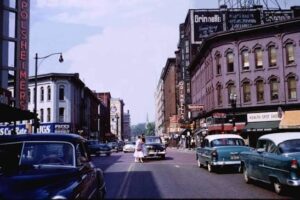
Daily life in Berlin in 1961 was shaped by the political divide. West Berliners enjoyed a consumer culture with modern shops, cafes, and cinemas. The Kurfürstendamm boulevard was a hub of activity, with neon lights and international brands. Housing varied from rebuilt apartments to pre-war buildings; many residents lived in cramped conditions, but the standard of living was rising. Food was abundant, with supermarkets offering goods from West Germany.
East Berliners faced shortages and surveillance. Shops stocked limited goods, and queues were common. The state provided basic housing, but buildings were often dilapidated. Clothing was functional, and Western fashions were frowned upon. Entertainment included state-controlled theaters and cinemas, but many East Berliners secretly watched West German television and listened to Western radio. The border closure on August 13 abruptly ended the daily commute of East Berliners who worked in the West, leaving thousands stranded and separated from families.
Major Events
The defining event of 1961 was the construction of the Berlin Wall. On the night of August 12-13, East German troops and police sealed the border, laying barbed wire and concrete blocks. The world woke to a divided city. The crisis escalated in June with the Vienna summit between Kennedy and Khrushchev, where the Soviet leader issued an ultimatum. In October, U.S. and Soviet tanks confronted each other at Checkpoint Charlie, a tense standoff that lasted 16 hours. Other events included the opening of the Berlin Wall’s first checkpoints, the escape attempts and shootings at the border, and the diplomatic negotiations that ultimately left Berlin divided.
What Newspapers Were Reporting
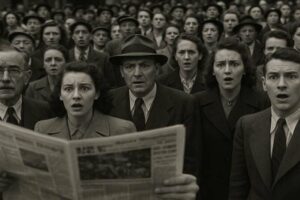
Newspapers around the world covered the Berlin Crisis extensively. The New York Times ran headlines like “East Germany Seals Off Berlin Border” and “Tanks Face Each Other at Checkpoint.” The Times of London reported on the refugee exodus and the Western response. West Berlin’s Der Tagesspiegel published editions on August 13 with the stark headline “The Border is Closed.” The BBC’s On This Day report quoted West German Chancellor Konrad Adenauer: “They are and remain our German brothers and sisters.” East German newspapers, controlled by the SED, justified the Wall as an “anti-fascist protective barrier.”
What People Were Talking About
Berliners talked of fear and separation. Letters and diaries from the period reveal anxiety about the future. West Berliners expressed solidarity with those trapped in the East, while East Berliners spoke of shock and despair. At the border, families were torn apart overnight. Eyewitness accounts describe people jumping from windows to escape, and the first fatalities occurred as border guards opened fire. The international community debated the legality of the Wall, but the superpowers avoided direct conflict. In the West, there was a sense of relief that the crisis did not escalate into war, but also anger at the permanent division.
Historical Photographs
The visual record of Berlin in 1961 is powerful. Photographs show the Brandenburg Gate with barbed wire strung across its columns, the first concrete slabs being placed, and crowds gathering on the Western side. Famous images include the iconic photo of East German soldiers building the Wall, and the October standoff at Checkpoint Charlie with American and Soviet tanks facing each other. Photographers like Peter Leibing captured the leap of East German police officer Conrad Schumann over the barbed wire to freedom. These photographs, published in Life magazine and newspapers, became symbols of the Cold War.
Documents & Primary Sources
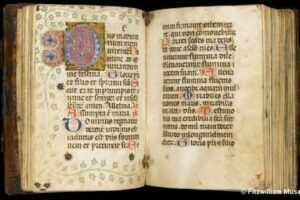
Historians rely on a wealth of primary sources. The National Archives and Records Administration (NARA) and the CIA have declassified documents from the Berlin Crisis, including intelligence reports, diplomatic cables, and military plans. The Department of State’s 600-page report on the crisis, released later, provides a detailed account. Personal letters and diaries of Berliners are preserved in archives like the Berlin Landesarchiv. Photographs, film footage, and radio broadcasts offer direct evidence. The East German Stasi records document surveillance and the regime’s perspective. The Berlin Wall Memorial and the Allied Museum in Berlin hold artifacts and testimonies.
1961 Timeline
| Date | Event |
|---|---|
| June 4 | Vienna summit between Kennedy and Khrushchev; Khrushchev issues ultimatum on Berlin |
| July 25 | Kennedy announces military buildup and declares U.S. resolve to defend West Berlin |
| August 12-13 | East Germany seals border; construction of Berlin Wall begins |
| August 13 | Berliners wake to a divided city; protests in West Berlin |
| August 15 | East German border guard Conrad Schumann defects to the West |
| October 22-28 | Standoff at Checkpoint Charlie between U.S. and Soviet tanks |
| November 9 | Crisis officially ends with a stalemate; Wall remains |
What Changed Next
The Berlin Wall became a permanent fixture, dividing the city for 28 years. The crisis solidified the Cold War order, with Germany remaining split into two states. West Berlin thrived as a showcase of capitalism, while East Berlin stagnated under communist rule. The Wall became a symbol of oppression, and its fall in 1989 was a pivotal moment in ending the Cold War. In 1961, the immediate consequence was a halt to the refugee exodus, but the long-term effect was the physical and ideological separation of families and communities. The events of 1961 also influenced NATO strategy and the arms race, leading to a period of détente later.
FAQ
What was the population of Berlin in 1961?
Berlin had an estimated population of 3.3 million, with West Berlin at about 2.2 million and East Berlin at about 1.1 million.
What major events happened in Berlin in 1961?
The most significant event was the construction of the Berlin Wall on August 13, 1961, which divided the city. Other events included the Vienna summit in June and the Checkpoint Charlie standoff in October.
What primary sources are available for studying Berlin in 1961?
Primary sources include declassified documents from the National Archives and CIA, diplomatic cables, intelligence reports, personal letters and diaries, photographs, film footage, and newspaper articles from the period.
How did daily life in Berlin in 1961 differ from today?
Daily life was heavily influenced by the Cold War division. West Berlin had a consumer economy, while East Berlin faced shortages and surveillance. The border closure separated families and restricted movement. Today, Berlin is a united city with a vibrant cultural scene, and the Wall is largely gone.



Leave a Reply