
Short Answer
Quick Snapshot
1945 was the year Germany collapsed and was reborn. The Nazi regime, which had plunged Europe into war, crumbled in the spring as Allied forces converged from east and west. Adolf Hitler’s suicide on April 30 marked the symbolic end of the Third Reich, and the unconditional surrender signed on May 8 brought the war in Europe to a close. Germany lay in ruins—its cities bombed, its economy shattered, and its population displaced. Yet from the ashes, the foundations of a new Germany began to emerge under Allied occupation.
The transformation was total. In January, German forces were still fighting on multiple fronts; by May, the country was occupied territory divided into zones controlled by the Soviet Union, the United States, Britain, and France. The Allied Control Council, comprising Marshal Georgy Zhukov, General Dwight D. Eisenhower, Field Marshal Bernard Montgomery, and General Jean de Lattre de Tassigny, assumed supreme authority. For ordinary Germans, 1945 was a year of survival—of finding food, shelter, and missing family members amid the rubble of a nation that had lost everything.
Germany in 1945
The geography of Germany in 1945 was one of devastation. Allied bombing had reduced major cities like Berlin, Hamburg, and Dresden to rubble. The country itself was a battlefield, with the Red Army advancing from the east and American, British, and French forces pushing from the west. The winter of 1944–45 was harsh, compounding the suffering of a population already facing food shortages and homelessness. By May, the nation was occupied territory, its borders redrawn and its future uncertain.
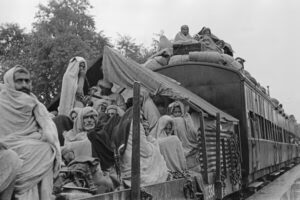
The atmosphere was one of exhaustion and dread mixed with cautious hope. In the East, civilians fled the advancing Red Army in terror, while in the West, many Germans awaited the arrival of American and British troops with a mixture of fear and relief. The landscape was littered with the detritus of war—abandoned tanks, bombed-out buildings, and endless columns of refugees. The country that had once been the industrial heart of Europe was now a vast ruin.
Population & Economy
Germany’s population in 1945 was approximately 66 million, down from about 69 million at the start of the war. Millions of soldiers were dead or in prisoner-of-war camps, and millions of civilians had fled or been expelled from the eastern territories as the Red Army advanced. The economy was in ruins. War production had consumed everything, and the transportation network was destroyed. The black market thrived, and the Reichsmark was nearly worthless—cigarettes often served as a more reliable currency than paper money.
Food rationing continued under Allied occupation, with daily caloric intake often falling below subsistence levels. In the industrial cities, many residents survived on whatever they could scavenge or grow in garden plots. Unemployment was massive, as factories lay idle and the war economy had collapsed. The cost of living was measured in survival terms: a loaf of bread might cost a week’s wages on the black market, and housing was scarce with millions of homes destroyed by bombing.
Government & Politics
The political structure of Germany underwent a dramatic transformation in 1945. Until April 30, Adolf Hitler ruled as Führer. After his suicide, Karl Dönitz briefly served as President, with Joseph Goebbels as Chancellor for a single day before his own suicide on May 1. Lutz Graf Schwerin von Krosigk then led the government as leading minister until May 23, when the Dönitz government was dissolved. The Allied Control Council—comprising Zhukov, Eisenhower, Montgomery, and de Lattre de Tassigny—assumed supreme authority over Germany.
The political climate was one of total rupture. The Nazi Party was banned, and the process of denazification began, removing former party members from positions of power. In the Soviet zone, the KPD (Communist Party) was quickly revived, while in the Western zones, the SPD and the new CDU began to organize. The Potsdam Conference in July–August laid out the principles for Germany’s occupation: democratization, denazification, demilitarization, and decentralization.
Industry
German industry in 1945 was largely destroyed or shut down. The Krupp works in Essen, the I.G. Farben chemical plants, and countless factories lay in ruins from Allied bombing. What remained was dismantled by the Allies as reparations, particularly in the Soviet zone where entire factories were shipped east. The immediate priority was survival—agriculture and basic food production. Under occupation, the Allies began the process of restructuring German industry away from war production toward civilian needs.
In the Ruhr, the industrial heartland, coal mines were flooded and steel mills were silent. The reconstruction of German industry would not truly begin until the Marshall Plan in 1948, but in 1945, the foundations were being laid as the Allies debated how to manage the German economy. The Soviet Union pushed for heavy reparations, while the Western powers began to recognize that a functioning German economy was essential for European recovery.
Education
The German education system had been thoroughly Nazified since 1933. In 1945, schools were closed across the country as the war ended. Many teachers had been Nazi party members and were removed from their positions during denazification. The Allied occupation authorities, particularly in the Western zones, worked to reopen schools with new curricula emphasizing democracy and anti-Nazi values. However, progress was slow, and many children spent the year in makeshift classrooms or none at all.
Textbooks had to be rewritten, as the Nazi-era materials were filled with racial ideology and militarism. In the Soviet zone, schools were quickly reopened with a Marxist-Leninist orientation, while in the Western zones, the emphasis was on democratic citizenship. Literacy rates remained high—Germany had a long tradition of universal education—but the content and purpose of education were being fundamentally redefined.
Transportation
Germany’s transportation infrastructure was devastated. The Reichsbahn railway network was severely damaged by bombing, and many bridges and tracks were destroyed. Roads were clogged with refugees and displaced persons. Fuel was scarce, and most private vehicles had been confiscated for the war effort. In the immediate postwar months, transportation was primarily by foot, bicycle, or horse-drawn cart. The Allies prioritized repairing railways and roads for military and humanitarian purposes.
By the end of 1945, some rail service had been restored, but it was unreliable and overcrowded. The famous Autobahn network, built in the 1930s, had been damaged by bombing and was often used as makeshift airstrips by the Allies. In the cities, streetcars were slowly brought back into service, but most Germans walked everywhere, often through streets still littered with rubble.
Everyday Life
Daily life in 1945 Germany was a struggle for survival. Housing was scarce, as bombing had destroyed millions of homes. Many families lived in cellars, in partially ruined buildings, or with relatives. Food was rationed, and many people relied on black market exchanges or foraged in the countryside. Clothing was patched and reused, and shoes were often made from wood or old tires. Entertainment was minimal, though some cinemas reopened under Allied control, showing newsreels of the war’s end and the liberation of concentration camps.
Family life was disrupted—women often managed households alone while men were at war, in prison camps, or dead. The arrival of Allied troops brought both relief and anxiety, particularly in the Soviet zone where reports of atrocities circulated. The so-called Trümmerfrauen (rubble women) became a symbol of the era, as women cleared bricks and debris from the streets by hand. Despite the hardship, there was also a sense of relief that the war was over and a cautious hope for the future.
Major Events
The defining event of 1945 was the unconditional surrender of the German Wehrmacht. Signed at Allied headquarters in Reims, France, on May 7 by Colonel General Alfred Jodl, the surrender established the cessation of hostilities at 11:01 p.m. on May 8. Required to re-sign with representatives of all the Allied militaries, including the Soviet Union, the German command repeated the ceremony at Red Army headquarters in Berlin-Karlshorst. Due to time zone differences, the date was May 9 in Moscow, explaining why Russia and the West celebrate the end of the war on different days.
Earlier in the year, the Soviet Union launched the Vistula-Oder Offensive on January 12, pushing deep into German territory. On January 27, Soviet forces liberated the Auschwitz concentration camp, revealing the horrors of the Holocaust to the world. More than 80,000 Jews had been freed in Budapest on January 6 by Russian soldiers. The year also saw the Potsdam Conference (July 17–August 2), where Truman, Stalin, and Attlee agreed on the framework for occupied Germany.
What Newspapers Were Reporting
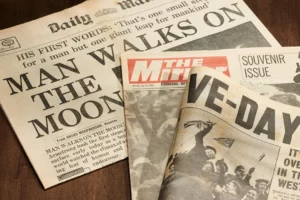
The Nazi press, including the Völkischer Beobachter, continued to print propaganda until the regime’s collapse, reporting on “final victory” even as the Allies closed in. After the surrender, Allied occupation authorities shut down all German newspapers and established new ones. The Frankfurter Rundschau, licensed by the American occupation forces, was among the first new newspapers to appear, reporting on the tasks of reconstruction and the upcoming Nuremberg trials. Headlines in the autumn of 1945 focused on food shortages, the return of prisoners of war, and the proceedings of the International Military Tribunal, which began in November.
In the Soviet zone, newspapers like the Berliner Zeitung were re-established under Soviet license, promoting the Communist Party’s vision for Germany. The contrast between the Western and Eastern press reflected the emerging divisions of the Cold War.
What People Were Talking About
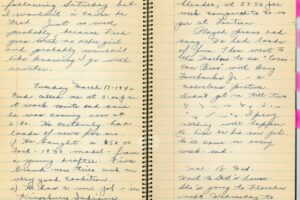
According to letters and diaries from the period, Germans in 1945 talked about survival above all—where to find food, whether homes would be rebuilt, and the fate of missing family members. In the East, there was widespread fear of the Red Army, stoked by Nazi propaganda and confirmed by real atrocities. In the West, there was a sense of relief mixed with shame as the scale of Nazi crimes became known. Many Germans claimed ignorance of the Holocaust, a claim that would be challenged in the years to come.
There was also talk of guilt and responsibility. The philosopher Karl Jaspers, in his lectures at Heidelberg, addressed the question of German collective guilt, a topic that would dominate intellectual discourse in the postwar years. For many ordinary Germans, the immediate concern was more practical: how to feed their families and rebuild their lives in a country that had lost everything.
Historical Photographs
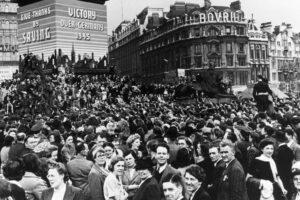
The visual record of Germany in 1945 is extensive. Photographs show the ruins of Berlin, including the bombed-out Reichstag, the Brandenburg Gate scarred by battle, and piles of rubble where buildings once stood. Images of refugees trudging along roads with their belongings, of Allied soldiers posing with German civilians, and of the liberation of concentration camps are among the most powerful. The signing of the surrender at Reims and Berlin-Karlshorst was documented by military photographers, providing iconic images of the war’s end.
Margaret Bourke-White, the American photojournalist, captured some of the most memorable images of the year, including the liberation of Buchenwald and the ruins of Cologne. Soviet photographers documented the Battle of Berlin and the raising of the Soviet flag over the Reichstag. These photographs are now held in archives such as the Bundesarchiv and the Imperial War Museum, and they remain essential sources for understanding the visual experience of 1945.
Documents & Primary Sources
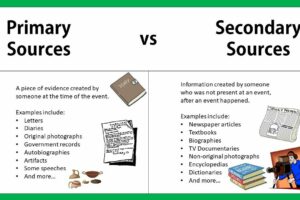
Key primary sources for studying Germany in 1945 include the surrender documents signed at Reims and Berlin-Karlshorst, the records of the Allied Control Council, military government reports, and the Nuremberg trial documents. Personal letters and diaries, such as those collected by German archives, offer intimate perspectives on daily life. The photographs and films taken by Allied military photographers and journalists provide visual evidence. Census and refugee records document the massive population movements of the year.
The Potsdam Agreement, signed on August 2, 1945, is a crucial document outlining the principles for Germany’s occupation. The Nuremberg indictment, filed in October, listed the crimes of the Nazi leadership. For historians, the records of the Office of Military Government, United States (OMGUS) and the Soviet Military Administration in Germany (SMAD) are invaluable sources for understanding the occupation.
1945 Timeline
| Date | Event |
|---|---|
| January 6 | More than 80,000 Jews held captive by the Nazis are freed in Budapest by Soviet soldiers. |
| January 12 | The Soviet Union begins the Vistula-Oder Offensive in Eastern Europe. |
| January 27 | Soviet forces liberate the Auschwitz concentration camp. |
| April 30 | Adolf Hitler commits suicide in Berlin; Karl Dönitz becomes President. |
| May 1 | Joseph Goebbels becomes Chancellor; he commits suicide the same day. |
| May 2 | Lutz Graf Schwerin von Krosigk becomes leading minister. |
| May 7 | Alfred Jodl signs the unconditional surrender at Reims. |
| May 8 | Ceasefire takes effect at 11:01 p.m.; V-E Day celebrated across the West. |
| May 9 | Re-signing of surrender at Berlin-Karlshorst (May 9 in Moscow time). |
| May 23 | The Dönitz government is dissolved; Allied Control Council assumes authority. |
| July 17–August 2 | Potsdam Conference: Truman, Stalin, and Attlee agree on Germany’s occupation. |
| November 20 | Nuremberg trials of major Nazi war criminals begin. |
What Changed Next
In the years following 1945, Germany was divided into East and West, with the Berlin Wall becoming the symbol of the Cold War. The Nuremberg trials held Nazi leaders accountable for war crimes. The Marshall Plan helped rebuild Western Germany’s economy, leading to the “economic miracle” of the 1950s. The process of denazification and democratization reshaped German society. By 1949, the Federal Republic of Germany and the German Democratic Republic were established, setting the stage for the division that would last until 1990.
The year 1945 was thus not only an end but a beginning. The Germany that emerged from the rubble was profoundly different—a nation forced to confront its past and to build a new identity. The events of 1945 shaped the entire trajectory of postwar European history, from the Cold War to the European Union.
FAQ
What was the population of Germany in 1945?
Approximately 66 million, down from about 69 million at the start of the war, due to military casualties, displacement, and flight from the eastern territories.
What major events happened in Germany in 1945?
The Soviet Vistula-Oder Offensive (January), the liberation of Auschwitz (January 27), Hitler's suicide (April 30), the unconditional surrender (May 8), the Potsdam Conference (July–August), and the beginning of the Nuremberg trials (November).
What primary sources are available for studying Germany in 1945?
The surrender documents, Allied Control Council records, military government reports, Nuremberg trial documents, personal letters and diaries, photographs, films, and refugee records. These are held in archives such as the Bundesarchiv, the National Archives, and the Imperial War Museum.
How did daily life in Germany in 1945 differ from today?
Daily life was a struggle for survival—food rationing, destroyed housing, black market economies, and the absence of most men. There was no functioning government, no reliable transportation, and the country was under military occupation. Today, Germany is a prosperous democracy with a stable economy.

Leave a Reply