
Short Answer
In the last week of October 1929, as the New York Stock Exchange convulsed in the most spectacular financial failure of the age, the world’s newspapers raced to interpret a catastrophe that seemed to come from nowhere. From Berlin to Paris to Rio de Janeiro, editors and readers turned to the wires with a mixture of shock, hope, and trepidation. In Berlin, the press greeted the crash with relief, seeing it as a long-awaited correction that would return capital to Europe. In Paris, right-wing commentators framed it as the inevitable collapse of American megalomania. In Rio, the elite press treated it as a distant tremor, while workers’ newspapers felt its immediate sting. The Wall Street Crash of October 1929 was not a purely American event; it was a global media event, filtered through a thousand editorial lenses.
What Happened?
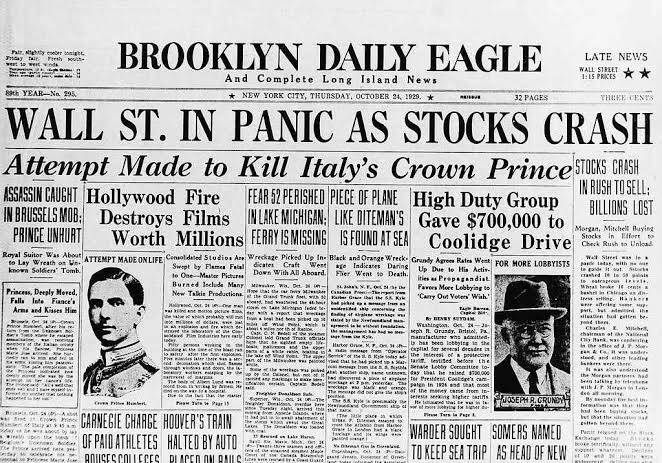
The crash began on October 24, 1929—known immediately as Black Thursday—when panic selling swept the New York Stock Exchange. The market had been inflated by a speculative boom, and many financial leaders had dismissed the dangers. Just days earlier, on October 14, Professor Irving Fisher of Yale University had declared that “stock prices have reached a plateau that will be permanently high.” Two days before the panic, Charles Mitchell, chairman of the National City Bank, assured journalists: “I know of nothing fundamentally wrong with the stock market or with the underlying business and credit structure.” Yet the market fell with astonishing speed. By October 26, the New York Times was already reporting on how the rest of the world was reacting.
- October 14, 1929: Fisher makes his “permanently high plateau” prediction.
- October 22–23: Mitchell’s reassurance to the press.
- October 24: Black Thursday—the panic begins.
- October 26: The New York Times publishes an article on Berlin’s reaction, titled “Berlin Is Relieved by Our Stock Crash.”
How It Was Seen at the Time
Contemporaries understood the crash through their own national experiences. In Berlin, the press was not merely calm but relieved. The New York Times reported that German newspapers agreed that “the slump here will return capital to European markets” and that “the ascendancy of stocks over bonds will pass, thus making way for loans to Germans.” They expected further decline and saw the crash as a positive development for Europe. In France, the right-wing press viewed the crash as a moral lesson. According to later historian Ralph Schor, the French right-wing press interpreted the crash as “the failure of American megalomania,” a vindication of traditional European values. In Brazil, the press offered two distinct interpretations: the elite newspapers of Rio de Janeiro saw the crisis as distant, while the workers’ press emphasized the immediate impact on the coffee economy and the working class.
“The newspapers agree that the slump here will return capital to European markets.” — New York Times, October 26, 1929, reporting on the Berlin press.
Contemporary Newspaper Coverage
The coverage of the crash was dominated by pundits who were spectacularly wrong. Fisher’s “permanently high plateau” became an immortal misjudgment. Mitchell’s reassurance came just two days before the panic. As the BBC later observed, “Times of crisis and uncertainty are boom times for pundits, but they produce a dozen pratfalls for every prophet.” The New York Times itself carried the story on October 26, 1929, with a headline that captured the global reaction: “Berlin Is Relieved by Our Stock Crash.” The article described how German newspapers were not only reporting the crash but interpreting it as a positive development for Europe. This kind of foreign-news reporting was typical of the time—the American press often used the reactions of foreign newspapers to underscore the significance of a story.
“I know of nothing fundamentally wrong with the stock market or with the underlying business and credit structure.” — Charles Mitchell, quoted in the BBC retrospective.
Different Perspectives
The German Press
As reported in the New York Times of October 26, 1929, German newspapers were relieved by the crash. They believed that the slump would return capital to European markets and that the “ascendancy of stocks over bonds would pass,” thus making way for loans to Germany. This hope was driven by Germany’s desperate need for foreign capital after the war and reparations. The crash was seen as a windfall that would restore the balance of financial power.
The French Right-Wing Press
The French right-wing press, as analyzed in the 1995 study “Les États-Unis vus de droite,” saw the crash as the first spectacular episode of a global crisis. It interpreted the crash as a failure of American megalomania and as a moral lesson. The French commentators argued that the American economic model of speculation and materialism was doomed, and that the crisis would restore Europe to a more conservative financial order. They also saw the crash as a consequence of American political and cultural dominance.
The Brazilian Press
The Brazilian press, according to the 2013 study “Representações da crise de 1929 na imprensa brasileira,” presented two distinct interpretations. The elite newspapers of Rio de Janeiro, such as Jornal do Commercio and Correio da Manhã, reported the crash as a distant event, focusing on its impact on the export of coffee. The communist journal A Classe Operária gave a different view, emphasizing the immediate effects on the working class and linking the crash to the broader suffering of the workers. This division showed how the same event was filtered through class and geography.
What People Expected Would Happen Next
Contemporaries made a range of predictions. In Berlin, the press expected a further decline in the American market and that capital would return to Europe, especially to Germany. They believed that the ascendancy of stocks over bonds would pass, making it easier for Germany to borrow. In the United States, Fisher and Mitchell both expected the market to continue upward. The French press predicted a moral rebalancing, while the Brazilian elite expected the crisis to be short-lived and not affect Brazil’s economy. These expectations were all wrong. The crash was not a correction; it was the beginning of a global depression that would devastate economies for a decade.
What the Sources Got Wrong
- Fisher’s “permanently high plateau” — He predicted that stock prices would remain at their peak; instead they collapsed within days. (BBC)
- Mitchell’s assurance — He said nothing was fundamentally wrong; the market crashed two days later. (BBC)
- Berlin’s expectation of capital return — The crash did not lead to a beneficial flow of capital to Europe; instead, it triggered a global crisis that hit Germany especially hard.
- The French press’s moralizing — They saw the crash as a temporary correction that would restore European values, but it was the start of a decade of depression.
- The Brazilian elite’s dismissal — They treated the crash as a distant event, but it eventually had a deep impact on Brazil’s coffee economy.
How Historians See It Today
Modern historians have used these contemporary sources to understand the crash’s global meaning. Ralph Schor’s 1995 study of the French press shows how the right-wing newspapers used the crash to reinforce their own ideology, rather than to analyze the economic causes. Andréa Casa Nova Maia’s 2013 study of the Brazilian press reveals how the coverage was shaped by class and geography, with the elite press downplaying the impact while the workers’ press reflected the immediate suffering. The BBC’s 2004 retrospective on punditry notes that the crash exposed the limits of financial forecasting. Historians now see the crash as a complex event that marked the beginning of a systemic crisis, not merely a stock market correction. The contemporary coverage, while often wrong, provides a valuable window into the hopes and fears of 1929.
The Wall Street Crash of 1929 was a global media event, interpreted through the prisms of national interests and ideologies. The primary sources—newspapers, financial leaders’ statements, and foreign correspondents’ reports—reveal a world that was not a passive observer of American events but an active participant in making meaning from the turmoil. The relief in Berlin, the moralizing in Paris, and the dismissiveness in Rio were all ways of coping with a crisis that would soon engulf the entire globe. These sources remind us that events are never simply experienced; they are always understood through the lenses of the media of their time.
FAQ
What did the German press think about the Wall Street Crash?
According to the New York Times of October 26, 1929, the German press was relieved. They believed the crash would return capital to European markets and make loans to Germany easier. They also expected a further decline in American stocks.
How did the French right-wing press interpret the crash?
The French right-wing press, as analyzed by Ralph Schor, saw the crash as a failure of American megalomania. They interpreted it as a moral lesson that would restore European values and conservative economic practices.
What was the Brazilian press's reaction to the crash?
The Brazilian press was divided. The elite newspapers in Rio de Janeiro treated the crash as a distant event that would only affect the coffee export sector, while the workers' journal 'A Classe Operária' emphasized the immediate impact on the working class.







Leave a Reply