
Short Answer
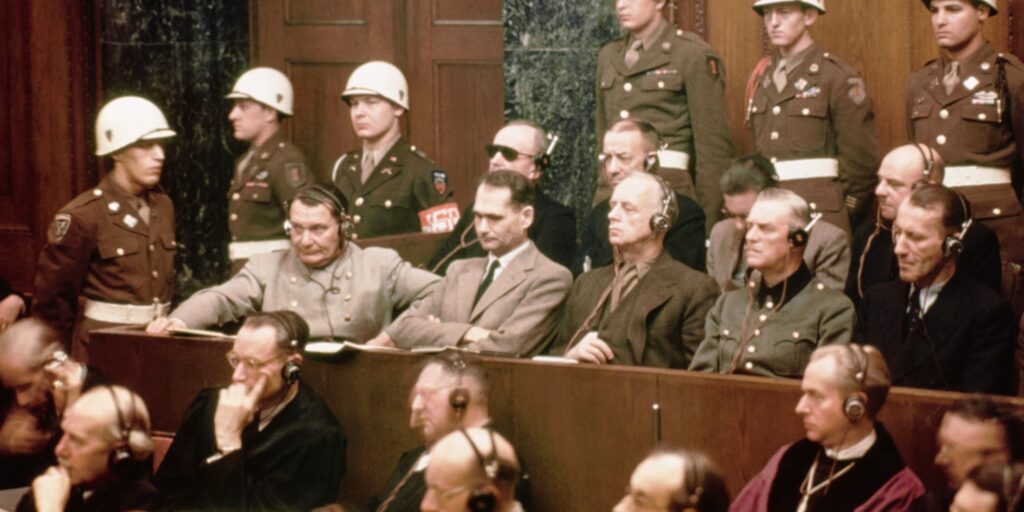
In the autumn of 1945, the city of Nuremberg lay in ruins, its medieval heart reduced to rubble by Allied bombing. Yet inside the Palace of Justice, a different kind of battle was about to begin. On November 20, 1945, the International Military Tribunal (IMT) convened to try twenty-two leading German officials for war crimes. American guards maintained constant surveillance over the defendants in the prison attached to the Palace of Justice, and photographers captured the scene for a world that had endured six years of war and genocide. The trial was not merely a legal proceeding; it was a revolutionary attempt to hold the architects of Nazi terror accountable before the court of international law.
What Happened?
The Nuremberg Trials were the culmination of a long Allied commitment to punish Nazi war criminals. As early as the winter of 1942, the Allied governments announced their intent to hold perpetrators accountable. In October 1943, US President Franklin D. Roosevelt, British Prime Minister Winston Churchill, and Soviet Premier Joseph Stalin signed the Moscow Declaration of German Atrocities. The declaration stated that at the time of an armistice, Germans responsible for atrocities, massacres, or executions would be sent back to the countries where they had committed their crimes to be judged and punished under the laws of those nations. Major war criminals, whose crimes affected more than one country, would be punished by joint decision of the Allied governments.
Although some Allied leaders advocated summary executions of Nazi Germany’s leaders, the United States proposed to try them instead. In the words of US Secretary of State Cordell Hull, “a condemnation after such a proceeding” would be more powerful than a simple execution. This view prevailed, and the International Military Tribunal was established in the summer of 1945 to try the “major war criminals” for committing wars of aggression, war crimes, and crimes against humanity. Twenty-four individuals and six organizations were indicted.
The trial opened on 20 November 1945. The tribunal heard testimony from 33 prosecution witnesses, 19 defendants, 61 defense witnesses, and 22 witnesses concerning organizations. Thousands of documents were received as evidence. The judgment and sentences were completed on 1 October 1946. Nineteen defendants were found guilty, with 12 given the death penalty; 3 were acquitted, and 3 organizations were found to be criminal. The trials set a precedent for international criminal law, though they were not without controversy.
How It Was Seen at the Time
To contemporaries, the Nuremberg Trials were a monumental departure from traditional warfare. For the first time, the leaders of a defeated nation were brought before a court of law rather than executed or simply exiled. The prevailing mood among the Allies was one of cautious optimism. Many saw the trial as a necessary legal reckoning, while others feared it was merely a victor’s revenge. The American Secretary of State Cordell Hull emphasized the importance of a judicial process, stating that “a condemnation after such a proceeding” would carry more weight than a summary execution. The trial was widely covered in the press, with photographers capturing the defendants in the dock and the piles of documents entered as evidence. The world watched as Hermann Göring and other former Nazi leaders sat in the prisoner’s box, their fates to be decided by judges from the four Allied powers.
Historical Snapshot
| Aspect | Detail |
|---|---|
| Date | 20 November 1945 – 1 October 1946 |
| Place | Palace of Justice, Nuremberg, Germany |
| People | International Military Tribunal (IMT) judges from the UK, USSR, US, and France; 24 individual defendants; 6 indicted organizations |
| What Happened | The IMT tried leading Nazi officials for crimes against peace, war crimes, and crimes against humanity. |
| Why It Mattered | Established the principle that individuals can be held accountable under international law for war crimes and atrocities. |
Official Reports
The most significant official document behind the trials was the Moscow Declaration of German Atrocities (October 1943). Signed by Roosevelt, Churchill, and Stalin, it laid out the Allied intention to bring German war criminals to justice. The declaration specifically stated that those responsible for atrocities would be sent back to the countries where they committed their crimes, and that major war criminals would be punished by joint decision of the Allied governments. This document was the foundation for the establishment of the IMT in 1945. The IMT’s own charter, the London Agreement, defined the categories of crimes—crimes against peace, war crimes, and crimes against humanity—that would be prosecuted. The tribunal’s proceedings, including the indictments, testimonies, and verdicts, were recorded in full and became the basis for subsequent trials.
Aftermath
After the verdicts on 1 October 1946, twelve defendants were sentenced to death by hanging. The executions were carried out on 16 October 1946. Three defendants were acquitted, and the remaining guilty received prison sentences of varying lengths. The IMT’s judgment also declared three of the indicted organizations to be criminal: the SS, the Gestapo, and the Nazi Party leadership corps. The trial did not end with the IMT; it was followed by twelve additional trials of lower-level officials, conducted by the United States in Nuremberg from 1946 to 1949. The IMT also set a legal precedent for later tribunals, including the Eichmann trial in Jerusalem in 1961, where the Nazi official Adolf Eichmann was tried for his role in the Holocaust.
How Historians See It Today
Contemporary observers often saw the Nuremberg Trials as a triumph of justice over tyranny. Modern historians, however, have a more nuanced view. They note that the trials were conducted by the victorious powers, leading to charges of “victor’s justice”—the defendants were tried only for crimes committed by the Axis powers, while the Allies’ own wartime actions (such as the Soviet Union’s Katyn massacre or the strategic bombing of cities) were not subject to the same scrutiny. Nevertheless, the IMT is widely recognized as a foundational moment in international law, establishing the principle of individual responsibility for war crimes and crimes against humanity. The trials also set a precedent for the establishment of the International Criminal Court and the modern human rights framework. Historians today acknowledge the flaws but also the enduring importance of the legal precedents set at Nuremberg.
Common Misconceptions
Key Documents
- Moscow Declaration (October 1943) – Signed by the Allied leaders, it declared the intention to punish war criminals.
- London Charter (8 August 1945) – Established the legal basis for the IMT, defining the crimes of war.
- Indictment (October 1945) – The formal charges against 24 individuals and 6 organizations.
- Judgment and Sentences (1 October 1946) – The final verdicts, including the death sentences and acquittals.
In the end, the Nuremberg Trials were more than a courtroom drama. They were a collective attempt to make sense of the unimaginable horrors of the Second World War and to lay the foundation for a world that would not repeat them. The primary sources—the declarations, the testimony, the photographs—show us not only what happened but how the world struggled to find a language of justice for crimes that had no precedent. The trials remain a powerful reminder that the law can be a tool for accountability, even in the face of the darkest chapters of human history.
FAQ
What were the Nuremberg Trials?
The Nuremberg Trials were a series of military tribunals held in Nuremberg, Germany, from 1945 to 1946. The International Military Tribunal tried 22 leading Nazi officials for war crimes, crimes against humanity, and wars of aggression. The trials resulted in 19 guilty verdicts, including 12 death sentences, and 3 acquittals.
How many people were executed after the Nuremberg Trials?
Twelve of the Nuremberg defendants were sentenced to death by hanging. The executions were carried out on October 16, 1946.
Why were the trials held in Nuremberg?
Nuremberg was chosen because it was the site of the Nazi Party’s annual rallies and had a large, largely intact Palace of Justice that could accommodate the court and the prison. It was also in the American occupation zone.






Leave a Reply