
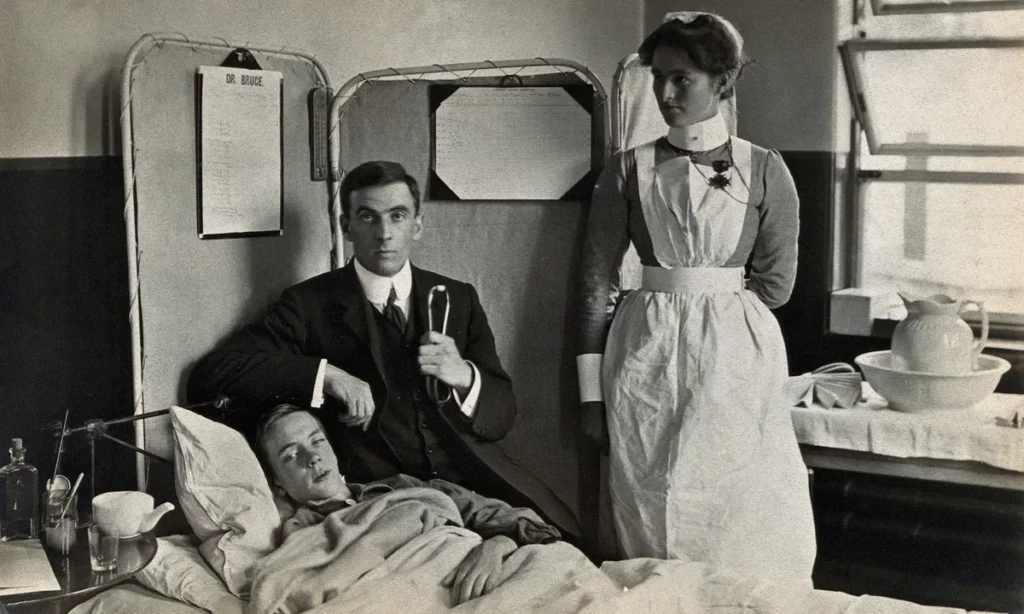
Short Answer
In October 1918, as the Great War staggered toward its final weeks, a second catastrophe was consuming the world: the Spanish flu. In military camps, quarantine stations, and crowded cities, nurses found themselves on a new front line, one where the enemy was invisible and the death toll climbed by the day. Their diaries and letters from that season preserve a raw, unfiltered record of fear, exhaustion, and duty. Australian nurse Susie Cone, writing from a quarantine station in Perth, called it “hell.” Volunteer nurse Lutiant LaVoye, a young Native American woman in Washington, D.C., reported that “as many as 90 people die every day here with the ‘Flu.’” These women—trained and untrained, military and civilian—left behind an intimate archive of the pandemic’s human cost, a testament to their courage and the fragile systems they held together.
What Happened?
The 1918 influenza pandemic, commonly called the “Spanish Flu,” arrived in waves across the globe, striking in the midst of the First World War. In Australia, the disease came with returning soldiers. The Woodman Point quarantine station near Perth became a site of acute crisis. Nurses like Susie Cone, a Victorian from Gippsland, volunteered to care for infected soldiers. The station was overwhelmed; dozens of soldiers died, and four of Cone’s fellow nurses perished from the same disease.
In the United States, the pandemic peaked in October 1918. In Washington, D.C., hospitals were desperate for staff. Lutiant LaVoye, a recent graduate of the Haskell Institute, an off-reservation boarding school in Kansas, responded to the wartime labor demand and took a train to the capital. She volunteered as a substitute nurse, despite having little formal training. She later wrote to a friend, “Really, they are certainly ‘hard up’ for nurses – even me can volunteer as a nurse in a camp or in Washington.”
Meanwhile, in France, Chief Nurse Julia Stimson of Base Hospital 21 in Rouen was being elevated to lead the Red Cross Nursing Service in France, and later the American Expeditionary Forces’ nursing service. In a letter to her parents dated October 13, 1918, she described her concerns about the new position, which would place her at the heart of the military’s medical response.
How It Was Seen at the Time
Contemporaries understood the pandemic through the lens of the war. The flu was often seen as a secondary battle, a “plague” that threatened the military and homefront alike. Nurses described their work in stark, visceral terms. Susie Cone’s diary, digitized by the Public Records Office of Victoria, calls the Woodman Point station “hell.” The word captures the physical and emotional toll of watching patients die without effective treatment. Lutiant LaVoye’s letter conveys the same urgency: “All nurses were required to work twelve hours a day–we worked from seven in the morning until seven at night, with only a short time for luncheon and dinner.” The prevailing mood was one of exhaustion and grim resolve, as the nurses carried on despite the constant death around them.
“Really, they are certainly ‘hard up’ for nurses – even me can volunteer as a nurse in a camp or in Washington.” — Lutiant LaVoye, letter to Louise, October 17, 1918
“Susie described the place as ‘hell’.” — ABC News, describing the diary of Australian nurse Susie Cone
Letters & Diaries
The most immediate records of the pandemic’s toll on nurses come from their own writings. Susie Cone’s diary, kept at the Woodman Point quarantine station in 1918, is a rare, first-hand account of the Australian experience. She recorded the deaths of soldiers and the loss of four colleagues, and her description of the station as “hell” conveys the horror of the place. The diary was digitized by the Public Records Office of Victoria, making it accessible to modern readers.
Lutiant LaVoye’s letter, written on October 17, 1918, to her friend Louise at the Haskell Institute, is a striking document. LaVoye, a Native American woman, had volunteered to serve as a substitute nurse with little training. Her letter describes the daily death toll in Washington D.C., the twelve-hour shifts, and the strange mixture of duty and resentment she felt toward the boarding school’s administrators. She wrote, “So everybody has the ‘Flu’ at Haskell? I wish to goodness Miss Keck and Mrs. McK. would get it and die with it. Really, it would be such a good riddance, and not much lost either!” This passage reveals a young woman both exhausted and defiant, using humor and anger to cope with the horrors around her.
Julia Stimson’s letter to her parents, written in October 1918, offers a more professional perspective. As chief nurse of Base Hospital 21 in Rouen, France, she had already spent months in the field. The letter describes her concerns about the new role, but also her commitment to her duty. She wrote, “This is an extraordinary place for me to be, for I am down at Rouen and as it has been three months since I was here last it seems extraordinary and certainly a lot of water has run.” Her words reflect the constant motion and responsibility of her position.
Different Perspectives
Australian Nurse: Susie Cone
Susie Cone, a nurse from Gippsland, Victoria, volunteered for service in the Great War, expecting to be sent to Europe. Instead, she was assigned to the Woodman Point quarantine station in Western Australia, where soldiers returning with the Spanish flu were held. Her diary records the suffering and the deaths, including those of four fellow nurses. Her perspective is that of a trained professional, but one who was utterly unprepared for the scale of the disaster. She described the place as “hell,” a term that underscores the conditions she witnessed.
Native American Volunteer: Lutiant LaVoye
Lutiant LaVoye, a graduate of Haskell Institute, an off-reservation vocational boarding school, was part of the labor pool that the government relied on during the war. She volunteered in Washington D.C., where she worked as a substitute nurse at Camp Humphreys, Virginia. Her letter to a friend shows her as a young woman thrown into a crisis, with minimal training and a cynical edge. She wrote, “All nurses were required to work twelve hours a day–we worked from seven in the morning until seven at night, with only a short time for luncheon and dinner. Believe me, we were always glad when night came.” Her perspective is that of an outsider, a Native American woman in a white-dominated profession, who nonetheless took on the work.
Chief Nurse in France: Julia Stimson
Julia Stimson was a professional nurse with a prominent career. As chief nurse of Base Hospital 21 in Rouen, she was asked to lead the Red Cross Nursing Service in France in April 1918, and later the American Expeditionary Forces’ nursing service. Her letter to her parents in October 1918 reveals her concerns about the new position, and her awareness of the immense responsibility. She wrote, “This is an extraordinary place for me to be, for I am down at Rouen and as it has been three months since I was here last it seems extraordinary and certainly a lot of water has run.” Her perspective is that of a leader, but also of a woman facing the enormous pressure of the war and the flu.
Daily Life
The daily life of a nurse during the 1918 flu was grueling. Lutiant LaVoye’s letter describes the routine: twelve-hour shifts from 7 a.m. to 7 p.m., with only short breaks for lunch and dinner. The work was physically demanding, and the constant death of patients made it emotionally draining. In the quarantine station in Australia, the conditions were equally harsh. Susie Cone’s diary recorded the isolation of the station, the deaths of the soldiers, and the loss of her colleagues. The nurses had to work without effective medicines, relying on basic nursing care—fresh air, food, and hygiene—to combat the disease. The daily death toll, as LaVoye noted, could reach 90 in Washington D.C., and the nurses were constantly surrounded by death.
Numbers at the Time
| Statistic | Detail | Source |
|---|---|---|
| Daily deaths in Washington, D.C. | “As many as 90 people die every day here with the ‘Flu.’” | Lutiant LaVoye, letter, October 1918 |
| Nurses’ shift length | 12 hours per day (7 a.m. to 7 p.m.) | Lutiant LaVoye, letter, October 1918 |
| Nurses who died at Woodman Point | 4 of Susie Cone’s colleagues | ABC News, 2023, based on Susie Cone’s diary |
| Number of soldiers who died at Woodman Point | “Dozens of soldiers” | ABC News, 2023 |
How Historians See It Today
Contemporary observers saw the 1918 flu as a wartime catastrophe, a disease that threatened the military and the homefront. They did not yet know that it was a pandemic of unprecedented scale, or that it would eventually kill more people than the war itself. Modern historians, however, have re-examined the pandemic, emphasizing the crucial role of women, especially nurses, in the public health response. The diaries and letters of nurses like Susie Cone, Lutiant LaVoye, and Julia Stimson have become primary sources that reveal the social history of the pandemic, highlighting the intersection of gender, race, and public health. Historians today also note the under-reporting of the disease in many countries, and the way the pandemic was overshadowed by the war. The primary sources from these nurses provide a vital, personal counterpoint to official statistics, showing the human cost of the pandemic and the resilience of those who cared for the sick.
The primary sources from these women teach us that the 1918 flu was not just a medical event, but a deeply personal one. The nurses’ diaries and letters capture the fear, the exhaustion, and the courage of those who stood at the bedside of the dying. They remind us that history is not just a series of events, but the lived experience of individuals, and that the voices of women, often overlooked in official accounts, are essential to understanding the past. Their words remain a testament to their service and to the human spirit in the face of an invisible enemy.
FAQ
What was the role of women nurses during the 1918 flu pandemic?
Women nurses provided the majority of direct patient care during the pandemic. They worked long hours, often 12-hour shifts, in hospitals, quarantine stations, and military camps. They faced high rates of infection and death themselves, as evidenced by the deaths of nurses like the four colleagues of Susie Cone at Woodman Point. Their work was essential, and their letters and diaries are some of the best primary sources we have for the pandemic.
How did the pandemic affect the nurses' own health?
Nurses were highly exposed to the virus. At the Woodman Point quarantine station, four of the nurses died from the disease. Many nurses, like Lutiant LaVoye, worked without adequate protection and with minimal training, making them vulnerable. The pandemic also took a mental toll, as described in Susie Cone's diary, which called the station 'hell'.
What is the significance of Lutiant LaVoye's letter?
Lutiant LaVoye's letter is significant because it provides a first-hand account from a Native American woman who volunteered as a nurse during the pandemic. It shows the labor shortage and the role of minority women in the war effort. The letter also details the daily death toll and the grueling working conditions, making it a valuable primary source for understanding the homefront experience.







Leave a Reply