
Short Answer
In the spring of 1945, as Allied forces pushed into the heart of Germany, the British housewife stood in a queue outside the local butcher, ration book in hand, wondering whether the week’s meat allowance would stretch to Sunday dinner. The war was not yet over, and the home front remained a battlefield of shortages and coupons. Rationing, introduced in early 1940, had become a way of life—a system of fair shares that touched every citizen. But in May 1945, the government announced reductions in rations, and the news struck like a blow. The war’s end, everyone had hoped, would bring abundance; instead, the cupboard seemed barer than ever. This article, drawn from contemporary records—a government film made for American audiences, a House of Commons debate, and official archives—tells the story of how Britain struggled for food and clothing in 1945, and what that struggle meant to the people who lived through it.
What Happened?
Rationing had been a constant companion since January 1940, when butter, sugar, and meat were first limited. By 1945, the system had expanded to include most foodstuffs—tea, cheese, eggs, and even bread (from 1946)—as well as clothing, which was rationed through a points system. The year 1945 brought no relief. On 13 June 1945, the Minister of Food, in a debate in the House of Commons, explained that the recent cuts in rations were due to a decline in world food production and an increase in demand. He cited shortages of man-power in producing countries, lack of fertilisers, drought in the Southern Dominions, South Africa, South America, and the Caribbean, and a decline in the pig population of North America. The increase in demand came from the liberated countries of Europe, which now required food and clothing from the same shrinking global pool.
- Early 1940: Meat, butter, and sugar rationed.
- Later additions: Tea, cheese, and other foodstuffs added to the ration list.
- May 1945: Government announces further reductions in rations.
- 13 June 1945: House of Commons debate on the reductions; Minister of Food explains the reasons.
- 1945: A government film, Watch Rationing in Britain, is produced for an American audience to explain the system.
The film, directed by Ralph Bond, followed the Green family as they navigated the complexities of rationing—the points for clothing, the coupons for food, and the taxes on luxury goods. It was part of a broader effort to explain Britain’s home front to its Allies, who often had no idea of the severity of the shortages.
How It Was Seen at the Time
Contemporary understanding of rationing was framed by the principle of “fair shares for all.” The public largely supported the system, seeing it as a necessary means of equitable distribution in a time of total war. The government film, made for American audiences, was designed to justify the system and to show that it was not a sign of defeat but of organised sacrifice. In the House of Commons debate, the Minister of Food was asked whether the housewife had been adequately informed of the reasons for the cuts. The questioner noted that “very little attempt has been made to explain to the housewife the reason for this.” This suggests a gap between the official narrative and the everyday experience of those who had to make do. The prevailing mood was one of stoic acceptance, but with a growing impatience as the war ended and rationing did not.
“The reductions in rations upon which the late Government decided, and which I announced in May, were due to a decline in world food production and an increase in demand.” – Minister of Food, House of Commons, 13 June 1945.
The film, Watch Rationing in Britain, was described as “a neatly explained film” that gave “context to an aspect of the home front synonymous with wartime Britain.” It presented the Green family as typical, getting by “as every citizen had to in challenging times.”
Historical Snapshot
| Aspect | Detail |
|---|---|
| Date | 1945 (especially May–June) |
| Place | United Kingdom, particularly London and other urban centres |
| People | The British civilian population; the Green family in the film; the Minister of Food |
| What Happened | Rationing of food and clothing continued, with new reductions announced in May 1945; a government film explained the system to Americans. |
| Why It Mattered | The cuts symbolised the enduring strain of war and the global food crisis; they tested public morale and shaped the post-war political landscape. |
What People Knew at the Time
| What People Knew Then | What We Know Now |
|---|---|
| Rationing was a temporary wartime measure that would end with victory. | Rationing continued for years after the war, with bread rationing lasting until 1948 and clothing until 1949. |
| The cuts were due to global shortages and the needs of liberated Europe. | The global food crisis was indeed severe, but the British government also had to manage a massive debt and balance of payments crisis. |
| The public generally believed rationing was fair and necessary. | Historians note that rationing actually improved public health, as it enforced a balanced diet, though black markets existed. |
Official Reports
The most authoritative contemporary official record is the House of Commons debate of 13 June 1945. The Minister of Food provided a detailed explanation of the reasons for the cuts:
“The fall in production is attributable to the continuing shortage of man-power in producing countries, to lack of fertilisers and to abnormal conditions of drought in the Southern Dominions, South Africa, South America and the Caribbean area. There has also been a decline in the pig population of North America. The increase in demand is due, in part, to the increased requirements of the liberated countries of Europe.”
The debate also revealed a concern about communication: the questioner asked whether “very little attempt has been made to explain to the housewife the reason for this.” This official acknowledgment of a gap between policy and public understanding is a key primary source for the period.
Daily Life
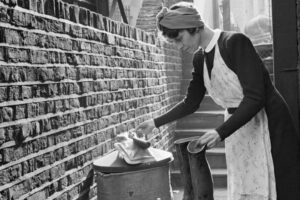
For the ordinary British citizen, rationing in 1945 was a daily exercise in arithmetic. Each person had a ration book with coupons for meat, butter, sugar, tea, and other staples. Clothing coupons were issued once a year, and each garment required a certain number of coupons—a new coat might cost 16 coupons, a pair of shoes 8. The government film Watch Rationing in Britain showed the Green family as they went about their day: the mother queuing at the butcher’s, the children saving their sweets coupons, the father checking the weekly allowance. The film was intended to reassure American audiences that rationing was not a sign of defeat but a demonstration of British resolve. In reality, the daily struggle meant careful meal planning, mending and remaking clothes, and bartering with neighbours. The government encouraged “make-do-and-mend” as a patriotic duty. Black markets existed, but they were never able to undermine the system. The health of the nation actually improved, as the rationing of sugar and fats reduced consumption of empty calories, while the compulsory consumption of vegetables and wholemeal bread improved nutrition.
What People Feared
As the war drew to a close, many Britons feared that the end of hostilities would not bring an end to shortages. The May 1945 cuts seemed to confirm that fear. The Minister of Food’s statement in June, explaining that the cuts were due to a “decline in world food production” and the needs of liberated Europe, did little to reassure. There was a widespread fear that the country would be unable to feed itself, that the United States would withdraw its support, and that the “land fit for heroes” promised after the First World War would never materialise. The fear of a return to pre-war poverty, with unemployment and hunger, was a constant undercurrent. The fact that the government had to explain the reasons to the housewife indicates that there was a genuine concern about public morale. The film itself, made for American audiences, was a propaganda tool to counter the perception that Britain was a defeated nation living in poverty. The fear was not unfounded: the global food crisis was real, and the British government had to negotiate loans from the United States and Canada to buy food.
How Historians See It Today
Modern historians, drawing on the same primary sources, have come to a more nuanced view. They agree that rationing was an equitable system that prevented the worst of shortages from falling on the poor. The National Archives’ “Attlee’s Britain” resource, which covers 1945–1951, lists rationing as one of the key themes of the era. The Institute of Historical Research notes that “by and large the public supported rationing as ensuring fair shares for all,” and that “food rationing improved the nation’s health through the imposition of a balanced diet with essential vitamins.” However, historians also point out that the rationing system was not without its inequalities: the black market, though small, benefited the wealthy, and the “points” system for clothing was often manipulated. Moreover, the continuation of rationing after the war was a political issue that contributed to the Labour victory in 1945, as voters sought a government that would manage the economy and provide for the common good. The film and the parliamentary debate are now seen as windows into a society that was both disciplined and anxious, proud of its sacrifices but eager for a better future.
Aftermath
Rationing did not end with the war. Bread was rationed from 1946, and clothing, though less restricted, remained rationed until 1949. The system was gradually dismantled as the global food supply recovered, but it was not until 1954 that the last rationing restrictions were lifted. The legacy of rationing was profound: it shaped the post-war consensus, the creation of the welfare state, and the national memory of a society that had shared sacrifice. The primary sources—the film, the parliamentary debates, and the records of the Ministry of Food—remain essential for understanding the daily reality of 1945.
The year 1945 stands as a pivot in British history. The war was ending, but the struggle for food and clothing continued. The primary sources of that year—the government film, the House of Commons debate, and the letters and diaries of ordinary citizens—reveal a people who were weary but resilient, critical but patriotic. They understood that the sacrifices of the war were not over, and they faced the future with a mixture of hope and fear. Their daily struggle is a testament to the endurance of the human spirit and a reminder that the end of a war is not always the end of the fight.
FAQ
Why did rationing continue after the war ended in 1945?
Rationing continued because of a global food shortage. The Minister of Food explained in June 1945 that world food production had declined due to shortages of labour, fertilisers, and drought, while demand increased from liberated Europe. The British government also had to manage a severe balance of payments crisis, so rationing was maintained until 1954.
What did the government film 'Watch Rationing in Britain' show?
The 1945 government film, directed by Ralph Bond, explained the rationing system to American audiences. It followed the Green family as they used ration books and clothing coupons, and showed how taxes on luxury goods helped the war effort. It aimed to show that rationing was a fair and necessary system, not a sign of British weakness.












Leave a Reply