Short Answer
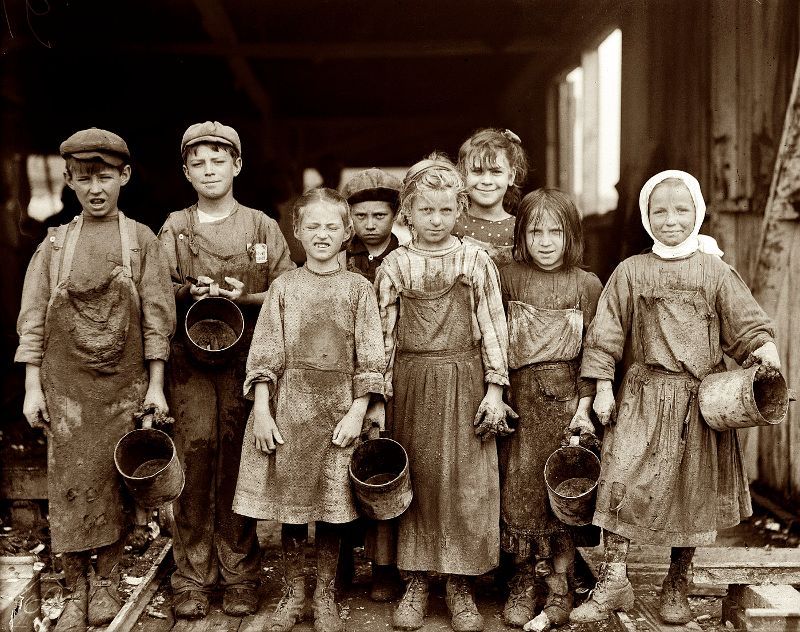
In the early years of the twentieth century, the cotton mills of the American South were a world of whirring spindles and clattering looms, where the air was thick with lint and the hours stretched from dawn to dusk. Amid this noise and dust moved the children—doffer boys, spinners, and sweepers—some as young as eight or nine. To the reformer’s eye, they were victims; to many mill owners and even some parents, they were breadwinners and blessings. Photographer Lewis Hine, working for the National Child Labor Committee, arrived in the Carolinas in 1908 with a camera and a mission. He was refused permission to photograph inside the mills, so he waited at the noon hour, capturing the children as they spilled out into the sunlight. His photographs, along with the testimony of investigators, would become the most enduring record of child labor in 1900—a record that still speaks to us today.
What Happened?
The National Child Labor Committee (NCLC), founded in 1904, launched a series of investigations into the conditions of child labor in the United States. In 1908–1909, the committee’s Southern office, led by Rev. A. E. Seddon and A. H. Ulm, with photographer Lewis W. Hine, conducted a detailed study of the cotton mills of North and South Carolina. The resulting report, Child Labor in the Carolinas, documented the lives of children who worked in the mills, including their ages, hours, wages, and conditions.
The investigation faced significant obstacles. As the report’s illustrations reveal, Hine was refused permission to photograph children inside the mills. He was forced to capture them at the noon hour, when they emerged for a brief break. The report notes:
“Mr. Hine was refused permission to photograph children in the mill. These doffer boys were photographed at the noon hour.”
Another image, titled “High Shoals,” shows a mill running at eight p.m., with the note: “Mr. Hine was forbidden to photograph children.”
Despite these restrictions, Hine’s photographs and the investigators’ testimony painted a vivid picture of child labor. The report documented not only the work itself but also the housing conditions, family situations, schooling, recreational activities, and work-related injuries of the children. The Library of Congress collection of these photographs includes images from Alabama, Connecticut, Delaware, Georgia, Indiana, Louisiana, Maine, Massachusetts, Mississippi, New Hampshire, New York, North Carolina, Ohio, Rhode Island, South Carolina, Tennessee, Texas, Vermont, and Virginia—showing that child labor was a national, not just a Southern, phenomenon.
How It Was Seen at the Time
At the time, child labor was a subject of fierce debate. Reformers saw it as a moral outrage, a violation of childhood and a threat to the nation’s future. The NCLC used words like “child slavery” and “the factory’s toll on childhood” to describe the mills. The photographs were meant to shock and persuade.
But there was a vocal opposition. The 1908 publication The Child That Toileth Not, written by a defender of the mills, argued that children were better off working in the mills than staying on the hardscrabble mountain farms of their families. The author, A. Dawley, claimed that life on the farm damaged children physically and morally, while the textile mills offered education, good health, and positive moral development. As the scholar Cara Finnegan describes, Dawley asserted that “the mill saves children rather than dooms them.” The reformers, he argued, were liars who used photographs to deceive the public—hence the title of Finnegan’s study: “Liars May Photograph.”
The prevailing mood was one of tension. The public was beginning to see the photographs, but many still believed that child labor was an economic necessity, especially in the South, where families depended on the wages their children brought home.
Historical Snapshot
| Aspect | Detail |
|---|---|
| Date | 1900–1910, with the major investigation in 1908–1909 |
| Place | Cotton mills in North and South Carolina, and other states across the U.S. |
| People | Lewis W. Hine (photographer), A. E. Seddon, A. H. Ulm (investigators), children, mill owners, reformers |
| What Happened | The National Child Labor Committee investigated and photographed child labor, producing a report that revealed the conditions of working children. |
| Why It Mattered | The photographs and testimony became powerful tools in the fight for child labor laws, eventually leading to federal reform. |
Eyewitness Accounts
Lewis Hine’s photographs were accompanied by his own testimony, recorded in the captions of the photographs and the reports of the NLC. His account of the difficulty of photographing children inside the mills is a direct eyewitness account:
“Mr. Hine was refused permission to photograph children in the mill. These doffer boys were photographed at the noon hour.”
Another photograph from High Shoals shows the mill running at eight p.m., with the note that Hine was “forbidden to photograph children.” This testimony reveals the lengths to which mill owners went to hide the conditions from the public, and the resourcefulness of the reformers in capturing evidence.
Different Perspectives
Reformers and the National Child Labor Committee
The reformers, including Hine, Seddon, and Ulm, believed that child labor was a moral and social evil. They documented the long hours, the physical strain, and the lack of education. Their photographs were intended to evoke sympathy and action. They used the language of the Progressive Era—calling for legislation to protect children.
Mill Owners and Defenders
Mill owners and their allies argued that the mills provided a necessary income for poor families and that the work was not harmful. The publication The Child That Toileth Not claimed that children were better off in the mills than on the farm. The author argued that the mills offered education (often mill schools), good health, and moral improvement. They saw the reformers’ photographs as deceptive, hence the accusation that “liars may photograph.”
What People Feared
Reformers feared that the future of the nation was being destroyed by the physical and moral degradation of its children. They feared that the children would grow up illiterate, sickly, and morally corrupt, and that the American democracy would suffer. They also feared the power of the mill owners, who blocked inspections and refused to let photographers in.
On the other side, mill owners and parents feared that if child labor were banned, their families would starve. They feared that the reformers were trying to take away their livelihood, and they feared the loss of the small wages the children brought home.
What People Expected Would Happen Next
Reformers expected that the publication of the photographs and testimony would lead to public outcry and the passage of state and federal child labor laws. They were right—the NCLC’s work helped to pass child labor legislation in many states and eventually the Keating-Owen Act of 1916 (though it was later struck down by the Supreme Court).
Mill owners expected that the reform movement would fail, as it had in the past. They believed that the economic necessity of child labor would keep it in place. They were partially right—federal legislation was delayed, but the tide of public opinion turned.
Aftermath
The immediate aftermath of the 1909 report was increased public awareness and a surge in child labor reform. The photographs were reproduced in newspapers and magazines, and the NCLC continued its work. In 1912, the U.S. Children’s Bureau was established, and in 1916, the Keating-Owen Act was passed, though it was ruled unconstitutional in 1918. It took the Fair Labor Standards Act of 1938 to finally establish federal child labor standards. The photographs of Hine and the testimony of the NCLC remain the most powerful primary source record of the lives of these children.
How Historians See It Today
Contemporary reformers saw the child labor issue as a moral crusade. They saw the children as innocent victims and the mill owners as greedy exploiters. Modern historians, while recognizing the injustice, also emphasize the complexity of the issue. They note that many families depended on child labor and that the children were often not passive victims but active contributors to their family’s survival. They also analyze the rhetoric of the era, including the use of photography as a persuasive tool. The article “Liars May Photograph” by Cara Finnegan shows how the debate over the truthfulness of photographs was central to the Progressive Era. Historians today see the photographs as both a documentary record and a rhetorical artifact, shaped by the perspectives of the photographers and the NCLC.
Related Primary Sources
- Mills. Child labor at cotton mills and other kinds of manufacturing in the United States – Library of Congress collection of photographs, including work by Lewis Hine.
- Child Labor in the Carolinas: Account of Investigations – 1909 report by the National Child Labor Committee, available at the University of North Carolina’s Documenting the American South.
- National Child Labor Committee photographs – Library of Congress Prints & Photographs Division, LOT 7484.
In the end, the photographs and testimony of 1900–1910 reveal a world that was both familiar and distant. The children of the mills were not just statistics; they were individuals, captured in the flash of a camera, their faces telling the story of a nation in transition. The primary sources—the photographs, the reports, the rhetoric—teach us that the past is not a simple story of good versus evil, but a complex web of economic necessity, moral conviction, and human resilience. They remind us that the fight for children’s rights was not a distant event but a struggle that continues to shape our world.
FAQ
Why did Lewis Hine photograph children at noon hour?
Because he was refused permission to photograph inside the mills. He waited until the children came out for their lunch break to capture their images.
What did opponents of child labor reform argue?
They argued that children were better off working in the mills than on the farms, and that the mills provided education and moral development, as seen in the publication 'The Child That Toileth Not'.




Leave a Reply