
Short Answer
In the late 1940s, a British housewife would step into her local grocery store and join a queue at the counter. She would ask for a quarter of tea, a half-pound of butter, and a tin of condensed milk, each item weighed and wrapped by an assistant behind the counter. The process was slow, labour-intensive, and, after the war, hampered by rationing and shortages. Then, almost without warning, a new kind of shop appeared: the self-service store. Customers walked in, took a wire basket, and moved along aisles of open shelves, selecting goods themselves. At the end, they paid a cashier. It was an American invention, and it promised to save labour, cut costs, and give shoppers new freedoms. But as it spread through Britain, it raised questions about the future of retailing, the role of the shop assistant, and the very nature of the British high street.
What Happened?
The story of self-service in Britain begins in the immediate postwar period, when the country faced severe shortages of labour and materials. American retailers had already pioneered self-service in the 1930s depression, but British interest was driven by a different imperative: to husband scarce resources, particularly labour, under the command economy. According to the authoritative study The Making of the Modern Supermarket (2025), the early adopters in Britain were not new entrants but established retailers who saw self-service as a way to cope with rising wages and staff shortages. The first experiments began in the late 1940s, but it was in the early 1960s that the supermarket format truly took off.
The key players included Premier, Laws Stores, Tesco, Fine Fare, and Safeway, each experimenting with self-service layouts. Tesco, founded by Jack Cohen, had already built a reputation for price-cutting, and self-service allowed him to offer even lower prices by reducing staff costs. Laws Stores, a chain in the north-east, was another early adopter, converting many of its shops to self-service in the early 1950s. Safeway, an American chain, entered the British market in 1962, bringing with it a fully developed supermarket model.
Sainsbury’s, however, took a different path. It moved slowly into self-service, but instead of simply copying the American model, it developed a distinctive format that emphasized fresh foods and perishable goods. By the end of the 1960s, Sainsbury’s had created a supermarket that became the template for others to follow, focusing on quality and fresh produce rather than low-cost, packaged goods. This was a more expensive route, but it proved immensely popular and shaped the future of British retail.
The transition from counter service to self-service was not instantaneous. It required investment in new equipment, such as refrigerated cases and checkouts, and a change in the relationship between customer and retailer. By 1960, self-service had become a familiar sight in many towns, though the full-blown supermarket—large, out-of-town, with free parking—was still a few years away.
How It Was Seen at the Time
Contemporaries saw self-service as an Americanisation of British retailing. The term was used both admiringly and suspiciously. On the one hand, self-service was praised for its efficiency, its speed, and its potential to lower prices. On the other hand, it was feared that it would destroy personal service and the traditional relationship between shopkeeper and customer. The business historian Andrew Godley and archivist Bridget Salmon note that the British market structure was fundamentally different from the American one, and that self-service had to adapt to a different context.
The trade press and popular newspapers often described the new stores as “American-style” and debated whether they would succeed. Some commentators predicted that the British shopper, accustomed to being served, would reject the new format. Others argued that the convenience of picking one’s own goods would quickly win over the public. The language of the time was full of words like “self-service”, “supermarket”, “checkout”, and “basket”. For the consumer, the experience was novel and sometimes confusing. Many shoppers initially left the store with goods they had not intended to buy, because the open shelves encouraged impulse purchases.
Historical Snapshot
| Aspect | Detail |
|---|---|
| Date | 1945–1960 (early adoption); 1960s (full supermarket) |
| Place | Britain, with early experiments in London, the North-East, and the Midlands |
| People | Retailers: Premier, Laws Stores, Tesco, Fine Fare, Safeway; Sainsbury’s as a later adopter; shoppers; shop workers |
| What Happened | Self-service stores replaced counter service, allowing customers to select goods from open shelves and pay at a central checkout. |
| Why It Mattered | It reduced labour costs, changed consumer behaviour, and laid the foundation for the modern supermarket and the dominance of large retail chains. |
What People Knew at the Time
| What People Knew Then | What We Know Now |
|---|---|
| Self-service was an American innovation, seen as a way to save labour and cut costs. | Modern historians see it as a fundamental shift in retailing that also changed the relationship between shoppers and goods, and that the British adaptation was distinct from the American model. |
| There was a fear that self-service would destroy the personal service of the corner shop. | While it did reduce personal service, it also gave consumers greater freedom and choice, and ultimately led to the dominance of large chains. |
| It was believed that self-service was only suitable for packaged goods and would not work for fresh food. | Sainsbury’s proved that fresh food could be central to a successful self-service format, and by the 1960s, supermarkets sold a wide range of perishable goods. |
Official Reports
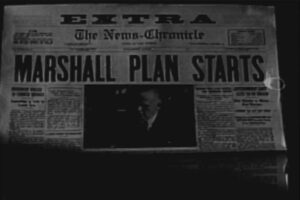
Official reports from the period, particularly those associated with the Marshall Plan, played a significant role in promoting American retail methods to Britain. The United States Technical Assistance and Production Programme (USTAPP) sent delegations of British retailers to the United States to observe self-service in action. These visits were documented in official reports that were circulated among British trade associations. The reports emphasised the efficiency gains of self-service, the use of refrigeration, and the importance of store layout. They were influential in persuading many retailers to experiment with the format. However, these reports often glossed over the differences in British consumer habits and market structure, leading to some early failures when the American model was transplanted without adaptation.
Different Perspectives
The Retailers
Retailers were divided. Some, like Tesco and Premier, embraced self-service enthusiastically, seeing it as a way to cut costs and undercut competitors. They believed that the lower prices would attract customers, even if the personal service was lost. Others, like Sainsbury’s, were more cautious, moving slowly and focusing on the quality of fresh goods. Sainsbury’s management argued that self-service had to be combined with a strong fresh-food offer to be successful in Britain. This difference in approach led to different store formats and business models.
The Consumers
Consumers were initially uncertain. Many were used to the personal attention of the counter, where the shopkeeper knew them by name and could give advice. The self-service store required them to make their own choices, and some felt that the quality of goods was lower because they could not inspect them as closely. However, as prices fell and the range of products increased, many shoppers came to appreciate the convenience. By the end of the 1960s, the majority of British households were buying their groceries in self-service stores, and the counter service was becoming a thing of the past.
What People Feared
One of the greatest fears was that self-service would lead to job losses. The counter service required a large number of assistants, and self-service drastically reduced the need for staff. In a period of full employment and labour shortage, this was actually a relief to many employers, but workers feared redundancy. Another fear was that the quality of food would decline, as goods would be left on open shelves and could be damaged or spoilt. There was also a moral panic about shoplifting, as the open shelves made it easier for customers to steal. These fears were often exaggerated, but they were real and they influenced public opinion.
How Historians See It Today
Modern historians, such as Andrew Godley and Bridget Salmon, argue that the rise of the supermarket in Britain was not a simple copy of the American model, but a complex adaptation to the British context. They emphasize that the British market was more concentrated and had a different structure, with a strong emphasis on fresh food. The success of Sainsbury’s, in particular, shows that the supermarket format was not just about low cost but also about quality and freshness. Historians also point out that self-service had a profound impact on women’s lives, as it changed the way they shopped and gave them more agency, but also placed new responsibilities on them. The transformation from counter service to self-service is now seen as a key moment in the development of modern consumer culture.
In conclusion, the rise of the supermarket was not just a change in the way goods were sold; it was a change in the very relationship between the shopper and the shop. The primary sources from the period show a mixture of excitement and anxiety, as Britons traded the personal service of the counter for the freedom of the open shelf. The story of that transition is a story of how an American innovation was reshaped by British needs, and how it set the stage for the retail landscape we know today.
FAQ
When did self-service begin in Britain?
Self-service began in Britain in the late 1940s and early 1950s, with early adopters like Premier, Laws Stores, and Tesco. The 1960s saw the full supermarket format become widespread.
Why did Sainsbury's take a different approach?
Sainsbury's moved slowly into self-service and instead of copying the American low-cost model, it focused on fresh and perishable goods, investing in refrigeration and quality. This became a template for many later British supermarkets.







Leave a Reply