
Short Answer
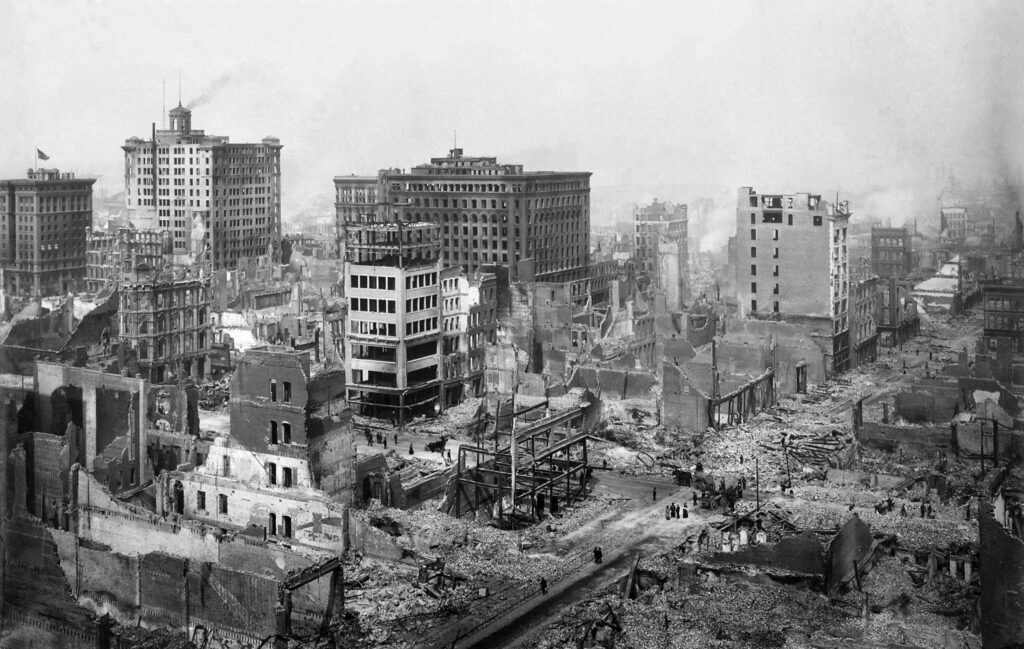
At 5:13 on the morning of April 18, 1906, San Francisco was jolted awake by a violent earthquake. The shock was so sudden and so terrifying that many residents, like Bishop William Ford Nichols, could only describe the sensation in raw, sensory terms: “Jolt-jolt-jolt, sway-sway-sway, rattle-rattle-rattle over big, age-like tens of seconds with a deep diapason of rumbling, and then a great, ugly, last BANG.” Within minutes, the city—already a bustling metropolis of 400,000 people—was transformed into a landscape of ruin and fire. The quake itself toppled buildings, broke gas mains, and ignited dozens of blazes that would burn for three days. By the time the flames subsided, more than half of the city’s residents were homeless, and the heart of San Francisco lay in ashes. The accounts that survive from those hours and days—written in letters, diaries, and official reports—offer an unvarnished window into the terror, confusion, and determination that defined the era. This article draws exclusively on those primary sources to reconstruct what it was like to be alive on that April morning.
What Happened?
The earthquake struck at 5:13 a.m. on April 18, 1906, with an epicenter along the San Andreas Fault, about two miles offshore from the city. The initial shock lasted approximately 40 to 60 seconds, causing widespread damage across the city. Buildings collapsed, streets buckled, and water mains burst, making firefighting nearly impossible. Within minutes, fires broke out from broken gas lines, overturned stoves, and electrical sparks. The conflagration quickly spread, fed by the city’s dense wooden buildings and the lack of water pressure. Over the next three days, the fire consumed over 490 city blocks, including the City Hall, the business district, and thousands of homes. Edward I. de Laveaga, a San Francisco resident, wrote in his diary: “But worse than the sight of the wrecked City Hall were the flames which were fast eating their way to Market Street. When I got down to Fifth Street, the fire seemed at or about Howard. When I neared 3rd Street the flames were just crossing Mission Street. This was about 7:45 A.M.” The fire was eventually stopped by a combination of dynamite, water from fireboats, and favorable winds. The official death toll was later estimated at over 3,000, and more than 250,000 people were left homeless. The earthquake and fire caused property damage estimated at $400 million in 1906 dollars.
How It Was Seen at the Time
Contemporaries experienced the earthquake as a sudden, catastrophic rupture of everyday life. The language of the accounts is often visceral and fragmented, reflecting the chaos. Bishop Nichols, writing to his children, described the shaking as “a great, ugly, last BANG” and later noted that “the whole city seemed to be in motion.” The prevailing mood was one of shock and disbelief, followed by a determined spirit of survival. Many residents initially believed the earthquake was a relatively minor event and that the fires would be controlled, but as the flames spread, fear and urgency mounted. In a letter to his mother on April 21, 1906, Captain George Musson described the earthquake and the subsequent fire, though the full text is preserved in the California Historical Society. The language of the time was often dramatic and emotional, as people tried to convey the enormity of the disaster. The prevailing interpretation was that this was a natural catastrophe, but also a test of the city’s spirit—a sentiment that would later fuel the rebuilding effort.
Historical Snapshot
| Aspect | Detail |
|---|---|
| Date | April 18, 1906 |
| Place | San Francisco, California, United States |
| People | Residents of San Francisco, including Bishop William Ford Nichols, Edward I. de Laveaga, Captain George Musson, and thousands of others |
| What Happened | A major earthquake struck at 5:13 a.m., followed by fires that burned for three days, destroying much of the city. |
| Why It Mattered | The disaster left more than half of the city’s 400,000 residents homeless, killed thousands, and reshaped the city’s physical and social landscape. |
Eyewitness Accounts
The most compelling primary sources are the personal accounts written by survivors in the immediate aftermath. Bishop William Ford Nichols, the Episcopal Bishop of California, wrote a detailed account for his children, which was later published to raise funds for the Church’s Chinese Mission. He described the earthquake as a “Jolt-jolt-jolt, sway-sway-sway, rattle-rattle-rattle” and later recounted the conditions at Mechanics’ Pavilion, a large auditorium turned into an emergency hospital. Another survivor, Edward I. de Laveaga, kept a diary that captured the movement of the fire. He wrote: “When I got down to Fifth Street, the fire seemed at or about Howard. When I neared 3rd Street the flames were just crossing Mission Street. This was about 7:45 A.M.” Emma M. Burke, whose account “Comprehending the Calamity” appears in the San Francisco Museum’s collection, described the confusion and the struggle to understand the scale of destruction. These accounts not only provide facts but also convey the emotional texture of the experience—the fear, the uncertainty, and the sheer will to survive.
Letters & Diaries
Personal letters and diaries are among the most intimate records of the disaster. The California Historical Society preserves many such documents, including a letter from Captain George Musson to his mother, dated April 21, 1906, in which he described the earthquake and its aftermath. Although the full text is not quoted here, the letter is a testament to the immediate shock and the need to communicate with loved ones. Edward de Laveaga’s diary is another critical source. He recorded not only the fire’s advance but also the confusion and the scramble to save belongings. He wrote: “The streets were crowded with people. […] My whole attention was fixed on the fire and so I did not take much note of the damage done by the earthquake.” His words illustrate how the fire became the dominant threat, overshadowing the earthquake itself. Bishop Nichols’s account, written for his children, is both a personal letter and a historical document, providing a vivid narrative of the earthquake’s first moments and the subsequent days.
What People Feared
In the immediate aftermath, residents feared the fire would consume everything, and many feared for their lives. The lack of water to fight the flames heightened the panic. As the fire spread, people feared that the entire city would be destroyed. The fear of looting and lawlessness also emerged, leading to the declaration of martial law. The military and police were deployed to maintain order. Some residents feared that the earthquake would be followed by a tsunami, though that fear was not realized. The greatest fear, however, was the loss of life and the destruction of the city’s commercial and cultural heart. The uncertainty about the fate of loved ones and the scale of the disaster fueled anxiety. The fear of a prolonged fire, as it continued to burn for days, was real, and many believed the entire city would be reduced to ashes.
What People Expected Would Happen Next
In the days following the disaster, contemporaries had varied expectations for the future. Many believed that the city would be rebuilt quickly, as the spirit of San Francisco was strong. However, some feared that the disaster would permanently cripple the city’s economy and its position as the leading city of the West Coast. The rebuilding effort began almost immediately, with temporary housing camps set up in parks and open lots. The expectation that the city would rise again was a common theme in speeches and editorials. The city’s leaders, including Mayor Eugene Schmitz, pledged to rebuild. However, the immediate future was one of uncertainty—how long would the fires last, and how many people would die? The expected outcome was that the city would be rebuilt, but the scale and speed of that rebuilding were unknown. In fact, the rebuilding was swift, but it also led to a new city with modern building codes and a new identity.
Aftermath
The fires were finally extinguished on April 21, 1906, after burning for three days. The immediate aftermath was a city of ruins and refugees. More than half of the 400,000 residents were homeless, and many lived in temporary camps set up in parks, including Jefferson Square. The military and relief agencies provided food, water, and shelter. The city began the slow process of clearing debris and rebuilding. The earthquake and fire led to significant changes in building codes and fire safety regulations. The disaster also had a profound psychological impact on the survivors, many of whom wrote memoirs and letters to preserve the memory. The rebuilding effort was a testament to the resilience of the city’s people, but it also resulted in a new city that was different from the one that had been destroyed. The 1906 earthquake remains one of the most significant events in San Francisco’s history, and the primary sources from that time continue to inform our understanding of the disaster.
The primary sources of the 1906 earthquake and fire offer a powerful, unmediated connection to the past. They show us not only the facts of the disaster—the time, the fire, the destruction—but also the human experience of fear, confusion, and survival. Through the letters, diaries, and eyewitness accounts, we hear the voices of those who lived through the catastrophe, and we see how they made sense of an event that shattered their world. These documents remind us that history is not just a series of dates and statistics, but a story of real people who faced extraordinary circumstances. As we read their words, we are invited to step into their shoes and to understand the enduring significance of this event.
FAQ
What time did the 1906 earthquake strike?
The earthquake struck at 5:13 a.m. on April 18, 1906, as recorded by contemporary accounts, including Bishop William Ford Nichols who described the shaking in his letter.
How many people were left homeless?
According to the NPR article, the earthquake left more than half of the city's 400,000 residents homeless, meaning over 200,000 people were displaced.



Leave a Reply