
Short Answer
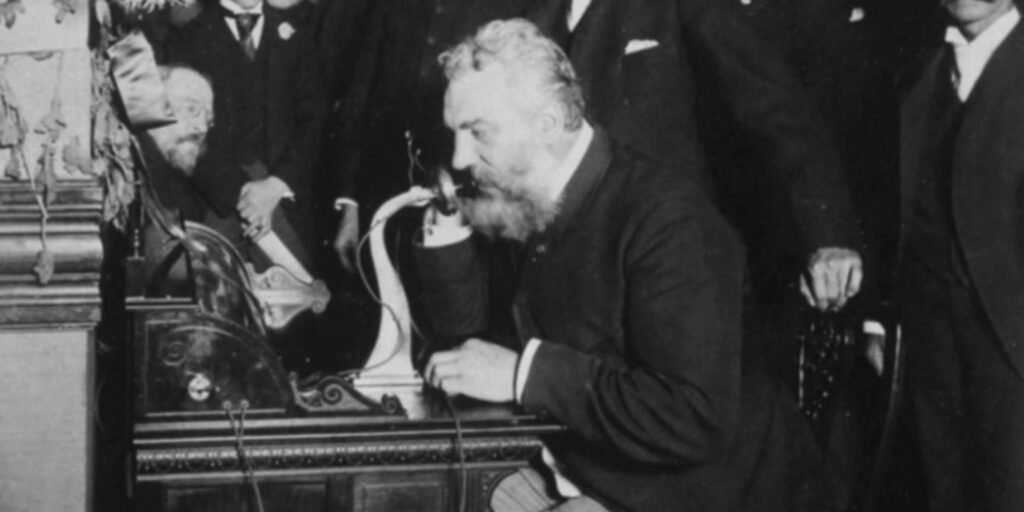
Boston, March 10, 1876. In a small laboratory at 5 Exeter Place, a 29-year-old professor of vocal physiology, Alexander Graham Bell, spilled battery acid on his trousers and instinctively called for his assistant, Thomas Watson, in the next room. “Mr. Watson, come here. I want to see you.” Those nine words, transmitted electrically through a wire, were the first intelligible speech ever carried by the telephone. The age of instantaneous voice communication had begun—though almost no one yet knew it. The public would learn of this marvel gradually, through modest demonstrations and the occasional breathless newspaper dispatch, rather than a grand unveiling.
What Happened?
Bell had spent years working on a “harmonic telegraph,” a device meant to send multiple telegraph messages simultaneously. In the course of his experiments, he became convinced that speech itself could be transmitted electrically. On March 7, 1876, he was granted a patent for the telephone. Three days later, on March 10, he made the first intelligible call. The words were recorded in Bell’s laboratory notebook: “Mr. Watson, come here. I want to see you.” Watson, who was in the next room, heard the words clearly through the receiver.
The first public demonstration came two months later. On May 10, 1876, Bell exhibited his telephone before the American Academy of Arts and Sciences at the Boston Athenaeum. He transmitted music tones over a wire running from his office down the street. The audience was impressed, but the event was modest—not the spectacle that would later accompany the invention.
The telephone’s reach expanded quickly. On February 12, 1877, Bell gave a demonstration in Salem, Massachusetts, before an audience of about 500 people. His assistant, Thomas Watson, remained in Boston. The Boston Globe arranged to have reporters at both ends. The call was the first newspaper dispatch sent by telephone. The Globe’s headline the next day read: “SENT BY TELEPHONE: The First Newspaper Despatch Sent by a Human Voice Over the Wires.” The report described the Salem audience as “thrilled” by the experience.
How It Was Seen at the Time
Contemporary reactions mixed wonder with uncertainty. The Boston Globe breathlessly recounted the Salem demonstration, calling the telephone “that wonderful instrument.” The report conveyed the excitement of the crowd and the novelty of hearing a human voice from a distance. Yet the same article noted that the telephone had “an unpredictable future.” The New York Times did not feature the invention prominently; it instead offered brief accounts of public demonstrations that were often “only modestly successful.” The telephone was not yet a household word, and many saw it as a scientific curiosity rather than a practical device.
“The Salem audience were thrilled as they…” — The Boston Globe, Feb. 13, 1877
Even Bell himself had to convince the world. According to a contemporary account, the inventor was sure he had created a technology that would change history, but he needed to persuade the public. The tone of early coverage was one of cautious excitement—the telephone was wonderful, but its purpose was unclear.
Historical Snapshot
| Aspect | Detail |
|---|---|
| Date | March 10, 1876 (first call); May 10, 1876 (first public demonstration); Feb. 12, 1877 (first newspaper dispatch) |
| Place | Boston, Massachusetts (laboratory and Athenaeum); Salem, Massachusetts (demonstration) |
| People | Alexander Graham Bell, inventor; Thomas Watson, assistant; members of the American Academy of Arts and Sciences; reporters from the Boston Globe |
| What Happened | Bell transmitted speech electrically for the first time; public demonstrations followed, culminating in a telephone call from Salem to Boston that was reported by the Globe. |
| Why It Mattered | The telephone changed communication, making the human voice travel over wires and laying the foundation for modern telephony. |
Contemporary Newspaper Coverage
The Boston Globe was the first newspaper to use the telephone for a news dispatch. On Feb. 12, 1877, the paper’s headline announced the event: “SENT BY TELEPHONE: The First Newspaper Despatch Sent by a Human Voice Over the Wires.” The report described the scene in Salem, where Bell stood before a crowd of 500 and communicated with Watson in Boston. The Globe’s reporters at both ends observed the call, and the article described the Salem audience as “thrilled.”
“SENT BY TELEPHONE: The First Newspaper Despatch Sent by a Human Voice Over the Wires.” — The Boston Globe, Feb. 13, 1877
The New York Times took a more measured approach. In an article titled “The Telephone’s Muted Emergence,” it noted that the telephone was not introduced at an “Apple-style product introduction extravaganza,” but rather through “brief accounts of public, and often only modestly successful, demonstrations.” The Times described a gradual public awareness, rather than a sudden sensation.
Eyewitness Accounts
From the Boston Globe‘s report of the Salem demonstration, we have a vivid eyewitness description. The audience at the Salem lecture hall was “thrilled” as they heard Bell’s voice transmitted from Boston. The report was breathless, conveying the excitement of hearing a human voice over a wire. The Globe’s reporter noted that the event was “a ringing success indeed” (as later echoed by the Boston Athenaeum).
At the Boston Athenaeum demonstration on May 10, 1876, the audience of the American Academy of Arts and Sciences heard music transmitted over the telephone. The event was described as a “ringing success” in the Athenaeum’s own records. The audience was composed of scientists and scholars, who were more likely to understand the technical significance, but the public at large remained skeptical.
What People Expected Would Happen Next
Contemporary expectations were uncertain. The Boston Globe in 1877 called the telephone “a new invention with an unpredictable future.” Some observers expected it to be a novelty, a tool for scientists or for transmitting music, but not a daily necessity. The New York Times coverage suggests that the public did not immediately grasp the telephone’s potential. There was no grand prediction of a global network; instead, the telephone was seen as an improvement on the telegraph, perhaps for sending voice messages in special circumstances.
Bell himself had a broader vision. He believed the telephone would change history. In a contemporary sketch, he depicted his invention as a device that would connect people across distances. But the public’s imagination was limited by the existing telegraph system, and the telephone was initially seen as a novelty for the wealthy or for special events.
How Historians See It Today
Modern historians have shifted the narrative. The first telephone call is now seen as a pivotal moment, but they also emphasize the contested nature of the invention. The Science Museum in London, in an article titled “Ahoy! Alexander Graham Bell and the first telephone call,” asks the question “but did he invent it?” This reflects a historiographical debate about whether Bell was the sole inventor, given that Elisha Gray filed a caveat for a similar device on the same day as Bell’s patent. However, the primary sources of the era—newspapers and public demonstrations—present Bell as the inventor, and the first call is attributed to him.
Historians also note that the public’s reception was not immediate. The telephone’s emergence was “muted,” as the New York Times put it, and it took years for the invention to become a household necessity. The first call was a scientific breakthrough, but its public adoption was gradual. This has led to a more nuanced understanding of how technological innovations are received: not with a bang, but with a series of small, often unremarkable demonstrations.
The primary sources from 1876-1877 show a public that was curious but cautious. The telephone was a marvel, but its ultimate impact was not yet clear. The Boston Globe recognized the novelty, but the New York Times recorded the modest demonstrations. The first telephone call was not a world-changing event in the eyes of the public at the moment; it was a scientific curiosity. Only in hindsight did it become the beginning of a revolution in communication. The primary sources teach us that the past was not a series of dramatic moments, but a slow accumulation of small, sometimes uncertain steps.
FAQ
What were the first words spoken on the telephone?
Alexander Graham Bell said, 'Mr. Watson, come here. I want to see you.' This occurred on March 10, 1876, in his Boston laboratory.
Did the public immediately embrace the telephone?
No. The first public demonstrations were modest, and the New York Times noted that the telephone emerged gradually, with often 'only modestly successful' demonstrations. The Boston Globe's 1877 report called it 'a new invention with an unpredictable future.'













Leave a Reply