
Short Answer
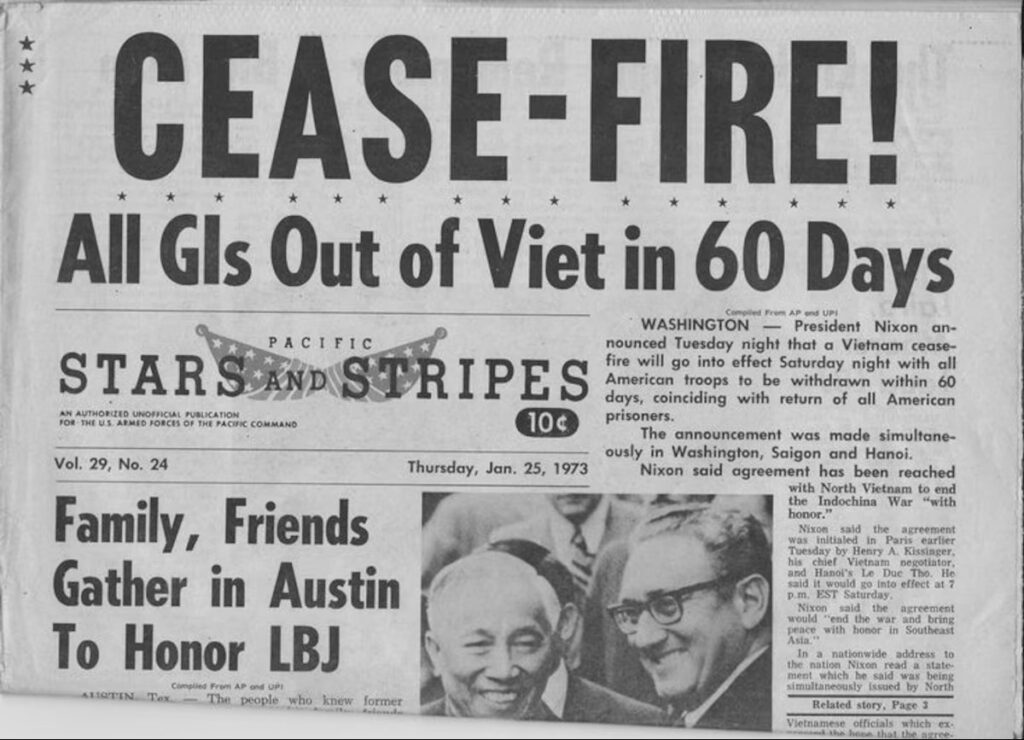
On the evening of 27 January 1973, the gilded salons of the Hôtel Majestic on the Avenue Kléber in Paris were crowded with diplomats, journalists, and photographers. At a long table draped in white, the foreign ministers of the Democratic Republic of Vietnam, the Republic of Vietnam, the Provisional Revolutionary Government of the Republic of South Vietnam, and the United States of America sat to sign a document whose title carried an audacious promise: the Agreement on ending the war and restoring peace in Viet-Nam [1]. The ceasefire was timed to begin at 24:00 GMT that very day. Four days earlier, President Richard Nixon had announced the breakthrough to the American people. In Saigon, crowds gathered under a tense sky; in Hanoi, officials spoke of a step toward unification. For millions of Vietnamese and Americans, the war, it seemed, was finally over. But many who had followed the negotiations through four years of starts and stalls knew that a signature was not the same as peace.
What Happened?
The Paris Peace Accords, officially titled the Agreement on ending the war and restoring peace in Viet-Nam, were signed in Paris on 27 January 1973 [1][2]. The signatories were the Democratic Republic of Vietnam (North Vietnam), the Republic of Vietnam (South Vietnam), the Provisional Revolutionary Government of the Republic of South Vietnam (the PRG, which represented the Viet Cong), and the United States of America [2]. The agreement entered into force upon signature and included a main treaty and accompanying annexes [2].
The key provisions included:
- A ceasefire in place throughout South Vietnam, scheduled to take effect at 24:00 GMT (8:00 PM Saigon time) on 27 January [2].
- The withdrawal of all remaining United States military forces from Vietnam.
- The return of all captured military personnel and foreign civilians.
- The establishment of a Four-Party Joint Military Commission to oversee the ceasefire and implementation [3].
- Recognition of the PRG’s role in the political future of South Vietnam.
US ground forces had begun withdrawing from Vietnam as early as 1969, and by the beginning of 1972 those that remained had very little combat role [2]. The Paris Accords were, in effect, the formal mechanism that completed the US exit. The treaty was registered with the United Nations Secretariat by the United States on 13 May 1974 and recorded in the UN Treaty Series under Volume 935, Treaty No. 13295 [1][2].
How It Was Seen at the Time
The public announcement came four days before the signing. On 23 January 1973, President Richard Nixon addressed the nation from the White House, declaring that the United States and North Vietnam had reached an agreement in Paris on “ending the war and restoring peace” in Vietnam [3]. The phrase “peace with honor” was on many lips, though the official language was more measured. In Washington, the mood was one of relief tempered by caution; in Saigon, President Nguyễn Văn Thiệu had signed under duress, fearing abandonment; in Hanoi, the agreement was presented as a victory of revolutionary struggle.
“On 23 January 1973, the President announced to the Nation that the United States and North Vietnam had reached agreement in Paris on ‘ending the war and restoring peace’ in Vietnam.”
The prevailing interpretation among the American public was that the war was over and the troops would be coming home. But among military officials and South Vietnamese leaders, there was deep skepticism. The ceasefire, many suspected, would be violated within hours. The Four-Party Joint Military Commission, charged with monitoring the ceasefire, faced an almost impossible task from the outset [3].
Historical Snapshot
| Aspect | Detail |
|---|---|
| Date | 27 January 1973 (ceasefire at 24:00 GMT) |
| Place | Paris, France (International Conference Center) |
| People | United States, Democratic Republic of Vietnam, Republic of Vietnam, Provisional Revolutionary Government |
| What Happened | Signed the Agreement on Ending the War and Restoring Peace in Viet-Nam, with a ceasefire and US withdrawal |
| Why It Mattered | Formally ended US military involvement in Vietnam but failed to end the war itself |
What People Knew at the Time
| What People Knew Then | What We Know Now |
|---|---|
| The ceasefire would stop the fighting in South Vietnam. | The ceasefire was violated almost immediately; major fighting continued for two more years. |
| The US would withdraw all forces and bring back POWs. | US forces did withdraw and POWs were returned, but the war continued. |
| The agreement would “end the war and restore peace” as its title promised. | The agreement was effectively a US exit mechanism; it failed to bring a durable peace. |
| The Four-Party Joint Military Commission would supervise the ceasefire. | The Commission was unable to resolve disputes; the ceasefire broke down quickly. |
Official Reports
The most detailed official account of the implementation comes from Walter Scott Dillard’s Sixty Days to Peace: Implementing the Paris Peace Accords, Vietnam 1973, published by the National Defense University in 1982 [3][4]. Dillard, who served with the US Delegation to the Four-Party Joint Military Commission, described the chaotic and often frustrating sixty-day period following the signing. The report, cleared for public release, details the difficulty of implementing a ceasefire in a country where no clear front lines existed.
The treaty text itself, as recorded in the United Nations Treaty Series, provides the official language of the agreement, including the provisions for the ceasefire and the political framework [1]. The UN record also includes the earlier Geneva Conference Final Declaration of 1954, which had attempted to restore peace in Indochina and set the stage for the later conflict [1].
What People Expected Would Happen Next
In the weeks after the signing, expectations varied sharply. Many Americans expected a swift withdrawal of the remaining troops and the return of prisoners of war—both of which did occur. The South Vietnamese government, however, feared that the US departure would leave them vulnerable to a renewed North Vietnamese offensive. The North Vietnamese, for their part, viewed the agreement as a stepping stone toward the reunification of Vietnam under their rule.
Military planners within the US government were cautious. Dillard notes that the accord provided for a Four-Party Joint Military Commission, but the practical challenges of implementing a ceasefire in a guerrilla war were immense [3]. The sixty-day implementation period was expected to be difficult, and it was. The ceasefire was violated almost immediately, and the Commission spent most of its time investigating infractions rather than preventing them.
Key Documents
- Agreement on Ending the War and Restoring Peace in Viet-Nam (27 January 1973) — The main treaty, signed by the four parties, establishing the ceasefire and US withdrawal [1][2].
- Protocol on the Cease-Fire in South Vietnam — Annex to the agreement detailing the ceasefire arrangements and the Joint Military Commissions [4].
- The Final Declaration of the Geneva Conference (1954) — The earlier accord on restoring peace in Indochina, recorded in the same UN Treaty Series volume as the Paris Agreement [1].
- Sixty Days to Peace: Implementing the Paris Peace Accords, Vietnam 1973 — Walter Scott Dillard’s official military history of the implementation period [3][4].
Aftermath
The ceasefire did not hold. Within weeks, both sides accused each other of major violations. The US completed its military withdrawal and the return of POWs, but the North Vietnamese continued to supply and reinforce their forces in the South, and the South Vietnamese government attempted to consolidate control over contested areas. The Four-Party Joint Military Commission was unable to resolve the disputes.
The agreement’s failure became complete on 30 April 1975, when North Vietnamese forces captured Saigon, ending the Vietnam War in a way the Paris Accords had not. The war had continued for more than two years after the signing, costing tens of thousands of additional lives.
How Historians See It Today
At the time, the Paris Peace Accords were presented as a victory for “peace with honor.” The contemporary interpretation was that the agreement had ended the war and restored peace, as its title claimed. Modern historians, however, view the accords as a temporary ceasefire that functioned primarily as a US exit strategy. The agreement did not address the fundamental political differences between North and South Vietnam, and it did not provide a mechanism for resolving those differences.
Historians also emphasize that the Accords were the result of a long and painful process. The US had begun withdrawing ground forces in 1969 [2], and by early 1972, the US military presence was minimal. The Paris Accords formalized a US departure that was already well underway, and it gave the North Vietnamese a free hand to continue their struggle for unification. The war continued for another two years, and the final outcome was determined by force, not by the provisions of the Paris Agreement.
The primary sources—the treaty text, the military reports, and the contemporary accounts—paint a picture of a peace that was never truly established. The signature on 27 January 1973 was a moment of hope, but the hope was not fulfilled. The Paris Peace Accords stand as a reminder that a treaty is only as strong as the will to enforce it.
FAQ
Did the Paris Peace Accords end the Vietnam War?
No. The Accords, signed on 27 January 1973, established a ceasefire and provided for US withdrawal, but the ceasefire was violated almost immediately. The war continued until the fall of Saigon on 30 April 1975, when North Vietnamese forces captured the South Vietnamese capital. The Paris Accords formally ended US military involvement but did not end the war itself.
Who signed the Paris Peace Accords?
Four parties signed the agreement: the United States of America, the Democratic Republic of Vietnam (North Vietnam), the Republic of Vietnam (South Vietnam), and the Provisional Revolutionary Government of the Republic of South Vietnam (the PRG, representing the Viet Cong). The agreement was signed in Paris on 27 January 1973.
What was the Four-Party Joint Military Commission?
The Four-Party Joint Military Commission was established by the Paris Peace Accords to supervise the ceasefire in South Vietnam. It was composed of representatives from the United States, North Vietnam, South Vietnam, and the PRG. The Commission faced significant challenges and was unable to prevent the ceasefire from breaking down.











Leave a Reply