
Short Answer
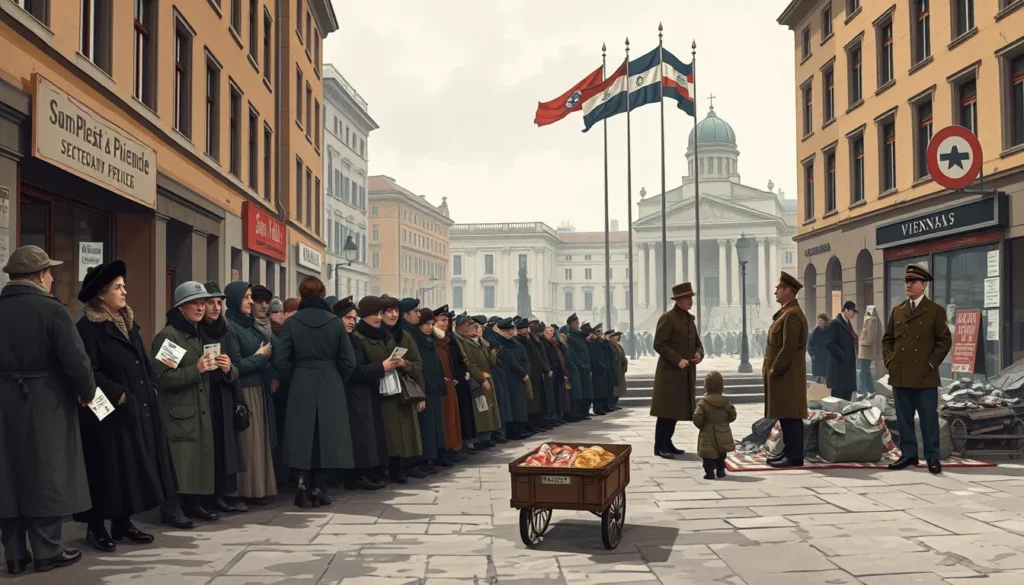
By April 1945 Vienna was a city of rubble, queues and rumours. The fighting that ended the German occupation had left more than a fifth of the housing stock damaged or destroyed, almost 87,000 flats uninhabitable and more than 3,000 bomb craters in the urban area; bridges, sewers, gas and water pipes were broken. Viennese emerged into a city simultaneously “liberated” and occupied. In the First District four Allied powers would soon share an Inter-Allied Zone, while the outer districts were parcelled into Soviet, American, British and French sectors. Food came from soldiers and relief parcels; ration cards multiplied; the Naschmarkt and the Resselpark became black-market bourses. The Austrian diplomat Josef Schöner noted in his diary that the American takeover of his district on 3 September 1945 was followed at once by “lard and real coffee.” This article reconstructs that world from contemporary reports, diaries, ration cards, museum objects and official records, and asks how Viennese lived through occupation, shortage and a divided city between 1945 and 1955.
What Happened?
Vienna’s postwar order was improvised before it was formalised. In April 1945, within days of the fighting, a provisional city government was constituted and political parties re-emerged. The city was in no condition for normal government. The municipal archives record that more than 20 percent of the housing stock was partly or completely destroyed, almost 87,000 flats had become uninhabitable, and the urban area contained more than 3,000 bomb craters. Many bridges were in ruins, and sewers, gas and water pipes had suffered severe damage. The immediate imperative was to restore basic services and feed the population.
- 1 May 1945: The Red Army distributed confiscated food to the Viennese, a measure remembered as the “Erbsenspende” (pea donation). From June it supplied further rations, this time against later payment.
- 9 July 1945: The victorious powers agreed the “Zonenabkommen” on sector boundaries and the administration of Vienna. The First District became an Inter-Allied Zone governed by all four powers.
- 1 September 1945: The Western Allies took over their sectors: the Americans Neubau, Josefstadt, Alsergrund, Hernals, Währing and Döbling; the British Hietzing, Meidling, Margareten, Landstraße and Simmering; the French Mariahilf, Penzing, Fünfhaus and Ottakring. All other districts remained under Soviet control. Districts 22–26, created by the Nazi expansion of 1938, were treated as Lower Austrian and also came under Soviet control.
- 3 September 1945: Food distribution began in the American, British and French zones. Viennese now faced five supply areas and five ration cards that could not be redeemed in other sectors.
- November 1945: The first City Council elections restored democratic politics. The 100 seats were divided among the Socialists (58), the People’s Party (36) and the Communists (6).
- 1946–1954: The Territorial Review Act of 1946 sought to reverse the 1938 expansion, but Allied approval was withheld for eight years; it took effect in 1954, leaving Vienna with 23 districts.
- May 1955: The Austrian State Treaty ended the occupation. Marshall Plan aid and the cessation of Soviet confiscations helped the city economy turn decisively upward.
How It Was Seen at the Time
Contemporaries experienced the occupation less as a single regime than as a patchwork of zones, queues and jurisdictions. The language of the period is revealing: “Besatzungszonen,” “Inter-alliierte Zone,” “Erbsenspende,” “Hamsterfahrten,” “Schleichhandel.” For many Viennese the Red Army’s food distribution in May 1945 was real relief; it was also remembered with ambivalence, because the peas contained worms and because Soviet soldiers were associated with plundering, assault and rape. The Western sectors were widely regarded as better supplied. The Vienna Kurier reported on 12 September 1945 that the “Civilian Supply Section of Vienna Area Command” had eased the food situation through unbureaucratic action, distributing grain, wheat flour, sugar, real coffee, lard and salt.

“The USA took over our administration from the Russians today and introduced themselves so well! Already there are considerable differences in the provisioning of the zones […] The inhabitants of the US zone are best supplied. This week we will even get lard and real coffee.” — Josef Schöner, diary, 3 September 1945 (translated from German)
This was not merely gratitude for calories. It was a way of mapping the city: the American sector as better fed, the Soviet sector as more feared, the First District as shared ground. The occupation was seen through food as much as through flags.
Historical Snapshot
| Aspect | Detail |
|---|---|
| Date | April 1945–May 1955 |
| Place | Vienna, Austria; four Allied sectors and the Inter-Allied Zone in the First District |
| People | Viennese civilians; Soviet, American, British and French occupation authorities; provisional and elected city governments; relief workers; diarist Josef Schöner |
| What Happened | The city was occupied and divided, its housing and infrastructure badly damaged; food shortages and black-marketeering shaped daily life; democratic elections resumed in November 1945; the State Treaty ended occupation in 1955. |
| Why It Mattered | Vienna became a laboratory of four-power administration and a test of how a devastated European city could be fed, governed and rebuilt. |
Letters & Diaries
Personal records show how quickly the occupation entered private life. Josef Schöner, an Austrian diplomat, kept a diary in Vienna in 1945. His entry for 3 September—the day the Americans took over his district—is one of the most direct witnesses to the zone system: he compared provisioning across sectors, noted the arrival of lard and coffee, and described the bread received that day as something to be looked at “reverently and with emotion.” The entry captures a mood that official records rarely do: relief at food, curiosity about the new occupiers, and a hunger sharpened by months of uncertainty.
They looked at the bread they received that day “reverently and with emotion.” — Josef Schöner, diary, 3 September 1945 (translated from German)
Daily Life
Daily life was organised around scarcity. Viennese carried ration cards that differed by sector and could not be used elsewhere; a family in the French zone and a family in the Soviet zone might stand in different queues, receive different parcels and pay different black-market prices. The black market concentrated at the Naschmarkt and the Resselpark in front of the Karlskirche. Many urban dwellers made Hamsterfahrten—treks to the countryside to barter clothing, watches or household goods for potatoes, eggs or flour. Housing was equally precarious: thousands lived in damaged flats, cellars or with relatives while municipal crews repaired gas, water and tram lines. Relief came from many quarters. The Red Army’s “pea donation” was followed by further Soviet rations; the US Army distributed food packages and its “10-in-1” ration menus; from 1946 CARE packages, purchased from surplus US Army rations and sent by the Cooperative for American Remittances to Europe, reached Austrian households. The city government made welfare for the young and old, repair of municipal utilities and rebuilding its first priorities.
Numbers at the Time
| Statistic | Figure |
|---|---|
| Housing stock partly or completely destroyed | More than 20% (City of Vienna) |
| Flats uninhabitable | Almost 87,000 (City of Vienna) |
| Bomb craters in the urban area | More than 3,000 (City of Vienna) |
| Vienna City Council seats, November 1945 | Socialists 58; People’s Party 36; Communists 6 (City of Vienna) |
| Daily calories for normal consumers, September 1945 | 1,550 (Wien Museum) |
| Daily calories, March 1946 | 1,200 (Wien Museum) |
| Daily calories, May 1946 | 950 (Wien Museum) |
| Ration systems in Vienna after September 1945 | Five supply areas and five ration cards (Wien Museum) |
Timeline
- October 1938: Nazi Greater Vienna expansion merges 97 Lower Austrian communities; the postwar Allies refused to accept the expansion.
- April 1945: Fighting ends; provisional city government constituted; political parties re-emerge amid ruin.
- 1 May 1945: Red Army distributes confiscated food, remembered as the “Erbsenspende.”
- June 1945: Red Army supplies further rations against later payment.
- 9 July 1945: Zone agreement defines sectors and the Inter-Allied Zone.
- 1 September 1945: Western Allies take over their sectors.
- 3 September 1945: Food distribution begins in western zones; five ration systems operate.
- November 1945: First City Council elections: Socialists 58, People’s Party 36, Communists 6.
- 1946: Territorial Review Act passed; Allied approval withheld.
- 1954: Territorial change takes effect; Vienna has 23 districts.
- May 1955: Austrian State Treaty ends occupation.
What People Feared
The most rational fear was starvation. Rations fell from 1,550 calories in September 1945 to 1,200 in March 1946 and 950 in May 1946. The economic research institute warned that Austria could not sustain itself by its own efforts and that if left alone hunger and chaos would follow. Viennese also feared the soldiers of the Red Army. The Wien Museum’s summary of occupation memory notes that alongside the “Erbsenspende” people remembered worms in the peas and, more gravely, plundering, assaults and rapes by Soviet soldiers; these were not simply rumours but part of the documented texture of occupation experience. A further anxiety was the division itself. Five ration systems and four sectors made the city’s fragmentation tangible, and no one in 1945 could know how long the four-power arrangement would last. The worst-case scenario—permanent partition or another winter of collapse—did not come to pass, but it was a reasonable fear in a city where the next meal was uncertain.
Vienna after 1945 shows how occupation is lived through small objects and daily routines: a ration card valid only in one sector, a CARE tin, a diary entry about bread, a queue at the Resselpark. The four-power administration is usually remembered as a diplomatic prelude to the State Treaty, but primary sources restore its texture—the relief and resentment that came with foreign food, the black market that supplemented official rations, the repair of sewers and tram lines, the slow return of elections. The city was divided, but not frozen; Viennese rebuilt institutions and infrastructure while the flags of four powers flew over the First District. When the occupation ended in 1955, it left behind both a recovered city and a memory of scarcity that shaped postwar Austrian identity.
FAQ
How was Vienna divided after World War II?
Vienna’s pre-1938 districts were divided into four Allied sectors: American, British, French and Soviet. The First District formed an Inter-Allied Zone governed by all four powers. Districts 22–26, created by the 1938 Nazi expansion, were treated as Lower Austrian and came under Soviet control. After September 1945 the city also had five food-supply areas, so ration cards often could not be used across sector boundaries.
What was the Erbsenspende?
The “pea donation” was the Red Army’s distribution of confiscated food in Vienna on 1 May 1945. It provided immediate relief but was remembered ambivalently: contemporaries recalled worms in the peas as well as the hunger it temporarily eased.
Why did Vienna have five ration systems?
After the Western Allies took over their sectors on 1 September 1945 and food distribution began on 3 September, each power ran supply in its own zone; the Inter-Allied Zone and Soviet zone added further arrangements. The result was five supply areas and five ration cards that could not be redeemed in other sectors.
When did Allied occupation end in Vienna?
The Austrian State Treaty was signed in May 1955 and ended the four-power occupation. The last Allied troops left later that year, and Austria regained full sovereignty.
Did all Viennese experience occupation the same way?
No. Provisioning differed sharply by sector; the Western zones were generally considered better supplied than the Soviet zone. Diarist Josef Schöner noted on 3 September 1945 that the US zone was best supplied and that his household would receive lard and real coffee. Food, housing and black-market access varied by district and by household.










Leave a Reply