
Short Answer
By the mid-1930s, central Appalachia had been depressed for more than a decade. In Harlan County, Kentucky, company houses lined the creek bottoms, and miners who had once worked six days a week now waited for four. A 1932 county summary report called idle men “victims of circumstances” and estimated that about 1,000 had been blacklisted as “Reds” or “trouble makers.” Into this landscape came the New Deal’s work-relief agencies, culminating in the Works Progress Administration (WPA), created in 1935. The WPA employed men and women on roads, schools, bridges, and sewers; ran sewing rooms and school lunch programs; and, through the Federal Writers’ Project and Historical Records Survey, sent interviewers and photographers into mountain communities. Those records—project reports, statistics, photographs, life histories, and county surveys—are among the richest primary sources for understanding Appalachian poverty, labor, and daily life in the 1930s. They show a region struggling with unemployment, disease, and displacement, but also with resilience and mutual aid.
What Happened?
The Great Depression arrived early in Appalachia. The coal industry had already contracted in the 1920s as overproduction, mechanization, and labor conflicts reduced working days. The 1929 crash deepened the crisis. By the early 1930s, thousands of miners and families in eastern Kentucky, southern West Virginia, western Virginia, and eastern Tennessee lived without regular wages. Company stores extended credit; company houses came with the job; when the job vanished, so did the house. County relief funds were overwhelmed.
Federal intervention began in 1933. The Federal Emergency Relief Administration (FERA) funded direct relief, while the Civil Works Administration (CWA) provided short-term work during the winter of 1933–34. In 1935, the Emergency Relief Appropriation Act and Executive Order 7034 created the Works Progress Administration, renamed the Work Projects Administration in 1939. It operated until June 30, 1943.
- 1929: The stock market crash worsens an already depressed Appalachian coal economy.
- 1931–32: Strikes and unrest in Harlan County, Kentucky, draw national attention; relief agencies struggle to define who is eligible for aid.
- 1933: FERA and CWA begin federal relief and work programs.
- 1935: The WPA is established; projects begin across Appalachia.
- 1935–43: WPA workers build roads, bridges, schools, and public buildings; operate sewing rooms, school lunch programs, and library services; and compile Federal Writers’ Project and Historical Records Survey records.
- 1939: The WPA is renamed the Work Projects Administration.
- 1943: The agency is abolished as wartime employment absorbs the unemployed.
WPA records document more than employment. The Division of Statistics collected wage and hours data. Project files recorded materials, workers, and completed projects. The Federal Writers’ Project produced guides and life histories; the Historical Records Survey catalogued county archives; photographers captured housing, schools, and families. Together, these records allow an unusually intimate reconstruction of daily life.
How It Was Seen at the Time
Contemporaries understood the WPA in several ways. For unemployed miners and farmers, it was a lifeline—often the only cash income. For local officials and operators, it was cheap labor and a potential threat to wage rates. For critics, it was “made work” or “boondoggling.” For recipients, it was necessary but often humiliating: pay was low, work was hard, and eligibility was means-tested. The language of the era was the language of “relief,” “work relief,” “the security wage,” and “the relief rolls.”
The 1932 summary report on Bell and Harlan counties captured the official view of the unemployed. It defended the Red Cross against charges that it had refused aid to strikers:
“Red Cross refuses help to striking miners or unemployed miners under instructions from National Red Cross office in Washington. Intended to give help to those affected by drouth only.” —Summary of Report on Bell and Harlan Counties, 1932
The same report offered a more sympathetic description of the blacklisted miner, while still using the political vocabulary of the day:
“Many idle men are victims of circumstances—having been intimidated and quit work for this reason. They are not Reds, Communists or trouble makers, but are so classed by mine operators and cannot find employment in county.” —Summary of Report on Bell and Harlan Counties, 1932
The prevailing mood was anxious and divided. People feared dependence on relief, but they also feared hunger, eviction, and disease. They welcomed WPA jobs, but they resented low wages and the stigma attached to them. They suspected that relief was arbitrary and that local power holders decided who would eat.
Historical Snapshot
| Aspect | Detail |
|---|---|
| Date | 1933–1943, with the WPA proper from 1935 to 1943 |
| Place | Central Appalachia: eastern Kentucky, southern West Virginia, western Virginia, eastern Tennessee, western North Carolina, and neighboring counties |
| People | Unemployed miners and farmers, WPA workers, Federal Writers’ Project interviewers, photographers, local relief officials, county physicians, and mine operators |
| What Happened | New Deal work-relief agencies employed Appalachians on public works and cultural projects and produced a vast documentary record of wages, hours, health, housing, and daily life |
| Why It Mattered | The WPA provided income and infrastructure during the Depression and left one of the richest primary-source collections on Appalachian life in the 1930s |
Official Reports
Record Group 69 at the National Archives preserves WPA administrative, statistical, project, and information records. State and county reports record employment, wages, hours, materials, and completed projects. For Appalachia, they are indispensable because they document the daily mechanics of relief.
The 1932 summary report on Bell and Harlan counties described a coal economy running at reduced capacity. According to the report, mines operated an average of four days per week, and any further reduction would leave miners unable to earn a living. Average mine wages were about $3.50 to $4.00 per day; common labor received approximately $2.00 per day. About 1,000 men connected with strikes, or known as Socialists and Reds, or “unfortunately classed as such,” could not find employment. The report also recorded a dysentery epidemic that caused many deaths in rural communities.
The report was not neutral. It was written from the perspective of local officials and relief administrators sympathetic to mine operators and suspicious of outside organizers. It accused Theodore Dreiser, the novelist who visited Harlan County in 1931, of publishing misleading and untrue statements about wages and conditions. That accusation reminds us that official reports are themselves primary sources with their own biases.
Eyewitness Accounts
WPA records preserve eyewitness testimony in several forms. Federal Writers’ Project interviewers collected life histories from farmers, miners, and laborers. County reports recorded the observations of physicians and relief workers. The following passage comes from the Bell and Harlan county report, which summarized the testimony of Dr. Edward Wilson, a physician who had traveled throughout the county:
“Dr. Edward Wilson stated as to health in the County, that he had been pretty well over the entire county a number of times in the past summer months, and that there had been an epidemic of dysentery in the country during the season. This had resulted in many deaths in the country communities.” —Summary of Report on Bell and Harlan Counties, 1932
Dr. Wilson’s testimony opens a window onto the health conditions that WPA workers and relief officials confronted. Dysentery was linked to contaminated water, poor sanitation, and crowded housing—conditions common in coal camps and rural hollows. Other WPA records, including photographs and project reports, show the same concerns: outdoor privies, unprotected springs, unpaved roads, and one-room schools without running water.
Daily Life
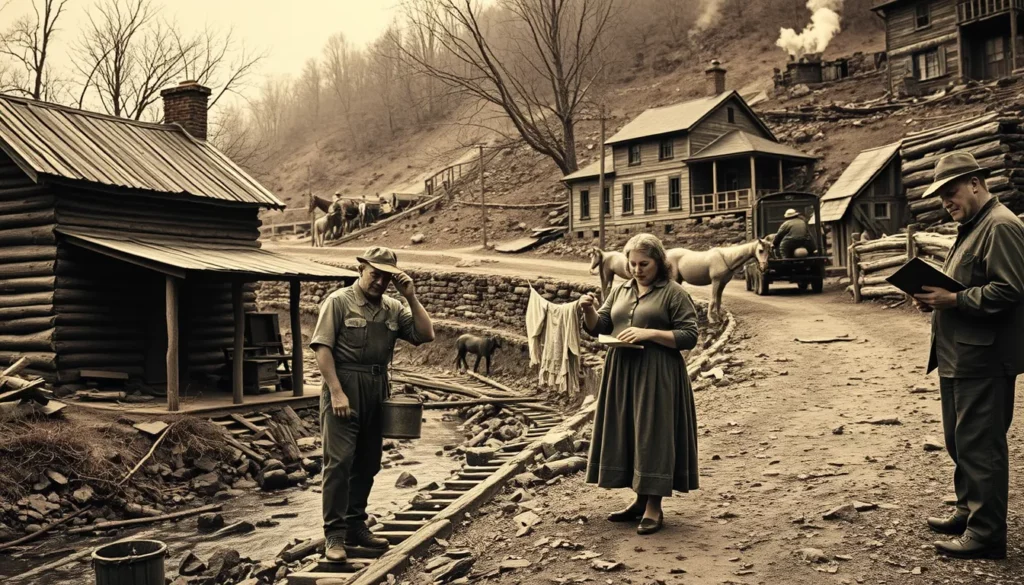
For most Appalachian families in the 1930s, daily life was organized around work, food, fuel, and kin. In coal camps, families lived in company houses—often small frame structures with four or five rooms, no running water, and an outdoor privy. In rural hollows, families lived in log cabins or boxed houses, heated with wood or coal, lit by kerosene lamps, and supplied by springs or wells. WPA photographs and project reports record these conditions without sentimentality: weathered siding, patched roofs, barefoot children, and laundry stiffening on the line.
Food was simple and seasonal. Cornbread, beans, potatoes, pork, and garden vegetables formed the base of many meals. Families canned what they grew; WPA canning and sewing projects helped stretch scarce resources. School lunch programs provided at least one hot meal for children who might otherwise go hungry. Clothing was patched and repatched; WPA sewing rooms made garments and bedding for relief families. In the coalfields, miners wore overalls, work shirts, and caps; women wore print dresses, aprons, and coats made over from older garments.
Work was varied and hard. Miners worked shifts underground when the mines ran; farmers plowed, planted, and harvested with horse or mule teams; women managed households, gardens, and children. WPA workers built roads, bridges, school buildings, and sanitary facilities. The Federal Writers’ Project employed unemployed teachers and writers to interview residents and compile guides. The Packhorse Library Project, a WPA initiative in eastern Kentucky, carried books to isolated homes on horseback and muleback. Churches, quilting bees, fiddle music, and Decoration Day gatherings provided social continuity. The records show a world of scarcity, but not of cultural emptiness.
Numbers at the Time
| Statistic | Figure | Source/Year |
|---|---|---|
| Average daily wage in Harlan County mines | $3.50–$4.00 | Bell and Harlan Counties report, 1932 |
| Minimum daily wage for common labor | Approximately $2.00 | Bell and Harlan Counties report, 1932 |
| Average mine operating time | Four days per week | Bell and Harlan Counties report, 1932 |
| Miners idle or blacklisted | About 1,000 | Bell and Harlan Counties report, 1932 |
| WPA lifespan | 1935–1943 | Record Group 69, National Archives |
| Predecessor relief agencies | FERA and CWA, 1933–1935 | Record Group 69, National Archives |
The WPA records do not merely document poverty; they preserve the voices, wages, meals, illnesses, and hopes of people who lived through the Depression in Appalachia. They show that the 1930s were not a single story of passive suffering. Mountain families worked, organized, shared, and endured. They also show how government relief was experienced as both salvation and stigma, and how local power shaped who received help. Reading these records today requires attention to their biases—the reports were written by officials, not by the poorest families—but also gratitude for the detail they preserve. They remain a vital bridge to a world that is gone, and a reminder that the history of poverty is also the history of work, dignity, and survival.
FAQ
What were WPA records?
WPA records are the administrative, statistical, project, photographic, and interview materials created by the Works Progress Administration and its predecessors. They include project files, wage and hour reports, county surveys, Federal Writers' Project life histories, and Historical Records Survey inventories. Record Group 69 at the National Archives preserves the core federal records.
How did the WPA affect Appalachia?
The WPA provided paid work on roads, bridges, schools, public buildings, and sanitation projects. It also operated sewing rooms, school lunch programs, canning projects, and library services such as the Packhorse Library Project. For many families, WPA wages were the only cash income during the Depression.
What do WPA records reveal about daily life in the 1930s?
They document housing conditions, wages, working hours, food supplies, health problems, clothing, education, and relief eligibility. Photographs and life histories capture the material details of mountain life, while county reports record official attitudes toward poverty, labor unrest, and relief.













Leave a Reply