
Short Answer
Quick Snapshot
Kuwait City in 1990 is remembered less as an ordinary capital than as the stage on which Iraq’s invasion of Kuwait turned daily life into a test of endurance. On 2 August, before dawn, Iraqi forces crossed the border and moved on the city; within hours the emir and government had fled, and Kuwait City became the administrative and symbolic center of a seven-month occupation. This article treats “Kuwait City in 1990” as the capital during the invasion and occupation that lasted into February 1991, with eyewitness diaries and contemporary press reports as its central evidence.
The city’s wide roads, air-conditioned offices, apartment blocks, souqs, and embassies were suddenly overlaid by checkpoints, Iraqi armor, curfews, and rumors. Foreign correspondents such as Caryle Murphy of The Washington Post and Victor Mallett of the Financial Times recorded the shock of a modern Gulf metropolis brought under military rule. Their accounts, filed after escape, describe not a single battle but a social unraveling: residents hiding valuables, expatriates seeking exit, and Kuwaitis testing what could be said aloud.
Because censorship and fear limited reporting, the record is fragmentary and often personal. Yet the eyewitness material is unusually vivid. It shows how a city accustomed to oil wealth, commerce, and a large expatriate workforce experienced invasion as a rupture in time, memory, and ordinary routine.
Kuwait City in 1990
Kuwait City sits on the southern shore of Kuwait Bay, a natural harbor that has made it a trading and pearling center long before oil. By 1990 it was a modern capital of broad ring roads, low-rise commercial districts, mosques, ministries, hospitals, schools, and concrete apartment buildings. The old center around the souqs and the waterfront stood beside newer districts such as Salmiya, Hawalli, and Farwaniya, which together formed a sprawling metropolitan area. Summer was hot and humid, with temperatures often above 40°C; in August 1990 the heat became part of the ordeal of queuing, hiding, and moving through checkpoints.
The city was also a mosaic. Kuwaiti families, South Asian and Egyptian workers, Filipino domestic staff, Palestinian professionals, Western oil and banking employees, diplomats, and journalists shared the same streets but experienced the occupation differently. Arabic, English, Urdu, Malayalam, Tagalog, and other languages were heard in shops and offices. The invasion did not erase that diversity; it made it more dangerous, as foreign residents became potential hostages or bargaining chips.
Kuwait City was not the whole country, but it concentrated the state’s institutions: the Emir’s palaces, the National Assembly building, ministries, banks, the central souq, Kuwait University’s city campus, hospitals, and the airport road. When those institutions were seized or shut, the capital became a gauge of how completely Kuwait had been occupied.
Population & Economy
Kuwait’s population in 1990 was roughly two million, with Kuwaitis a minority and expatriates forming a large share of the labor force. Kuwait City and its surrounding governorates held the largest concentration of residents, offices, and services. No reliable wartime census exists; the invasion and occupation triggered flight, displacement, and concealment, so figures for the city alone are estimates rather than exact counts.
The economy was oil-dominated. Crude production, refining, petrochemicals, shipping, and the financial management of oil revenues underpinned national income. Kuwait City itself was the headquarters for banks, investment houses, insurance firms, trading families, government ministries, and the Kuwait Investment Authority. The Kuwaiti dinar was a strong currency, roughly equivalent to US$3.50 in 1990, and fuel and many basic goods were subsidized. Imported food, clothing, electronics, and household goods filled the souqs and air-conditioned shopping streets.
Occupation disrupted this economy abruptly. Banks closed or limited withdrawals; shops shuttered; oil facilities were damaged or militarized; foreign workers lost jobs and sought evacuation. Looting and requisitioning stripped businesses, and the informal economy of barter, hoarded goods, and favor exchange grew. The city’s prosperity did not vanish overnight, but it was frozen, hidden, or redirected into survival.
Government & Politics
In 1990 Kuwait was an emirate led by Sheikh Jaber al-Ahmad al-Sabah, with Crown Prince Sheikh Saad al-Abdullah al-Sabah as prime minister. The National Assembly had been suspended since 1986, and the emir ruled by decree. Kuwait City was the seat of the Sabah family, the cabinet, and the bureaucracy. Its palaces and ministries were therefore immediate targets when Iraqi forces entered the capital.
On 2 August the emir and senior officials escaped to Saudi Arabia. Iraq quickly installed a pliant “free provisional government” and then, on 8 August, declared Kuwait annexed as Iraq’s nineteenth province. In Kuwait City, Iraqi officials, soldiers, and intelligence agents replaced or supervised civil authority. Kuwaiti resistance cells, often small and decentralized, emerged in neighborhoods and workplaces; their leaflets, graffiti, and clandestine networks became a counter-government of rumor and morale.
The political climate was one of fear and uncertainty. Public gatherings were banned, curfews imposed, and checkpoints controlled movement. Loyalty could be inferred from a car, a family name, or a conversation. The occupation made politics intimate: what one said at a shop, whether one flew a flag, whether one sheltered a foreigner, or whether one joined a protest could determine safety.
Industry
Kuwait City’s industry was less smokestack manufacturing than commerce, finance, and services organized around oil wealth. The Kuwait Oil Company and related ministries managed production, while the city hosted banks such as the National Bank of Kuwait, insurance companies, shipping agents, construction firms, and import-export houses. The port at Shuwaikh handled goods for the capital; the international airport linked it to the world. The central souq, gold market, and modern shopping streets formed a retail network dependent on imports and expatriate labor.
After 2 August, Iraqi forces seized vehicles, equipment, and supplies. Factories and workshops outside the city center slowed or stopped. Oil-sector installations were militarized, and the occupation authorities sought to redirect Kuwaiti resources to Baghdad. The city’s commercial rhythm—early office hours, afternoon closures, evening shopping—was replaced by curfew schedules and the threat of arbitrary detention.
Small trades persisted. Bakers, mechanics, pharmacists, and food sellers became vital. But the formal economy was under duress, and the occupation turned many workplaces into sites of suspicion, resistance, or forced collaboration.
Education
Kuwait had invested heavily in education. Kuwait University, founded in 1966, was the leading higher-education institution, and the capital’s schools served Kuwaiti and expatriate children. Literacy was relatively high by regional standards, and English was widely taught. In August 1990, schools were between sessions or preparing for the academic year; the invasion turned classrooms into shelters, storage spaces, or closed buildings.
Teachers and students faced a disrupted year. Expatriate families left or tried to leave; Kuwaiti families kept children indoors; universities and ministries issued conflicting instructions. Iraqi authorities sought to impose new curricula and administrative controls, while Kuwaiti educators and families resisted where they could. The loss of a normal school year was one of the occupation’s quieter injuries: a generation’s calendar was marked by checkpoints rather than examinations.
Transportation
Kuwait City was a car-dependent city. Wide roads, ring roads, and highways connected the capital to residential districts, the airport, the port, and the oil fields. Buses served lower-income commuters, but private cars dominated. There was no passenger railway. Kuwait International Airport was the main gateway, and Kuwait Airways was the national carrier.
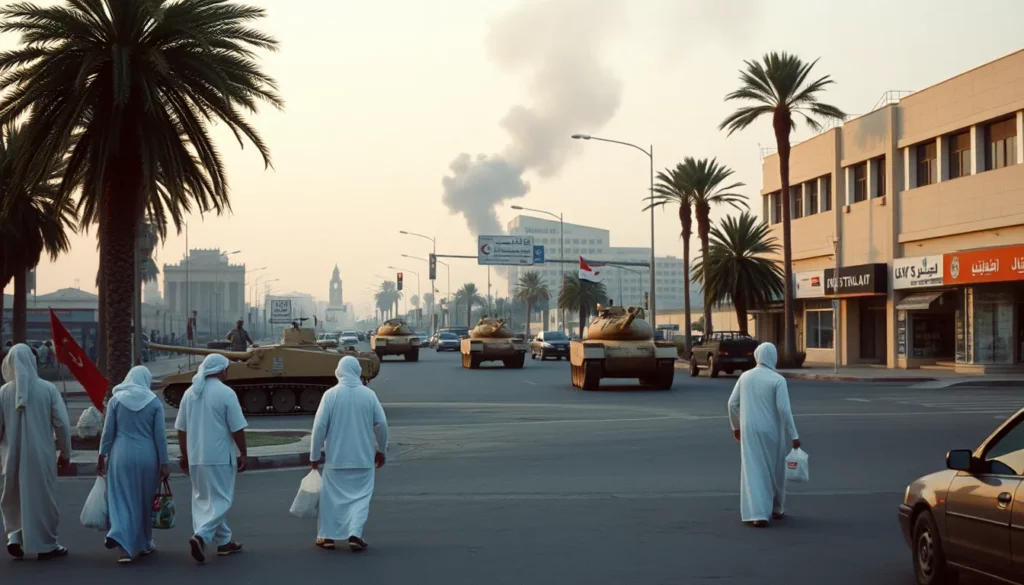
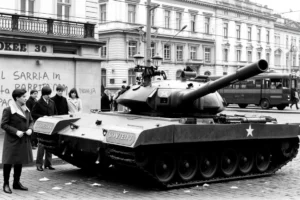
On 2 August, tanks and armored vehicles appeared on the main roads. Eyewitnesses described civilians still commuting to work hours after Iraqi forces had crossed the border, a sign of how suddenly normal movement collapsed into military control. Checkpoints multiplied; travel permits and identity documents became critical; fuel, once cheap and abundant, was subject to queues and requisition. The airport and border routes became escape corridors for foreigners and Kuwaitis able to leave.
Everyday Life
Daily life in occupied Kuwait City narrowed to essentials: food, water, electricity, medicine, information, and safety. Families stockpiled rice, flour, sugar, and canned goods. Water and power could fail or be cut. Curfews confined people to homes after dark, and even daytime movement required explaining oneself at checkpoints. Women, children, and the elderly were especially vulnerable to the disruption of medical care and the fear of searches.
Housing changed character. Villas and apartments became hiding places for valuables, documents, or foreign friends. Some residents moved in with relatives; others sheltered in embassy compounds or tried to reach Saudi Arabia. Food was shared and rationed. The evening gatherings that once marked Kuwaiti social life turned into whispered exchanges about which road was closed, who had been arrested, and whether a rumor was true.
Clothing and manners adapted. Kuwaiti men and women wore conservative dress, but the occupation added a layer of caution: less display, fewer public outings, more attention to who might be watching. Entertainment contracted to radio, television announcements, cassette tapes, and conversation. Iraqi broadcasts and official communiqués competed with Kuwaiti memory and rumor. The city was not silent, but its sounds were now engines, soldiers, and the occasional crackle of gunfire.
Major Events
The defining event was the invasion of 2 August 1990. Iraqi forces crossed the border before dawn and moved quickly on Kuwait City. Kuwaiti troops resisted in places, especially around the royal palaces, but the capital was overwhelmed. The emir and government escaped; Iraqi soldiers took control of ministries, media, and key roads. Civilians were caught in the fighting or detained briefly, as Victor Mallett recorded when he was held under guard in the open before release.
On 6 August the UN Security Council adopted Resolution 661, imposing sanctions on Iraq. On 8 August Baghdad announced Kuwait’s annexation. Foreign nationals were rounded up or restricted, and the hostage issue became international. In November, Resolution 678 authorized member states to use “all necessary means” to reverse the invasion if Iraq did not withdraw by 15 January 1991. Inside Kuwait City, resistance, arrests, and disappearances continued through the autumn and winter.
These events were experienced locally as a sequence of shocks: the first day of tanks, the disappearance of normal government, the imposition of occupation rules, the fear of annexation, and the slow approach of war.
What Newspapers Were Reporting
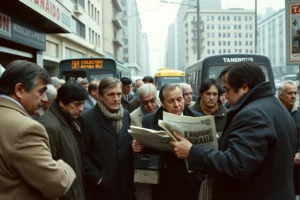
Foreign newspapers carried eyewitness diaries that became some of the most important contemporary accounts. The Washington Post of 2 September 1990 published Caryle Murphy’s “Kuwait Diary: A Country Becomes a Prison,” describing her 26 days as the only American newspaper reporter in Kuwait during the invasion. Murphy wrote of ordinary Kuwaitis and Americans coping with “the nightmare of war and occupation”; her account conveyed how a modern city had become a place of concealment and constrained movement.
“For 26 days, Caryle Murphy was the only American newspaper reporter in Kuwait chronicling the Iraqi invasion.” — The Washington Post, 2 September 1990.
The Los Angeles Times of 15 August 1990 carried Victor Mallett’s Financial Times diary, “Kuwait Diary: Shock Lingers Even After the Smoke Clears.” Mallett recorded that Iraq invaded before dawn, “taking the population completely by surprise” despite the collapse of negotiations in Jidda the day before. He described people still commuting hours after Iraqi forces had crossed the border and civilians held under guard before release. Such reports emphasized confusion, rapid collapse, and the vulnerability of foreigners and residents alike.
“Iraq invades Kuwait before dawn, taking the population completely by surprise.” — Victor Mallett, Financial Times diary, 1990.
Kuwaiti newspapers were disrupted, censored, or forced to adapt. Baghdad radio and Iraqi announcements became official channels, while foreign correspondents’ dispatches, filed after escape, supplied alternative testimony. The press record is therefore split between occupation propaganda and the fugitive journalism of eyewitnesses.
What People Were Talking About
Conversation in Kuwait City turned on survival and rumor. People asked which neighborhoods were safe, which checkpoints were stricter, and which families had vanished. They debated whether foreign embassies could protect third-country nationals, whether Iraq would allow evacuations, and whether the outside world would act. The hostage crisis made every foreign face potentially significant; Kuwaitis who sheltered foreigners weighed risk against duty.
Rumors of resistance attacks, executions, and mass arrests circulated faster than verification. The occupation authorities tried to control information through radio, posters, and warnings, but word of mouth remained powerful. In homes and mosques, people discussed how to preserve Kuwaiti identity under annexation: hiding flags, keeping documents, refusing to accept Iraqi citizenship papers, and teaching children what the official broadcasts denied.
Themes of dignity and humiliation recur in recollections. Kuwaitis resented being treated as a conquered province; expatriates feared abandonment; diplomats worried about evacuation. The city’s talk was not only political. It was also practical: where to find bread, how to get medicine, how to send word to relatives abroad, and how to leave.
Historical Photographs
The visual record of Kuwait City in 1990 is dominated by press photography and television footage. Images show Iraqi tanks and armored personnel carriers on broad boulevards, soldiers at checkpoints, smoke rising after clashes or sabotage, and civilians moving cautiously past military vehicles. Photographs of the royal palaces, ministries, and airport road document the swift militarization of the capital.
Portraits of journalists are part of the record: Caryle Murphy was photographed in Riyadh after her escape, a reminder that much of the eyewitness testimony reached the world only after the witness had crossed a border. Photographs of queues, shuttered shops, and graffiti are rarer but valuable; they show occupation as a lived environment rather than a battlefield. Because Iraqi authorities restricted photography, many images are official, military, or taken by foreign correspondents in the first days or after liberation.
Historians also use satellite imagery and captured Iraqi photographs, but the most human visual evidence remains the news photograph: grainy, hurried, and often taken under threat.
Documents & Primary Sources
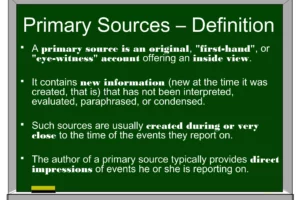
The key primary sources include the published diaries of Caryle Murphy and Victor Mallett, which blend reporting with personal observation. UN Security Council resolutions 660, 661, and 678 provide the international legal framework. Newspaper archives of The Washington Post, Los Angeles Times, Financial Times, and other outlets preserve contemporary dispatches.
Kuwaiti sources include resistance leaflets, graffiti photographs, unpublished family letters, oral-history interviews, and documents from ministries, banks, and schools. Embassy evacuation lists, passport records, and airline manifests help trace the movement of foreign nationals. Maps of Kuwait City show checkpoints, military positions, and neighborhood boundaries. Iraqi decrees and propaganda broadcasts reveal the occupation’s official language. Museum and archival collections in Kuwait, Britain, and the United States hold photographs, audio recordings, and personal papers.
These sources must be read critically. Diaries are vivid but partial; propaganda is useful for intention rather than truth; oral histories are shaped by later memory. Together they allow a reconstruction that is both detailed and honest about its gaps.
1990 Timeline
| Date | Event in or affecting Kuwait City |
|---|---|
| 2 Aug 1990 | Iraqi forces invade Kuwait before dawn; Kuwait City is seized; emir and government flee. |
| 4 Aug 1990 | Iraq installs a provisional Kuwaiti government; resistance and uncertainty spread. |
| 6 Aug 1990 | UN Security Council Resolution 661 imposes sanctions on Iraq. |
| 8 Aug 1990 | Iraq declares Kuwait annexed as its nineteenth province. |
| Aug 1990 | Foreign nationals are restricted; hostage crisis develops; eyewitness journalists escape and file diaries. |
| Sep–Oct 1990 | Occupation routines harden: curfews, checkpoints, arrests, shortages, and resistance. |
| 29 Nov 1990 | UN Resolution 678 authorizes force if Iraq does not withdraw by 15 Jan 1991. |
| Dec 1990 | Kuwait City remains under occupation as diplomatic efforts fail and war fears grow. |
What Changed Next
The occupation lasted until February 1991. A US-led coalition began Operation Desert Storm on 17 January 1991, and Iraqi forces were expelled from Kuwait by the end of February. Kuwait City was liberated, but the city faced smoke, oil fires, damaged infrastructure, looted buildings, and the human cost of occupation. Returning Kuwaitis found homes altered, records missing, and communities grieving.
The invasion also changed Kuwaiti politics and memory. The suspension of parliament ended in 1992, and the experience of occupation strengthened demands for greater participation and for accountability. The city rebuilt, but the events of 1990 became a founding trauma of modern Kuwait. Eyewitness accounts, once urgent journalism, became historical documents.
For historians, the year marks a transition: a wealthy, cosmopolitan Gulf capital was forced into a militarized occupation and then into a war of liberation. The city that emerged was physically repaired but politically and emotionally transformed.
Sources
- Caryle Murphy, “Kuwait Diary: A Country Becomes a Prison,” The Washington Post, 2 September 1990, https://www.washingtonpost.com/archive/politics/1990/09/02/kuwait-diary-a-country-becomes-a-prison/c8d9f5ad-95b5-430b-9c00-b4b39ad88ebe/.
- Victor Mallett, “Kuwait Diary: Shock Lingers Even After the Smoke Clears,” Los Angeles Times, 15 August 1990, https://www.latimes.com/archives/la-xpm-1990-08-15-mn-680-story.html.
- Lawrence Freedman and Efraim Karsh, The Gulf Conflict 1990–1991: Diplomacy and War in the New World Order (Princeton University Press, 1993).
- Dilip Hiro, Desert Shield to Desert Storm: The Second Gulf War (Routledge, 1992).
- United Nations Security Council Resolutions 660, 661, and 678 (1990), UN Digital Library.
FAQ
What was the population of Kuwait City in 1990?
No reliable city-only wartime census exists. Kuwait’s national population was roughly two million, with Kuwait City and its surrounding governorates forming the largest urban concentration.
What major events happened in Kuwait City in 1990?
Iraq invaded on 2 August 1990; the emir and government fled; Iraq installed a provisional government and declared annexation on 8 August; UN sanctions followed; and occupation, resistance, and hostage-taking continued through the autumn.
What primary sources are available for studying Kuwait City in 1990?
Key sources include eyewitness diaries by Caryle Murphy and Victor Mallett, contemporary newspaper archives, UN resolutions, press photographs, Kuwaiti resistance leaflets, oral histories, embassy records, and captured Iraqi documents.
How did daily life in Kuwait City in 1990 differ from today?
In 1990 residents faced curfews, checkpoints, censorship, shortages, and military occupation; normal commerce, schooling, and travel were disrupted. Today Kuwait City is a rebuilt, independent capital with a very different political and media environment.




Leave a Reply