
Short Answer
Quick Snapshot
Beirut in 1975 was Lebanon’s capital, its largest city, and a Mediterranean crossroads of trade, finance, tourism, publishing, and higher education. It was also a city of mixed neighbourhoods and sharp inequalities, where Lebanese communities, Palestinian refugees, foreign residents, and migrant workers lived close together. This article treats “Beirut in 1975” as the city’s experience during the first year of the Lebanese Civil War, from the Ain al-Rummaneh bus attack of 13 April through the “Black Saturday” killings of 6 December, with national developments included only where they directly shaped the city.
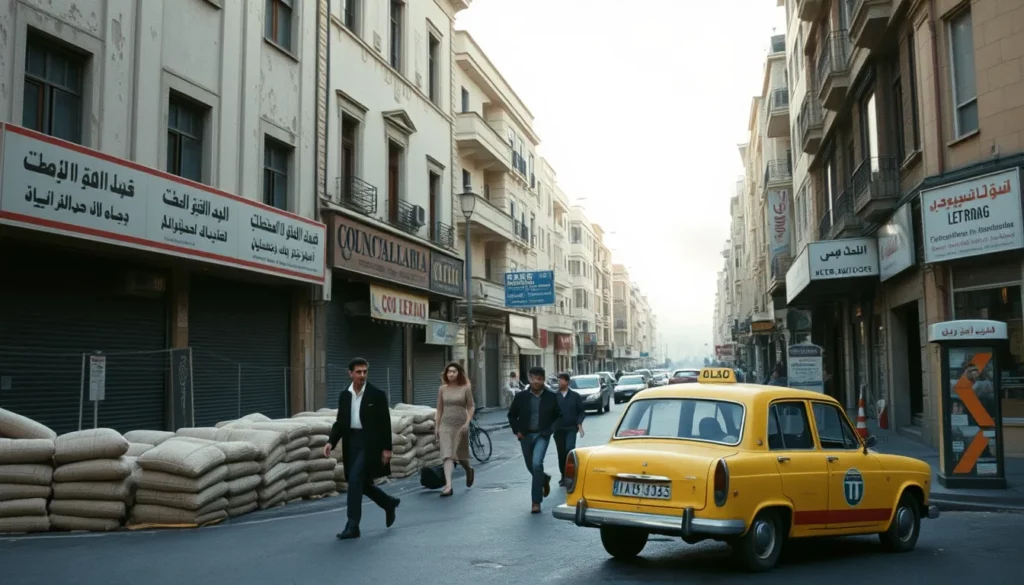
Before April, Beirut’s image was still that of a liberal commercial capital—often called the “Paris of the Middle East”—with cafés, cinemas, beaches, banks, and newspapers. After 13 April, that image was steadily overtaken by roadblocks, sniper fire, militia posters, burnt vehicles, and displaced families. The year did not yet produce the fully entrenched “Green Line” of later memory, but it established the geography of fear and partition that would dominate the city for years.
By December 1975, Beirut was no longer simply the site of political tension. It had become a battlefield in which the state’s authority was contested by armed movements, sectarian militias, and Palestinian factions. Newspapers recorded casualty counts; photographers captured barricades and ruined facades; families debated whether to stay, move within the city, or leave Lebanon altogether.
Beirut in 1975
Beirut lies on a rocky promontory facing the Mediterranean, backed by hills that rise toward Mount Lebanon. The city’s core included the old downtown, the port, and the commercial streets around Martyrs’ Square; to the west lay Ras Beirut, Hamra, and the American University of Beirut; to the east and south-east lay Ashrafieh, Ain al-Rummaneh, and newer residential districts. The Mediterranean climate gave Beirut mild, rainy winters and hot, humid summers, while the nearby mountains offered a summer escape and, in wartime, a place of relative safety.
The atmosphere of early 1975 was tense but still recognisably urban and commercial. Traffic filled the streets; service taxis and buses carried commuters; shops, offices, and schools operated; newspapers appeared daily. Yet political violence was already present in Lebanon, and Beirut’s neighbourhoods were increasingly read through sectarian and political lenses. The city’s geography mattered: a roadblock in Ain al-Rummaneh, a clash near the hotel district, or a killing in a mixed quarter could rapidly draw in armed groups from elsewhere.
Population & Economy
Greater Beirut probably approached 1.5 million people in 1975, within a Lebanese population of roughly 3 million. The city was religiously and socially diverse: Sunni and Shia Muslims, Maronite and Greek Orthodox Christians, Druze, Armenians, Palestinian refugees, and foreign workers all formed part of its urban fabric. Population figures are estimates because Lebanon had no recent comprehensive census and because wartime displacement made counting difficult. During 1975, Beirut’s population was swollen by families displaced from southern Lebanon and by Palestinian refugees already living in camps and informal settlements.
The economy rested on services rather than heavy industry. Beirut was a regional banking centre, supported by Lebanon’s banking-secrecy laws, and a hub for insurance, shipping, aviation, tourism, publishing, and retail trade. The port and the airport were gateways for goods and people. The Lebanese pound remained strong before the war, and basic foodstuffs were relatively affordable by regional standards, though wealth was unevenly distributed. Rents varied sharply between districts and apartment sizes.
After April, economic life was disrupted by closures, transport interruptions, capital flight, and the destruction of commercial property. Tourism collapsed; hotels near the seafront became contested ground; shops in frontline areas shuttered. Yet Beirut’s economy did not stop. Many offices, newspapers, hospitals, bakeries, and schools continued to function when fighting allowed, and informal networks supplied food, fuel, and news.
Government & Politics
Lebanon was a parliamentary republic with a president, prime minister, and cabinet, but its political system distributed power among confessional communities. In 1975 Suleiman Frangieh was president. Takieddine Solh was prime minister at the start of the year, and Rashid Karami later headed cabinets as the crisis deepened. Beirut itself was administered by a central-government-appointed mohafez, or governor, alongside a municipal council, but municipal authority was increasingly overshadowed by armed actors.
The main political forces included the Kataeb Party under Pierre Gemayel, the National Liberal Party under Camille Chamoun, and the Progressive Socialist Party under Kamal Jumblatt. Palestinian factions, especially within the Palestine Liberation Organization under Yasser Arafat, were a major armed presence. The Lebanese National Movement, a coalition of leftist and Arab nationalist groups, allied politically with the Palestinian movement, while Christian nationalist parties increasingly organised their own militias. The state’s security forces were too fragmented to impose a monopoly on violence.
Beirut’s local politics were therefore national and international at once. Decisions in cabinet offices, militia headquarters, and Palestinian camps shaped what happened on a single street. By the end of 1975, the city’s political geography was being remade by armed checkpoints and neighbourhood defences.
Industry
Beirut’s “industry” in 1975 was broad: commerce, finance, transport, hospitality, media, and light manufacturing. The port handled imports and exports; the airport linked Lebanon to regional and global markets; banks and insurance companies clustered in the centre and Hamra; hotels such as the Holiday Inn, St Georges, and Phoenicia symbolised the tourist economy. The city’s press was itself an industry, with newspapers, magazines, and publishing houses serving readers across the Arab world.
- Banking and finance, supported by Lebanon’s offshore banking and secrecy regime.
- Port and shipping services, plus customs and warehousing.
- Tourism, hotels, restaurants, cinemas, and beach clubs.
- Newspapers, magazines, printing, and advertising.
- Light manufacturing and food processing, often in small workshops.
- Retail trade in the souks, Hamra, and residential districts.
War damaged these sectors unevenly. The hotel district became a battlefield in October; the port and airport were vulnerable to closures; tourism vanished. But printing presses and newspapers continued, and small businesses adapted to shortages and insecurity.
Education
Beirut was the centre of higher education in Lebanon. The American University of Beirut, founded in 1866, was a leading regional institution with a hospital and a library that would later become a key archive. The Université Saint-Joseph, the Lebanese University, and Beirut Arab University also drew students from across Lebanon and the region. Missionary and private schools supplemented a relatively high literacy rate, especially in urban areas.
Education was not insulated from politics. University campuses were sites of debate and mobilisation, and students belonged to competing political camps. After April 1975, classes were repeatedly suspended or interrupted by fighting, and some families sent children abroad or to safer areas. Schools became shelters, meeting places, and sometimes targets. The educational infrastructure survived, but the war began to distort access and continuity.
Transportation
Beirut was connected to the world through Beirut International Airport at Khaldeh and through the Port of Beirut. Within the city, people relied on private cars, buses, service taxis, and walking. The old tram network had been phased out by the mid-1960s, so the street scene was dominated by cars, taxis, and buses rather than rail. Roads toward Damascus and the mountains carried both commerce and, increasingly, displaced people.
In 1975, transport became a matter of life and death. Armed groups set up checkpoints and inspected identity papers; roads could close without warning; vehicles were stolen or destroyed. The airport and port were strategic assets, and control over approaches to them mattered militarily. For ordinary residents, a short journey across town could require planning, rumours, and knowledge of which routes were open.
Everyday Life
Before April, daily life in Beirut included work, school, shopping, café conversations, cinema, radio, television, and family visits. Apartments mixed communities; markets and bakeries served dense neighbourhoods; the seafront and mountain resorts offered leisure. Food culture was Mediterranean and Levantine: mezze, grilled meats, kibbeh, manakish, pastries, and strong coffee. Dress was largely Western in urban public life, with religious and regional variation.
War changed routines incrementally. Families stocked food and water, listened to radio news, and exchanged rumours about roadblocks. Some moved to relatives in safer districts or to mountain villages. Women often managed household survival while men negotiated with militias or employers. Hospitals treated gunshot wounds; schools closed and reopened; newspapers were read for casualty lists as well as politics.
Social customs did not disappear. Weddings, funerals, and religious observances continued when possible, but they were increasingly shaped by security. Neighbourhood solidarity coexisted with suspicion. The first year of the war did not yet normalise long-term partition, but it taught Beirutis the habits of a city at war.
Major Events
The year’s defining events moved from national protest to urban combat. On 26 February, Maaruf Saad was assassinated in Sidon while leading a protest against fishing-sector privatisation; the killing deepened sectarian and class tensions. On 13 April, a bus carrying Lebanese and Palestinian civilians was attacked at Ain al-Rummaneh; 27 passengers were killed and 19 wounded. The attack and its reprisals are conventionally treated as the start of the civil war.
- April–May: Clashes spread, militias mobilised, and checkpoints appeared across Beirut.
- October 24: The Battle of the Hotels began in the hotel district and lasted into 1976, turning luxury buildings into fortified positions.
- December 6: “Black Saturday” brought sectarian killings at roadblocks; hundreds were murdered on both sides.
- December: Demarcation lines hardened between predominantly Christian East Beirut and predominantly Muslim West Beirut.
What Newspapers Were Reporting
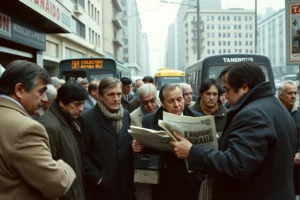
Beirut’s newspapers—including An-Nahar, L’Orient-Le Jour, Al-Anwar, Al-Hayat, and Al-Muharrir—reported the crisis in real time, though their offices and staff were also vulnerable. They carried casualty figures, political statements, militia communiqués, and appeals for calm. The American University of Beirut’s online exhibit summarises the Ain al-Rummaneh incident with the words:
“27 passengers were killed and 19 wounded.”
For Black Saturday, the same exhibit records that by the end of the day:
“at least 300 Muslims and an equal number of Christians have been murdered on arbitrary roadblocks.”
Newspapers also reported the Battle of the Hotels as street fighting that defined demarcation lines and divided the city into East and West. Their pages show how quickly a political crisis became a matter of urban geography: which streets were open, which buildings were occupied, which communities were fleeing.
What People Were Talking About
Conversations in 1975 centred on safety, identity, and the state’s collapse. Beirutis discussed rumours of armed men at checkpoints, the reliability of the police and army, the role of Palestinian fighters, and the responsibility of political leaders. Families debated whether to remain in mixed neighbourhoods or move to areas dominated by their own community. Employers and shopkeepers worried about looting, closures, and wages.
Letters, diaries, and later memoirs from the period record the small practical questions of wartime: whether to send children to school, how to store food, which route to take to work, how to obtain a pass, and whether to leave Lebanon. Public debate also concerned foreign involvement—Syrian, Israeli, and other regional interests—and the fear that Lebanon’s internal conflict would become a proxy war. The first year produced not one unified public opinion but many competing fears.
Historical Photographs
Visual evidence for Beirut in 1975 includes professional press photography, family snapshots, and archival collections. The American University of Beirut’s Manoug Photograph Collection, 1940–1970s, preserves images of the city before and during the early war years, including the entrance of the Grand Omari Mosque on Maarad Street, the Holiday Inn Hotel, St Georges Hotel, and Allenby Street. These photographs are valuable because they show buildings and streetscapes that were later damaged or transformed.
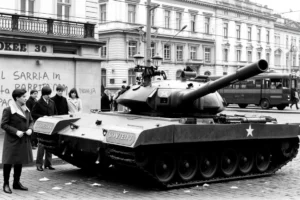
- Press photographs of barricades, militia checkpoints, and burnt vehicles.
- Hotel-district images before and during the Battle of the Hotels.
- Street scenes showing shops, cinemas, and ordinary traffic in early 1975.
- Portraits of displaced families and civil-defence workers.
- Newspaper photo archives held in Lebanese libraries and private collections.
Such images must be read critically: they were often taken for newspapers and emphasise drama, but they also reveal clothing, signage, architecture, and the material texture of daily life.
Documents & Primary Sources
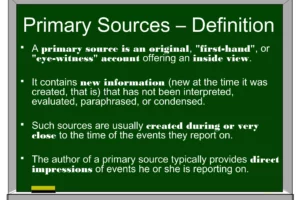
Historians of Beirut in 1975 rely on newspapers, photographs, official records, and oral testimony. The American University of Beirut’s Jafet Library holds archives and special collections, including the Manoug photographs and periodicals from 1975–1976. Lebanese newspaper archives preserve daily reporting and political statements. Municipal and government records, where available, document administration and security. Palestinian and Lebanese militia communiqués, posters, and leaflets show how armed groups presented their actions.
- Beirut newspapers and magazines on microfilm, especially An-Nahar and L’Orient-Le Jour.
- Manoug Photograph Collection and other AUB archival photographs.
- Lebanese government and municipal records, maps, and security reports.
- Militia, Palestinian, and Lebanese National Movement publications.
- Oral histories and interviews with residents, combatants, journalists, and relief workers.
- Red Cross, UNRWA, and civil-defence reports on displacement and casualties.
1975 Timeline
| Date | Event |
|---|---|
| 26 February 1975 | Maaruf Saad is assassinated in Sidon during a protest over fishing-sector privatisation, raising national tensions. |
| 13 April 1975 | Ain al-Rummaneh bus attack kills 27 and wounds 19; reprisals mark the conventional start of the civil war. |
| April–May 1975 | Clashes, militia mobilisation, and checkpoints spread through Beirut. |
| Mid-1975 | Cabinet changes and negotiations fail to restore order; armed groups entrench in neighbourhoods. |
| 24 October 1975 | The Battle of the Hotels begins in Beirut’s hotel district and continues into 1976. |
| 6 December 1975 | Black Saturday: sectarian killings at roadblocks kill hundreds. |
| December 1975 | Demarcation lines harden between East and West Beirut. |
What Changed Next
In 1976 the war escalated: Syrian forces intervened, Palestinian camps were besieged, and massacres at Karantina and Damour deepened sectarian polarisation. The Green Line became a durable partition, and Beirut’s state institutions, economy, and public spaces were further eroded. Later years brought Israeli invasions, foreign occupations, and repeated rounds of internal fighting. The first year of the war was not the whole catastrophe, but it established the patterns—militia rule, checkpoints, displacement, and the fragmentation of the city—that defined Beirut for the next decade and a half.
Sources
- Fregonese, Sara. “City, war and geopolitics: the relations between militia political violence and the built environment of Beirut in the early phases of the Lebanese civil war (1975–1976).” PhD thesis, Newcastle University, 2008. https://theses.ncl.ac.uk/jspui/bitstream/10443/3608/1/Fregonese%20S.pdf
- American University of Beirut Libraries. “1970s.” Lebanon: Fifty Years of War Memory and Testimony, online exhibit. https://online-exhibit.aub.edu.lb/exhibits/show/civil-war-50th-anniversary/1975
- Traboulsi, Fawwaz. A History of Modern Lebanon. London: Pluto Press, 2007.
- Khalaf, Samir. Civil and Uncivil Violence in Lebanon: A History of the Internationalization of Communal Conflict. New York: Columbia University Press, 2002.
- Cobban, Helena. The Making of Modern Lebanon. London: Hutchinson, 1985.
FAQ
What was the population of Beirut in 1975?
Greater Beirut is estimated to have approached 1.5 million people, within a Lebanese population of roughly 3 million. Exact figures are uncertain because Lebanon had no recent comprehensive census and wartime displacement disrupted counting.
What major events happened in Beirut in 1975?
Key events include the 13 April Ain al-Rummaneh bus attack, the spread of militia checkpoints and clashes, the Battle of the Hotels beginning on 24 October, and the Black Saturday killings of 6 December. By late 1975, demarcation lines were hardening between East and West Beirut.
What primary sources are available for studying Beirut in 1975?
Researchers use Beirut newspapers such as An-Nahar and L’Orient-Le Jour, the Manoug Photograph Collection and other AUB archives, government and municipal records, militia and Palestinian publications, Red Cross and UNRWA reports, maps, oral histories, and private diaries and letters.
How did daily life in Beirut in 1975 differ from today?
In 1975 Beirut was still a regional commercial and press capital, but daily life was increasingly shaped by checkpoints, sniper fire, closures, displacement, and militia authority. Today’s city has rebuilt much of its infrastructure, but the wartime geography and memory remain part of its urban fabric.



Leave a Reply