
Short Answer
Quick Snapshot
This article examines Warsaw in 1939, with particular attention to the German invasion of Poland in September and the ways Varsovians experienced and recorded it in diaries and newspapers. The scope is the capital city of the Second Polish Republic during the final year of peace and the opening weeks of the Second World War; it does not attempt a full history of the entire Polish campaign.
On the eve of war Warsaw was a metropolis of roughly 1.3 million people, the political and cultural heart of a state squeezed between Nazi Germany and the Soviet Union. Its streets, cafés, trams, newspapers, and universities gave it the rhythm of a modern European capital, but the September bombardment turned that rhythm into a struggle for shelter, food, and survival.
The reconstruction below leans on two kinds of evidence: the September 1939 Polish daily press, analysed in a 2019 Jagiellonian University thesis, and the recollections gathered for the 1948 “Diary of a Varsovian” competition and later used by the Muzeum Warszawy. Together they allow the invasion to be seen not only as a military event but as a cascade of ordinary and extraordinary moments.
Warsaw in 1939
Warsaw lies on the Vistula River, roughly in the centre of the Polish lands. In 1939 it was a city of wide avenues, dense tenements, churches, factories, and government offices. The Old Town and the Royal Route formed its historic face; the districts of Wola, Praga, and Śródmieście carried its industrial and working-class life. The river divided the city and also served as a symbolic boundary: bridges were strategic points, and the eastern suburb of Praga became a refuge for some during the siege.
The climate in early September 1939 was warm and dry, a condition that helped the German armoured advance but also intensified the dust and smoke of bombardment. The city had prepared civil-defence measures, but nothing on the scale of modern total war. Newspapers and diaries from the period describe a place that moved within days from late-summer normalcy to the sound of sirens, the smell of burning, and the sight of refugees streaming in from the countryside.
Population & Economy
Warsaw’s population stood at approximately 1.3 million in 1939, making it one of the largest cities in Central Europe. The population included a large Jewish community—roughly one-third of the city—as well as Poles, Germans, Ukrainians, and other groups. It was a city of contrasts: elegant boulevards and impoverished courtyards, department stores and open-air markets, salaried officials and casual labourers.
The economy was diversified. Warsaw was a centre of publishing, printing, food processing, metalworking, textiles, chemicals, and consumer crafts. It was also a city of services: banks, insurance offices, shops, restaurants, and transport. The war disrupted these sectors almost immediately. Bread prices and tram fares, small sums in peacetime, became markers of normal life remembered in diaries. A kilogram of bread cost roughly 0.40–0.50 zł, and a tram ticket about 0.20 zł; by late September, queues, rationing, and destroyed shops had made such figures partly academic.
Unemployment had been a social problem in interwar Poland, though Warsaw’s role as an administrative and cultural centre cushioned some of it. The September crisis brought sudden unemployment, flight, and the destruction of workplaces. The diaries collected in 1948 recall not abstract economics but concrete losses: a workshop closed, a shop burned, a wage never collected.
Government & Politics
Warsaw was the seat of the Polish government and the focus of national politics. The Second Polish Republic in 1939 was governed under the Sanacja regime, with President Ignacy Mościcki and a government led until September by Prime Minister Felicjan Sławoj Składkowski. The city’s own leadership was dominated by Stefan Starzyński, President of Warsaw from 1934, who became Civil Commissioner for the Defence of the Capital in September 1939.
Starzyński is central to the Warsaw story of 1939. His radio speeches and public appearances sought to steady the population, organise defence, and maintain a semblance of civil order. Newspapers reported his appeals; diaries recorded his voice. Politics in September became less about parties than about survival and authority: who would keep the city running, who would negotiate, and who would stay.
The government evacuated Warsaw in early September, but municipal and military authorities remained. The political climate was shaped by censorship, mobilisation, and rumour. The press, already subject to state controls, became a weapon of information and morale; its final September issues are therefore both propaganda and evidence.
Industry
Warsaw’s industry was varied rather than dominated by a single giant concern. Printing and publishing were especially important: the city produced newspapers, books, magazines, and advertising. The daily press itself was an industrial product, requiring paper, presses, distribution networks, and workers who kept printing through air raids. The Bierzyńska study of 1939 dailies shows how many titles still appeared in September, including “Kurier Warszawski”, “Express Poranny”, “Robotnik”, “Goniec Warszawski”, and “Wieczór Warszawski”.
Other factories produced food and drink, clothing, furniture, metal goods, and chemicals. Warsaw also had railway workshops and military-related production. German bombing and artillery targeted bridges, railway lines, power stations, and factories, not only to break resistance but to cripple the city’s capacity to function. Diaries mention the loss of workplaces and the sight of burned industrial buildings; newspapers carried appeals to workers and notices about essential services.
Education
Warsaw was an educational centre. The University of Warsaw, the Warsaw Polytechnic, and numerous secondary and primary schools served the city and drew students from across Poland. Literacy was relatively high by interwar standards, and the city’s publishing culture depended on a broad reading public. Newspapers were sold on streets and read in cafés, offices, and homes; diaries were written by people accustomed to expressing themselves in prose.
The invasion disrupted education abruptly. Schools became shelters, hospitals, or command posts; classes stopped; students and teachers joined defence efforts or fled. The 1948 “Diary of a Varsovian” competition later collected recollections from people of different backgrounds, including teachers and white-collar workers. These diaries show that education in 1939 was not only institutional but personal: people recorded what they saw, what they read, and what they hoped to preserve.
Transportation
Warsaw moved by tram, bus, railway, horse-drawn cart, and on foot. Trams were the most visible form of mass transport, and their routes shaped daily life. The railway network linked Warsaw to the rest of Poland and to Europe; the bridges over the Vistula were vital for military movement and civilian flight. In September, transport became a matter of life and death: railway stations were bombed, bridges were guarded, and roads filled with refugees.
Newspapers published notices about transport disruptions, mobilisation, and evacuation. Diaries describe waiting for trams that never came, walking long distances, and seeing horse carts loaded with belongings. The city’s transport system did not collapse all at once; it degraded under bombardment and siege, and its partial functioning became a measure of the authorities’ ability to keep Warsaw alive.
Everyday Life
Before September, everyday life in Warsaw followed familiar rhythms: work, school, shopping, newspaper reading, café conversations, cinema, radio, and family meals. Housing ranged from elegant apartments to crowded tenements. Clothing followed European fashions of the late 1930s. Food was bought fresh in markets and shops; bread, milk, vegetables, and meat were staples, though poverty was never absent.
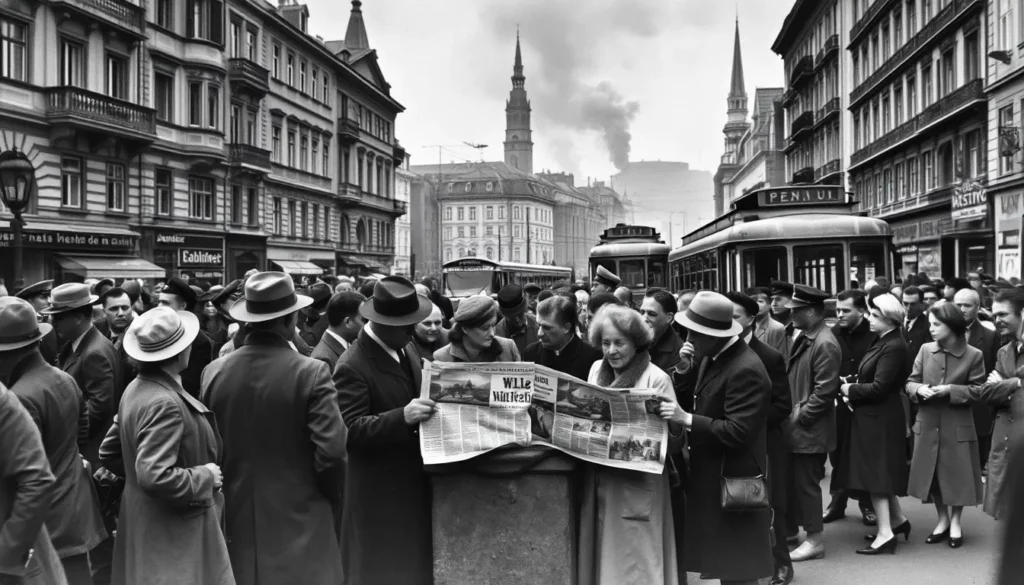
The invasion transformed routine into emergency. People queued for food, dug shelters, covered windows, and listened to radio bulletins. Newspapers became scarce and precious; a single copy might be read by several people. Diaries record the sound of aircraft, the fear of parachutists and “fifth columnists”, and the moral exhaustion of not knowing what would happen next. Entertainment shrank to gossip, prayer, and the small comfort of a shared cigarette or a piece of bread.
Major Events
The central event of 1939 for Warsaw was the German invasion, launched on 1 September. German aircraft bombed the city from the first day, targeting railway stations, bridges, and military installations, but also hitting civilian areas. On 3 September Britain and France declared war on Germany, news that Varsovians followed in newspapers and radio. The Polish government left Warsaw in early September, while Starzyński and military commanders organised defence.
German forces reached the Warsaw suburbs by around 8 September, and the siege tightened. Artillery and air bombardment continued; civilian casualties mounted. On 17 September the Soviet Union invaded Poland from the east, a blow that made the strategic situation desperate. Warsaw capitulated on 28 September 1939. The city had not been taken by storm but was battered into surrender; the human and material cost was enormous. Starzyński was later arrested by the Germans and did not survive the war.
What Newspapers Were Reporting
Polish dailies in September 1939 reported the invasion under extreme pressure. Bierzyńska’s analysis of titles such as “Kurier Warszawski”, “Express Poranny”, “Robotnik”, “Goniec Warszawski”, “Dobry Wieczór. Kurier Czerwony”, and “Wieczór Warszawski” shows a press trying to inform, mobilise, and reassure. Headlines and articles covered German aggression, Polish defence, Allied declarations, air raids, and appeals for calm. Some issues carried military communiqués; others printed notices about shelters, food, and missing persons.
As the siege worsened, newspapers became thinner and less frequent. Printing presses were damaged, paper ran short, and distribution broke down. The press did not simply report events; it participated in them, urging resistance and recording the city’s determination. For historians, these newspapers are both a source of facts and a record of how facts were framed for a frightened public.
What People Were Talking About
The diaries gathered for the 1948 “Diary of a Varsovian” competition offer a more intimate view. Varsovians wrote about rumours of German paratroopers, the search for food and water, the fear of Soviet invasion, and the fate of relatives. A phrase used by one diarist and later chosen as the title of a Muzeum Warszawy exhibition captures the atmosphere:
“No sky or earth in sight.”
It evokes the smoke, dust, and disorientation of bombardment.
People debated whether to flee or stay, whether to trust official communiqués, and whether the city could hold. They talked about Starzyński’s speeches, the behaviour of neighbours, and the ethics of survival. These were not abstract political debates; they were conversations held in cellars and courtyards, between people trying to make sense of a world that had changed in days.
Historical Photographs
Photographs of Warsaw in September 1939 exist in considerable numbers. They show burning buildings, ruined streets, civilians digging trenches, soldiers, queues, and people reading newspapers pasted on walls. The Muzeum Warszawy’s exhibition “No sky or earth in sight. Varsovians on September 1939” combined such images with diary extracts to present the invasion from a personal perspective. Other archives hold press photographs, amateur snapshots, and German propaganda images.
These photographs are significant because they preserve the visual texture of the city: the clothing, the trams, the shop signs, the faces of people under stress. They also require caution. Wartime photography was often staged or censored, and German images served propaganda purposes. Historians compare photographs with diaries and newspapers to establish what was typical and what was exceptional.
Documents & Primary Sources
The key primary sources for Warsaw in 1939 include the September daily press, personal diaries, photographs, civil-defence orders, posters, maps, and radio transcripts. The 1948 “Diary of a Varsovian” competition is especially valuable: it collected recollections written less than a decade after the events, when memory was still fresh but shaped by postwar experience. These diaries are held in Polish archival and museum collections and were used by the Muzeum Warszawy.
Newspapers such as “Kurier Warszawski” and “Robotnik” are available in Polish libraries and digital archives. The Bierzyńska thesis provides a systematic analysis of many September 1939 titles. Photographs can be found in the Muzeum Warszawy, the Polish National Archives, and the Institute of National Remembrance. Together these sources allow historians to reconstruct not only what happened but how it was reported, remembered, and understood.
1939 Timeline
| Date | Event in Warsaw |
|---|---|
| 1 September | Germany invades Poland; Warsaw is bombed from the air. |
| 3 September | Britain and France declare war on Germany; Warsaw newspapers report the news. |
| 5–6 September | Polish government evacuates Warsaw; municipal and military authorities organise defence. |
| 8 September | German forces reach the Warsaw suburbs; siege conditions tighten. |
| 10 September | Intensified artillery and air bombardment of the city. |
| 17 September | Soviet Union invades Poland from the east; Warsaw’s strategic situation worsens. |
| 28 September | Warsaw capitulates after weeks of bombardment and siege. |
| October | German occupation begins; Stefan Starzyński is arrested and later killed. |
What Changed Next
The surrender of Warsaw in September 1939 opened the way for German occupation. The city was divided, plundered, and terrorised. In 1940 the Germans established the Warsaw Ghetto, sealing hundreds of thousands of Jews into a cramped district. Diaries and newspapers from 1939 became documents of a lost world; the press that had reported the invasion was replaced by controlled occupation newspapers. The city’s population suffered deportation, forced labour, and mass murder.
The destruction of 1939 was only the beginning. The Warsaw Ghetto Uprising of 1943 and the Warsaw Uprising of 1944 brought further devastation; by 1945 much of the city was in ruins. The diaries and newspapers of 1939 therefore mark a threshold: they record the last months of an independent Warsaw and the first weeks of a catastrophe whose full scale was not yet known.
Sources
- Muzeum Warszawy, “No sky or earth in sight. Varsovians on September 1939”, exhibition, 2019–2020, https://muzeumwarszawy.pl/en/wystawa/no-sky-or-earth-in-sight/.
- Bierzyńska, Karolina. “Kampania wrześniowa na łamach polskich dzienników z 1939 roku.” Master’s thesis, Jagiellonian University, 2019, https://ruj.uj.edu.pl/entities/publication/caf58128-b32c-4cec-b70d-8d420aaea482.
- Kochanski, Halik. The Eagle Unbowed: Poland and the Poles in the Second World War. Cambridge, MA: Harvard University Press, 2012.
- Czerniaków, Adam. The Warsaw Diary of Adam Czerniaków: Prelude to Doom. Edited by Raul Hilberg, Stanisław Staron, and Josef Kermisz. Chicago: Ivan R. Dee, 1999.
- Davies, Norman. God’s Playground: A History of Poland, Vol. II: 1795 to the Present. New York: Columbia University Press, 2005.
FAQ
What was the population of Warsaw in 1939?
Warsaw had approximately 1.3 million inhabitants in 1939, including a large Jewish community of roughly one-third of the city’s population.
What major events happened in Warsaw in 1939?
The German invasion began on 1 September 1939 with air raids on Warsaw. The city was besieged through September, the Soviet Union invaded Poland on 17 September, and Warsaw capitulated on 28 September. German occupation followed.
What primary sources are available for studying Warsaw in 1939?
Researchers use September 1939 newspapers such as Kurier Warszawski and Robotnik, personal diaries gathered in the 1948 ‘Diary of a Varsovian’ competition, photographs held by the Muzeum Warszawy and other archives, civil-defence orders, posters, maps, and radio transcripts.
How did daily life in Warsaw in 1939 differ from today?
In 1939 Warsaw had no modern digital media, and news travelled by newspapers, radio, and rumour. Daily life was disrupted by air raids, food queues, and shelters; transport relied on trams, railways, and horse-drawn vehicles. The city was also on the brink of occupation and mass violence.










Leave a Reply