Short Answer
Quick Snapshot
Washington in 1933 was the federal capital of the United States at a moment of extraordinary crisis and sudden political renewal. This article treats Washington as Washington, D.C., the seat of the federal government, rather than Washington State. On March 4, Franklin D. Roosevelt took the oath of office while banks across the country were closing and millions of Americans feared for their savings. The city was still a low-rise, southern-tinged capital, but for a few months it became the command center of national recovery.
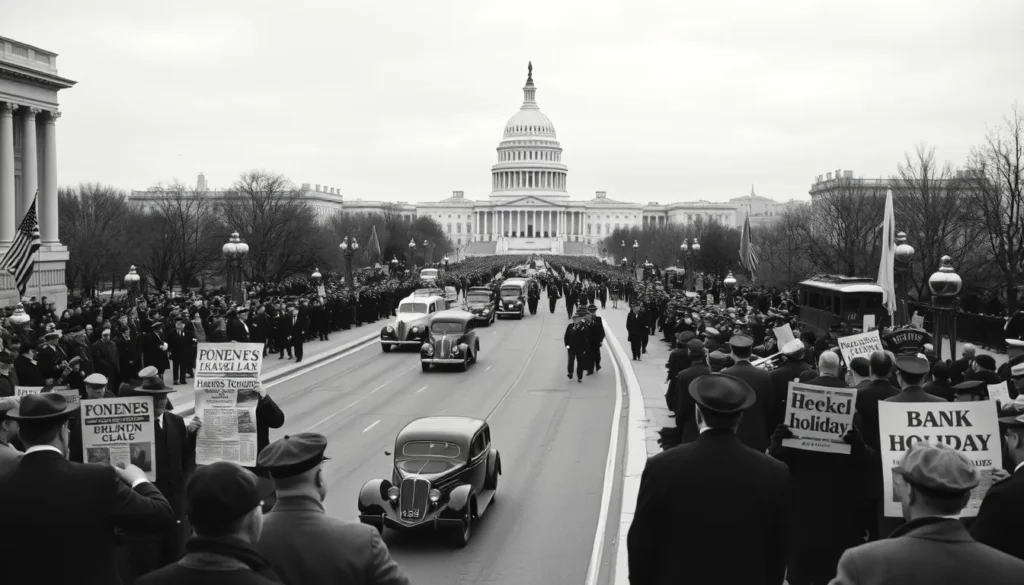
The First Hundred Days, conventionally dated from Roosevelt’s inauguration to the adjournment of the special session of Congress on June 16, 1933, transformed the atmosphere of Washington. Emergency banking legislation, the Civilian Conservation Corps, the Agricultural Adjustment Act, the Tennessee Valley Authority, and the National Industrial Recovery Act followed in rapid succession. Contemporary observers described a city of crowded hotel lobbies, anxious crowds outside the White House, urgent congressional debates, and a new president whose voice on the radio seemed to reach directly into American homes.
Through newspapers, photographs, diaries, and reports such as Morris Markey’s New Yorker dispatch from Washington, the year emerges not as a single triumphant story but as a tangle of fear, improvisation, spectacle, and hope. The capital was both a working city of clerks, cooks, streetcar conductors, and cleaners and a national symbol under enormous pressure.
Washington in 1933
Washington, D.C., lies on the Potomac River between Maryland and Virginia. In 1933 it remained a spacious, unhurried city with a distinctly southern flavor. Large sections of the District were still wooded or only lightly built up, and the city had not yet been wrapped by the automobile suburbs that would later surround it. The World War I temporary buildings still stood in scattered clusters, and the unfinished columns of the Department of Labor building suggested a capital still under construction.
The climate was humid and changeable. Inauguration Day was gray and overcast, and the spring of 1933 brought cool, damp days that matched the national mood. Yet the city’s physical appearance could be deceptive. Behind the broad avenues and classical facades, Washington was the center of a political storm. The Depression had eroded confidence in banks, businesses, and government itself, and the arrival of a new administration drew reporters, job seekers, Democratic office seekers, and curious citizens into the city.
Washington was not yet the imperial city of later decades. It was still a place of row houses, corner groceries, streetcars, and government offices where clerks worked by lamplight and papers moved by hand. But the First Hundred Days began to change that scale. Roosevelt’s advisers, the emergency agencies, and the press corps turned the capital into a laboratory for national action.
Population & Economy
The 1930 federal census counted 486,869 residents in the District of Columbia, and the city’s population was generally estimated at roughly half a million by 1933. Washington was a racially segregated city. African Americans made up roughly a quarter of the population and lived largely in neighborhoods such as Shaw and parts of Anacostia, while many worked in government service, domestic labor, hotels, restaurants, and small businesses. Public facilities, schools, and many workplaces were rigidly separated by race.
The federal government was the economic anchor. Beyond government employment, Washington depended on hotels, restaurants, retail shops, printing and publishing, construction, local transit, utilities, and the service trades that supported visitors and residents. The Depression had hit the city less severely than industrial cities such as Detroit or Pittsburgh, but bank failures, salary cuts, unemployment, and falling property values still caused hardship. The banking crisis of March 1933 was especially visible in Washington because it struck the capital just as the new administration arrived.
Prices were low by later standards but daunting for families with reduced income. Newspaper advertisements and city directories suggest that a loaf of bread cost about seven or eight cents, a quart of milk about ten cents, and a modest family flat could rent for twenty to thirty-five dollars a month. Many households took in lodgers, bought on credit, or relied on relief. The city’s economy was not industrial in the heavy sense, but it was deeply dependent on the federal payroll and on the confidence of visitors and investors.
Government & Politics
Washington, D.C., had no elected mayor in 1933. The District was governed by three commissioners appointed by the president, and Congress exercised ultimate authority over local affairs. Residents could not vote for president, and they had no voting representation in Congress. Local government therefore blended municipal administration with federal oversight, a arrangement that limited home rule and made the city especially sensitive to national politics.
The political climate in early 1933 was electric. The Democratic landslide of 1932 had ended twelve years of Republican control of the White House, and Democrats also controlled Congress. Franklin D. Roosevelt took office on March 4, succeeding Herbert Hoover. Vice President John Nance Garner presided over the Senate, while congressional leaders scrambled to pass emergency legislation. The capital filled with Democratic office seekers and party workers who had been out of power since 1921.
Roosevelt’s inaugural address set the tone. He declared that “the only thing we have to fear is fear itself” and promised action. Within days, he proclaimed a national bank holiday and summoned Congress into special session. The Hundred Days that followed were not a single law but a cascade of measures: the Emergency Banking Act, the Economy Act, the Beer-Wine Revenue Act, the Civilian Conservation Corps, the Agricultural Adjustment Act, the Tennessee Valley Authority, the Home Owners’ Loan Act, and the National Industrial Recovery Act. For contemporaries, Washington seemed to be legislating at emergency speed.
Industry
Washington’s largest industry was government itself. The departments, bureaus, and commissions employed thousands of clerks, stenographers, messengers, accountants, lawyers, and custodians. The Government Printing Office, the Bureau of Engraving and Printing, and the Washington Navy Yard were important workplaces, as were the railroads, utilities, and telephone exchanges that kept the city running. Hotels, restaurants, laundries, and retail stores served both residents and the steady flow of visitors drawn by politics and tourism.
Printing and publishing were significant local trades. Newspapers, government reports, trade journals, and commercial printers all required skilled labor. Construction had slowed during the Depression, but federal projects and private repairs continued. The city also had local breweries and bottling works, and the legalization of 3.2 percent beer in March 1933 was greeted with particular enthusiasm. Street railways, taxicabs, and bus companies formed another part of the urban economy, employing drivers, mechanics, and office staff.
Work was unevenly distributed. Federal employment offered relative security, but many private-sector jobs paid poorly or were vulnerable to layoffs. African American workers faced discrimination and were often confined to lower-paid positions. Women worked in government offices, shops, schools, and domestic service, though professional opportunities remained limited. The New Deal agencies that opened in 1933 would soon add another layer to the city’s employment landscape.
Education
Washington had a substantial educational infrastructure for a city of its size. Howard University, Georgetown University, George Washington University, Catholic University of America, and American University all operated in or near the District. Howard, founded in 1867, was the leading institution of higher education for African Americans, though it was not yet the large research university it later became. The city’s white public schools and its segregated Black public schools were separate and unequal in resources, facilities, and prestige.
Literacy was relatively high, but educational opportunity depended heavily on race and class. Public school budgets were strained by the Depression, and many families struggled to keep children in school rather than send them to work. Night schools, trade courses, and church-sponsored classes offered some adults a chance to learn new skills. The presence of so many universities and government offices gave Washington a lively lecture and club culture, even as ordinary residents faced cuts in school services and teachers’ pay.
The New Deal did not immediately transform Washington’s schools, but the emergency programs of 1933 foreshadowed later federal involvement in education, recreation, and youth employment. The Civilian Conservation Corps, created at the end of March, offered young men work and training outside the city, while local relief agencies tried to assist families whose children needed shoes, books, and meals.
Transportation
Washington in 1933 was a city of streetcars and pedestrians. The Capital Traction Company and the Washington Railway and Electric Company operated an extensive streetcar network, while buses and taxis supplemented rail service. Automobiles were increasingly common, but many working-class residents relied on walking, streetcars, and buses. Traffic was light compared with later decades, though downtown intersections could become congested during inaugurations and congressional sessions.
Union Station was the city’s great rail gateway, served by the Pennsylvania Railroad, the Baltimore and Ohio Railroad, and other lines. Travelers arriving for the inauguration or for government business passed through its grand concourse and into a city of taxis, porters, newsstands, and hotel runners. The Potomac bridges connected Washington to Virginia, and the Maryland suburbs were reachable by rail and road. There was no subway; the first Metro line would not open until 1976.
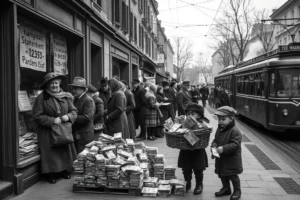
Transportation was also a social dividing line. Wealthier residents owned cars or hired taxis, while poorer residents depended on public transit. Streetcar routes shaped neighborhoods and shopping districts, and the sounds of bells, motors, and newsboys were part of the urban soundtrack. The bank holiday briefly disrupted fare collection, payrolls, and commerce, showing how thoroughly money and movement were intertwined.
Everyday Life
Daily life in Washington in 1933 was shaped by the Depression and the sudden excitement of the new administration. Housewives stretched budgets, clerks worried about pay, and families doubled up in row houses and apartments. In the crowded hotel lobbies and government corridors, visitors and residents talked constantly about banks, jobs, and Roosevelt. The city’s restaurants offered cheap lunches, while church suppers, fraternal lodges, and neighborhood clubs provided social life at low cost.
Housing ranged from elegant homes in Georgetown and Wardman Park to crowded alley dwellings and segregated tenements. Many middle-class families employed a maid or cook, though such help was often precarious during hard times. Food was plain and seasonal: bread, soup, stews, vegetables, and inexpensive cuts of meat. Clothing was practical and frequently mended. Men wore hats and suits in public; women wore dresses, coats, and modest heels, though everyday dress was simpler than the glamorous images of the inaugural balls.
Entertainment included radio, movies, dance halls, and baseball. Amos ‘n’ Andy was a national radio sensation, and movie houses did brisk business when people could afford tickets. The Washington Senators gave the city a baseball identity. Churches, clubs, and civic organizations sponsored lectures, concerts, and charity events. The first fireside chat on March 12, 1933, became an immediate topic of conversation, as families gathered around radios to hear Roosevelt explain the banking crisis in plain language.
Major Events
The central event of 1933 in Washington was Roosevelt’s inauguration on March 4. Herbert Hoover departed by train, and Morris Markey reported that the former president was weeping as his train drew out of the station. That same weekend, bank failures in New York, Illinois, and Michigan pushed the financial system toward collapse. Roosevelt proclaimed a national bank holiday, and on March 9 Congress passed the Emergency Banking Act. On March 12 the president delivered the first of his fireside chats, and banks began reopening on March 13.
The Hundred Days produced a stream of major legislation. The Civilian Conservation Corps was created on March 31. The Agricultural Adjustment Act and the Federal Emergency Relief Administration followed in May. The Tennessee Valley Authority was established on May 18. The National Industrial Recovery Act, which created the Public Works Administration, passed on June 16. In May, a second Bonus Expeditionary Force of veterans arrived in Washington seeking early payment of service bonuses; Roosevelt’s administration provided camp facilities and offered some men places in the CCC.
Other national developments touched Washington directly. The Beer-Wine Revenue Act in March legalized 3.2 percent beer and signaled the approaching end of Prohibition. In April, Roosevelt took the United States off the gold standard, a decision that shocked financiers but gave the government more room to act. Throughout the spring, the city hosted emergency meetings, press conferences, and congressional hearings that made national news almost daily.
What Newspapers Were Reporting
Washington’s newspapers—the Washington Post, the Washington Evening Star, and the Washington Daily News—filled their columns with the banking crisis, the inauguration, and the emergency session of Congress. Headlines emphasized action and suspense: banks closed, Congress summoned, Roosevelt confident, gold standard abandoned, relief plans drafted. The Afro-American and other Black newspapers covered the New Deal’s promises and the persistent realities of segregation and discrimination.
National magazines sent correspondents to capture the mood. Morris Markey’s New Yorker piece, “Washington Weekend,” described the inaugural parade, the crowds outside the White House, and the nervous jokes in hotel lobbies. He reported that hotels posted notices saying that “owing to the confused banking situation” they could not cash checks. He also caught the gallows humor of reporters: “Gentlemen, it’s revolution. I’m telling you.” Such reporting showed how quickly the capital had moved from celebration to emergency.
Local papers also carried practical news: which banks would reopen, how to obtain cash, which government offices were hiring, and what new regulations meant for businesses. Readers followed the president’s radio addresses and the congressional debates. The press was not merely a recorder of events; it helped shape public confidence by explaining the bank holiday and presenting Roosevelt as a calm, commanding figure.
What People Were Talking About
Conversation in Washington in March 1933 revolved around money. Could a check be cashed? Would a bank reopen? Was it safe to keep cash at home? Markey recorded a joking reference to “U. S. Cigar Store certificates” and the anxious plea, “I’ve got to get home, I tell you! You’ll just have to cash this check.” Such remarks reveal how the abstract banking crisis became a daily inconvenience and fear.
People also talked about Roosevelt himself. His inaugural address, with its warning against fear, and his fireside chat, with its plain explanation of banking, reassured many listeners. Others worried about inflation, presidential power, and the end of the gold standard. Progressive reformers debated relief and public works, while businessmen complained about emergency controls. Prohibition’s end was another lively topic, especially after 3.2 percent beer became legal in March.
Letters, diaries, and memoirs from the period suggest a mixture of exhaustion and hope. Government clerks worried about pay cuts; hotel workers worried about tourists; African American leaders pressed for fair treatment in New Deal programs; and Democratic activists enjoyed their return to power. The city’s social life continued—cocktail parties in Georgetown, receptions in Wardman Park, crowded movie houses—but beneath the gaiety ran a current of uncertainty.
Historical Photographs
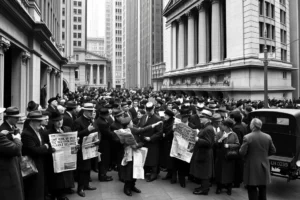
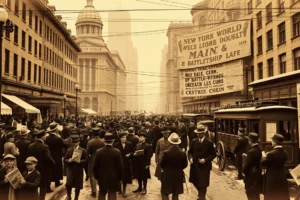
Washington in 1933 is richly documented in photographs. The Library of Congress holds major collections from the period, including the National Photo Company Collection and the Harris & Ewing Collection. These images show Roosevelt and Hoover in open cars on Inauguration Day, crowds lining Pennsylvania Avenue, the Capitol during the emergency session, and the White House under heavy guard. Photographers also captured bank depositors, government offices, street scenes, and Bonus Army camps.
Photographs from the period are valuable because they record details that text often omits: the cut of a man’s overcoat, the expression of a clerk, the signs in a hotel lobby, the cramped offices where emergency agencies worked. News photographers and government photographers documented the New Deal’s early days, while studio portraits and family snapshots preserve everyday life. The visual record confirms that Washington was both a monumental capital and a working city of ordinary people.
Documents & Primary Sources
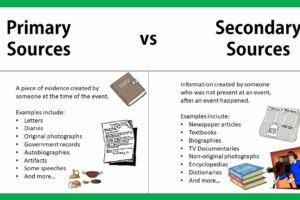
Historians studying Washington in 1933 rely on a wide range of primary sources. The 1930 federal census provides household and demographic data, while District of Columbia government records document local administration, schools, police, and public works. Congressional records, presidential proclamations, and executive orders trace the First Hundred Days. The Franklin D. Roosevelt Presidential Library and Museum holds Roosevelt’s papers, press conferences, and correspondence, including letters from ordinary citizens.
Newspapers are essential. The Washington Post, Washington Evening Star, Washington Daily News, and Black press titles provide daily coverage of local and national events. Magazines such as The New Yorker offer vivid eyewitness reporting. Photographs from the Library of Congress and the National Archives show streets, buildings, crowds, and workplaces. Diaries, letters, and memoirs held by historical societies and university archives add personal perspectives on the crisis.
1933 Timeline
| Date | Event |
|---|---|
| March 4 | Franklin D. Roosevelt inaugurated; Herbert Hoover leaves Washington. |
| March 6 | Roosevelt proclaims a national bank holiday. |
| March 9 | Congress passes the Emergency Banking Act. |
| March 12 | Roosevelt delivers the first fireside chat on banking. |
| March 13 | Banks begin reopening under federal supervision. |
| March 22 | Beer-Wine Revenue Act legalizes 3.2 percent beer. |
| March 31 | Civilian Conservation Corps created. |
| April 19 | United States goes off the gold standard. |
| May 12 | Agricultural Adjustment Act and Federal Emergency Relief Administration created. |
| May 18 | Tennessee Valley Authority established. |
| May–June | Second Bonus Expeditionary Force arrives in Washington. |
| June 16 | National Industrial Recovery Act passes; Hundred Days ends. |
What Changed Next
The First Hundred Days did not end the Depression, but they changed Washington’s role in national life. Federal agencies grew, new buildings and offices appeared, and the city became the center of a expanding New Deal state. The Public Works Administration, the Civil Works Administration, and later agencies brought jobs and construction. Washington’s population continued to grow, and the federal workforce expanded.
The political effects were equally lasting. Roosevelt’s use of radio, press conferences, and emergency legislation set a new model for presidential leadership. The bank holiday and the fireside chat restored some confidence in the banking system, though Recovery was slow and uneven. For Washington residents, the New Deal brought both opportunities and frustrations: jobs and relief, but also continued segregation and limited home rule. The city that had seemed sleepy in 1933 was becoming the command center of modern American government.
Sources
- Morris Markey, Washington Weekend, The New Yorker, March 18, 1933, https://www.newyorker.com/magazine/1933/03/18/a-reporter-at-large-washington-weekend.
- David M. Kennedy, The Hundred Days, in The American People in the Great Depression: Freedom from Fear, Part One (Oxford University Press, 2003), https://doi.org/10.1093/oso/9780195168921.003.0006.
- Anthony J. Badger, FDR: The First Hundred Days (Hill and Wang, 2008).
- William E. Leuchtenburg, Franklin D. Roosevelt and the New Deal, 1932–1940 (Harper & Row, 1963).
- Library of Congress, National Photo Company Collection and Harris & Ewing Collection, https://www.loc.gov/pictures/collection/npco/ and https://www.loc.gov/pictures/collection/hec/.
FAQ
What was the population of Washington, D.C., in 1933?
The 1930 census recorded 486,869 residents in the District of Columbia. By 1933 the population was generally estimated at roughly half a million.
What major events happened in Washington in 1933?
Franklin D. Roosevelt was inaugurated on March 4, the national bank holiday began on March 6, the Emergency Banking Act passed on March 9, and the First Hundred Days produced agencies such as the CCC, AAA, TVA, and NIRA. A second Bonus Expeditionary Force also arrived in May.
What primary sources are available for studying Washington in 1933?
Key sources include the 1930 census, District of Columbia government records, congressional documents, Roosevelt’s papers at the FDR Library, Washington newspapers, The New Yorker, and photographs from the Library of Congress and National Archives.
How did daily life in Washington in 1933 differ from today?
Washington had no elected mayor or subway, streetcars were central to daily travel, segregation shaped schools and public life, and the banking crisis made cash and checks a daily worry. Radio and newspapers were the main sources of immediate news.


Leave a Reply