
Short Answer
Quick Snapshot
In 1923 Berlin was the capital of the Weimar Republic and of Prussia, a vast metropolis of about four million people, and the stage on which Germany’s hyperinflation became a daily, visible crisis. The year began with French and Belgian troops occupying the Ruhr and the German government backing passive resistance; it ended with the introduction of the Rentenmark and the first hesitant signs of stabilization. Between those poles, Berliners experienced money that lost value faster than it could be spent, food queues, shuttered businesses, and a public life saturated with exchange rates.
This article treats Berlin in calendar year 1923, focusing on hyperinflation and everyday survival. ‘Berlin’ here means the Greater Berlin municipality consolidated in 1920, not the older pre-1920 city boundaries. The emphasis is on how ordinary residents—workers, white-collar employees, shopkeepers, children, pensioners—lived through the crisis, as recorded in letters, diaries, newspapers, photographs, and official documents.
The year was not simply an economic collapse. It was also a political emergency, a cultural moment, and a test of municipal government. Berlin’s streets, trams, schools, hospitals, and shops became the places where abstract monetary policy turned into concrete questions: Could wages be spent before they lost value? Was there coal for the stove? Would a pension buy a loaf of bread?
Berlin in 1923
Berlin lies on the North German plain, on the Spree and Havel rivers, with a continental climate of cold winters and warm summers. In 1923 the city was still absorbing the effects of the 1920 Greater Berlin Act, which had merged surrounding towns, villages, and estates into a single municipality. The result was a sprawling urban landscape of tenements, factory districts, railway yards, leafy western suburbs, and administrative centres. The contrast between the fashionable west—around Kurfürstendamm and the Tiergarten—and the crowded working-class districts of the north and east was sharp, though hyperinflation blurred some of those distinctions as salaries and savings collapsed.
The atmosphere was tense, improvised, and exhausting. Berlin was the seat of the Reich government, the Reichstag, and the Prussian state government, so national crises were reported and debated in the city with particular intensity. At the same time, it was a city of neighbourhoods where people stood in queues, argued with shopkeepers, pawned possessions, and traded goods. The mood recorded by contemporaries was not only fear but also a kind of grim humour and disbelief: prices changed so often that waiters, clerks, and children followed the dollar rate as if it were the weather.
Population & Economy
Berlin’s population in 1923 is usually estimated at around four million people, following the 1920 expansion of Greater Berlin. The city was Germany’s largest industrial and administrative centre and a major European capital. Its workforce included metalworkers, electrical workers, garment workers, printers, builders, transport employees, shop assistants, civil servants, and a large service sector. Literacy and newspaper readership were high, and Berlin had a dense network of trade unions, political organisations, and voluntary associations.
The economy was dominated by large firms such as Siemens and AEG in electrical engineering, by metalworking and machine construction, by clothing and textiles, by publishing and printing, and by food processing, brewing, and retail trade. But behind the famous names lay thousands of small workshops and family businesses. Hyperinflation did not affect all equally. Industrialists with debts and foreign currency could sometimes benefit; wage-earners, pensioners, landlords, and people on fixed incomes were devastated. Wages were often paid daily or even more frequently, and workers rushed to convert cash into goods before the next price rise.
Cost-of-living figures from 1923 are almost surreal. In February a Berlin correspondent reported that a litre of milk cost 560 marks; by late November Käthe Kollwitz noted that one loaf of bread cost 140 billion marks, later reduced to 80 billion. Rent control and tenancy protection shielded some tenants, but housing was overcrowded and underheated. Unemployment and short-time work spread, while municipal poor relief and soup kitchens struggled to meet demand.
Government & Politics
Berlin was both the Reich capital and the Prussian capital, and its municipal government was headed by Oberbürgermeister Gustav Böß, a liberal economist who served from 1921 to 1929. The city administration had to manage transport, hospitals, schools, poor relief, housing, and food supply under conditions of accelerating inflation. Municipal workers, like other employees, saw their wages chased upward by prices.
At national level, 1923 was dominated by the Ruhr occupation, the passive resistance policy, the chancellorship of Wilhelm Cuno until August, and then Gustav Stresemann’s government from August to November. President Friedrich Ebert remained head of state. The Reichstag and Prussian Landtag sat in Berlin, and political meetings, strikes, and demonstrations were part of the city’s life. The government declared states of emergency and used emergency decrees; Berlin police and Reichswehr units were visible at critical moments. Communist and nationalist agitation competed for attention, while many Berliners concentrated on survival rather than ideology.
The political climate was volatile. Rumours of putsches, separatist plots, and foreign intervention circulated. The Rhenish Republic was proclaimed in October, and in November Adolf Hitler’s putsch in Munich briefly raised fears of wider disorder. Berlin itself remained under government control, but the crisis eroded confidence in parliamentary government and strengthened extremist movements on both left and right.
Industry
Berlin’s industrial base was broad and modern. Siemens & Halske and AEG employed thousands in electrical engineering and communications; machine works, metal foundries, and chemical plants supplied domestic and export markets. The clothing trade, centred in the Scheunenviertel and surrounding districts, was a major employer, much of it in small workshops. Printing and publishing made Berlin a newspaper and book centre, with firms producing everything from mass-circulation dailies to avant-garde journals.
Hyperinflation disrupted industry in contradictory ways. Some firms with debts and access to foreign currency could profit from inflation; others suffered from shortages of raw materials, transport bottlenecks, and falling real wages. Short-time work and layoffs spread. The letters of a Berliner named Wolfgang to the American composer Edgar Stillman Kelley record the closure of a literary office where he had been hired: after three months the company rescinded the job because costs were too high. Such small disasters were repeated across the city’s commercial and industrial life.
Education
Berlin had a dense educational system, from elementary and secondary schools to the Friedrich-Wilhelms-Universität, the Technische Hochschule in Charlottenburg, and numerous technical and commercial institutes. Literacy was high, and the city’s schools were part of a wider Weimar experiment in educational reform. But 1923 placed enormous strain on pupils and teachers. Teachers’ salaries lost value, schools faced shortages of fuel, paper, and food, and malnourished children struggled to concentrate.
Municipal and voluntary organisations expanded school meals and relief, but demand outstripped resources. University students took on paid work, sold possessions, or relied on family and foreign aid. The crisis also shaped children’s consciousness: Käthe Kollwitz recorded a small child asking, ‘How is the dollar doing?’ and another child seeing telegraph wires and asking, ‘Mother, is that the dollar?’ Such anecdotes show how completely the currency had entered everyday speech.
Transportation
Berliners moved by electric tram, bus, U-Bahn, S-Bahn, and suburban railway. The city’s transport network was among the most modern in Europe, but 1923 made every journey a calculation. Fares rose repeatedly, and passengers sometimes found that the price of a ticket had changed between stations. Conductors, ticket offices, and municipal treasuries struggled with the logistics of rapidly depreciating cash. Many people walked when they could, both to save money and because services were crowded or unreliable.
The railways were also vital for bringing food, coal, and raw materials into the city. The Reichsbahn, still recovering from wartime damage and reparations demands, faced coal shortages and political disruption. The Ruhr occupation and passive resistance affected supplies of coal and iron, with knock-on effects for Berlin’s factories, gasworks, and domestic heating.
Everyday Life
Daily life in 1923 Berlin was organised around the race against prices. Workers collected wages and hurried to buy food, coal, or clothing before the money lost value. Some employers paid several times a day; shoppers carried baskets or bags of banknotes; shopkeepers repriced goods constantly. Barter became common: goods, cigarettes, foreign currency, and services were exchanged alongside paper marks. Notgeld, emergency money issued by municipalities and firms, circulated in some areas, and foreign currencies—especially the dollar—served as a reference point.
Food was the central concern. Bread, milk, potatoes, fat, and meat were scarce or unaffordable. Queues formed outside shops and soup kitchens. Malnutrition weakened resistance to disease; tuberculosis and rickets were recurring fears. Housing was overcrowded, and coal shortages made winters miserable. Clothing was patched and repatched. Yet ordinary life did not stop: people went to work, cared for children, visited cinemas, drank in taverns, and followed sport and theatre. Berlin’s famous nightlife and cultural experimentation continued, though often in a darker, more desperate key.
Käthe Kollwitz, who lived in a working-class district with her physician husband Karl, recorded the human cost with few words and many exclamation marks. In late November 1923 she wrote of hunger, looting, and unemployment. The crisis was not only statistical; it was written on bodies and in family budgets.
Major Events
The year’s defining event was the Ruhr occupation. In January 1923 French and Belgian troops entered Germany’s industrial heartland to enforce reparations deliveries. The German government responded with passive resistance, promising to support workers who refused to cooperate. This policy required massive government spending and more money printing, accelerating inflation. Berlin, as the political capital, was the site of debates, decrees, and protests about the Ruhr.
In August the Cuno government fell after a nationwide general strike, and Gustav Stresemann formed a new government. In September Stresemann ended passive resistance, a painful decision that nevertheless opened the way to stabilization. In November the Rentenmark was introduced, and the old Papiermark was effectively abandoned. The Munich putsch of 8-9 November briefly threatened a wider nationalist uprising, but it failed. By December the dollar rate had fallen and prices were beginning to stabilise, though relief came slowly.
What Newspapers Were Reporting
Berlin’s newspapers—among them the Berliner Tageblatt, Vossische Zeitung, Vorwärts, Deutsche Allgemeine Zeitung, and the mass-circulation B.Z. am Mittag—were filled with the crisis. They printed daily exchange rates, commodity prices, strike notices, government decrees, and reports from the Ruhr. The letters of Wolfgang to Edgar Stillman Kelley mention an enclosed article from that day’s newspaper comparing prices in Germany and America; such comparisons were a staple of the press.
Newspapers reported the dollar’s rise, the cost of bread and milk, the closure of businesses, and the difficulties of municipal relief. They carried advertisements for goods priced in foreign currency and notices from firms adjusting wages. Political reporting covered the Reichstag, the Prussian government, and the emergency decrees. The press was also a means of coping: readers clipped articles, sent them abroad, and used them to explain their situation to relatives and friends.
“A liter of milk now costs 560 marks,” wrote Wolfgang in February 1923. “In our house, where many old ladies live on small pensions, almost every week someone dies of exhaustion—starved to death!!!”
What People Were Talking About
Conversation in Berlin in 1923 returned constantly to the dollar, prices, and the future. People discussed whether to emigrate, whether to buy goods or hold foreign currency, and whether the government could restore order. Kollwitz’s diary records family conversations about leaving Germany: ‘One cannot make a happy life here.’ The letters to America show similar calculations: Wolfgang hoped Kelley might invite him and his wife to Oxford, Ohio, because ‘it is almost impossible to live a decent life here.’
Rumours circulated about secret supplies, hoarded food, and political plots. Children absorbed adult anxieties and repeated them in play. The crisis also produced solidarity: neighbours shared food, unions organised relief, and municipal kitchens fed thousands. But it produced suspicion too—of profiteers, foreigners, and politicians. The public mood combined exhaustion, anger, and a grim fascination with the numbers.
Historical Photographs
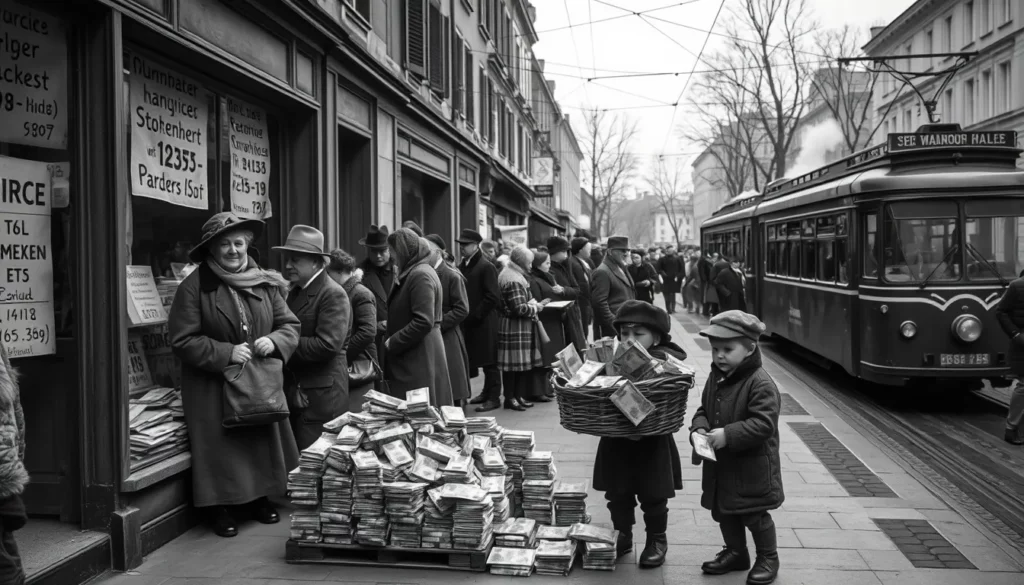
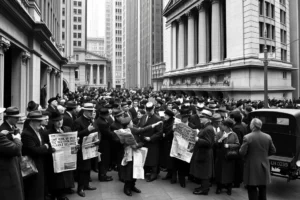
Photographs from Berlin in 1923 show queues outside shops, children playing with bundles of banknotes, shop windows filled with handwritten prices, and families carrying cash in baskets or bags. Press photographers and illustrated magazines such as the Berliner Illustrirte Zeitung recorded the crisis for mass audiences. The images are often staged or selective, but they capture the visual shock of hyperinflation: money as waste paper, children using stacks of notes as toys, and adults moving through streets with the strained expressions of people doing arithmetic.
Other photographs document political meetings, strikes, street demonstrations, and the city’s transport and housing conditions. Together with film footage and postcards, they provide a visual record of how Berliners experienced the year. Historians use them cautiously, asking who took the photograph, for what audience, and what it included or omitted.
Documents & Primary Sources
Historians of Berlin in 1923 rely on a wide range of primary sources. Personal letters and diaries—such as Wolfgang’s letters to Edgar Stillman Kelley and Käthe Kollwitz’s diaries—give intimate accounts of prices, hunger, work, and fear. Newspapers provide daily prices, political reports, advertisements, and obituaries. Municipal records document poor relief, housing, schools, and transport. Banknotes, Notgeld, ration cards, wage slips, and shop receipts are material evidence of everyday transactions.
Police reports, Reichstag and Prussian Landtag proceedings, and government decrees illuminate the political and administrative response. Photographs, posters, and films show the visual culture of the crisis. Address books and city directories help reconstruct neighbourhoods and occupations. Later memoirs and oral histories add recollection, though they must be checked against contemporary documents.
1923 Timeline
| Date | Event |
|---|---|
| January 1923 | French and Belgian troops occupy the Ruhr; Berlin government backs passive resistance. |
| February 1923 | Wolfgang’s letters to America record milk at 560 marks a litre and mounting layoffs. |
| August 1923 | Nationwide strikes bring down the Cuno government; Gustav Stresemann becomes chancellor. |
| September 1923 | Stresemann ends passive resistance and imposes a state of emergency. |
| October 1923 | The Rhenish Republic is proclaimed; Kollwitz notes the dollar at 40 billion marks. |
| November 8-9 1923 | Hitler’s Munich putsch fails; Berlin remains under government control. |
| November 15 1923 | The Rentenmark is introduced to stabilise the currency. |
| Late November 1923 | Kollwitz records bread at 140 billion marks, later 80 billion; hunger and unemployment persist. |
| December 1923 | Prices begin to stabilise, though relief is slow and hardship continues. |
What Changed Next
The Rentenmark and the ending of passive resistance marked a turning point. In 1924 the Dawes Plan renegotiated reparations and foreign loans helped stabilise the currency. Berlin entered the so-called Golden Twenties, with new housing, cultural experimentation, and a fragile economic recovery. But the trauma of 1923 remained. Savings had been wiped out; many middle-class families never recovered their former status; and faith in the Weimar Republic was weakened. The experience of hyperinflation shaped later political behaviour and made many Germans fearful of inflation for decades.
Berlin itself changed rapidly after 1923. The city continued to grow culturally and architecturally, but the crisis had exposed the fragility of its economy and administration. The stabilization was real, but it was built on foreign loans and political compromises that would be tested again after 1929.
Sources
- German History in Documents and Images, ‘Letters to America Reflect the Effects of Hyperinflation in Berlin (February 1923)’, https://germanhistorydocs.org/en/weimar-germany-1918-1933/ghdi:document-5414.
- German History in Documents and Images, ‘Käthe Kollwitz on Hyperinflation (1922/1923)’, https://germanhistorydocs.org/en/weimar-germany-1918-1933/kaethe-kollwitz-on-the-effects-of-hyperinflation-1922-23.
- Gerald D. Feldman, The Great Disorder: Politics, Economics, and Society in the German Inflation, 1914-1924. New York: Oxford University Press, 1993.
- Detlev J. K. Peukert, The Weimar Republic: The Crisis of Classical Modernity. New York: Hill and Wang, 1992.
- Berliner Tageblatt, 1923, digitised newspaper collection, Staatsbibliothek zu Berlin / ZEFYS.
FAQ
What was the population of Berlin in 1923?
Berlin's population in 1923 is usually estimated at around four million people, following the 1920 creation of Greater Berlin; the 1925 census recorded about 4.02 million.
What major events happened in Berlin in 1923?
The year was dominated by the Ruhr occupation and passive resistance, the fall of the Cuno government, Stresemann's chancellorship, the end of passive resistance, the Rentenmark reform, and the political shock of the Munich putsch.
What primary sources are available for studying Berlin in 1923?
Researchers use personal letters and diaries such as Wolfgang's letters to Edgar Stillman Kelley and Käthe Kollwitz's diaries, Berlin newspapers, municipal records, police reports, banknotes and Notgeld, ration cards, wage slips, photographs, and government decrees.
How did daily life in Berlin in 1923 differ from today?
Money lost value by the hour, wages were spent immediately, barter and foreign currency were common, food and coal were scarce, and children followed the dollar rate as ordinary conversation. Modern electronic payments, stable currency, and extensive social welfare did not exist in the same form.




Leave a Reply