
Short Answer
Quick Snapshot
Paris in 1919 was a city of official triumph and private anxiety. The Great War had ended in November 1918, and the French capital became the diplomatic centre of the world as the Paris Peace Conference opened at the Quai d’Orsay on 18 January 1919. This article treats “Paris in 1919” as the city of Paris during the year of the Paris Peace Conference; it is not a study of the later peace settlement alone.
The city hosted the “Big Four”—Woodrow Wilson, David Lloyd George, Georges Clemenceau, and Vittorio Emanuele Orlando—along with delegations from across the globe. On 28 June the Treaty of Versailles was signed in the Hall of Mirrors, and on 14 July a great victory parade moved through Paris. Yet the streets also held demobilised soldiers, war widows, striking workers, and the sick.
Contemporaries experienced 1919 as both an ending and a beginning. The peace conference promised a new world order, but inflation, coal shortages, labour unrest, and the Spanish influenza pandemic gave daily life an uneasy edge. Paris was victorious, but it was not at ease.
Paris in 1919
Paris lay astride the Seine, its grand boulevards and Haussmann apartment blocks still ringed by the old Thiers fortifications, then in the early stages of demolition. The city’s geography shaped both ceremony and hardship: government ministries clustered near the river, fashionable districts stood to the west, and working-class neighbourhoods such as Belleville and Ménilmontant pressed against the northern and eastern edges. The spring of 1919 was cold and unsettled, and coal shortages made heated rooms a luxury.
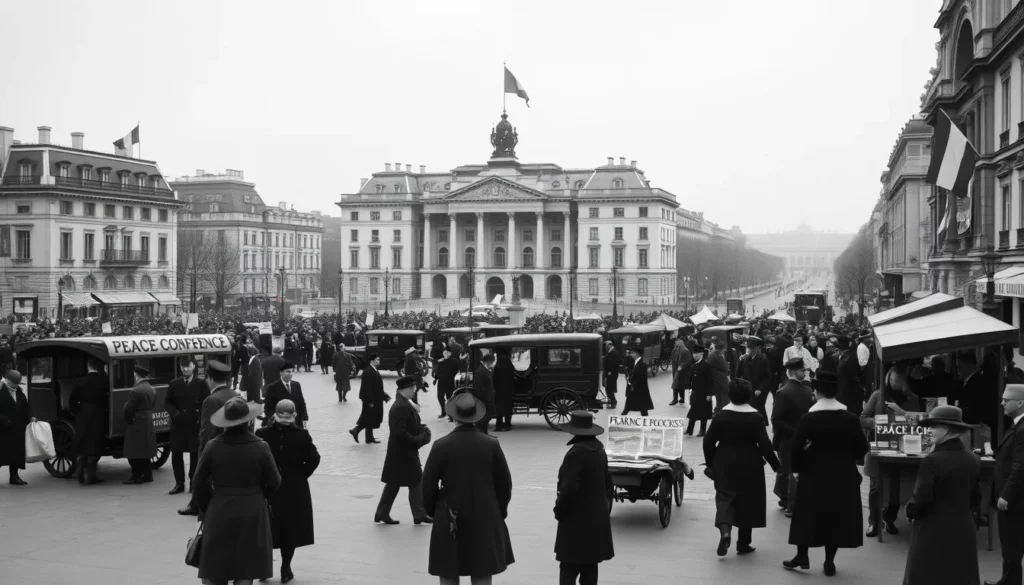
The atmosphere was layered. Official Paris glittered with flags, motorcars, uniforms, and newspaper kiosks carrying the latest communiqués. Ordinary Parisians queued for bread, mourned the dead, and followed the conference in the press. The city was still a wartime capital in its habits—rationing, price controls, and rent restrictions continued—even as it began to imagine the pleasures and freedoms of the postwar decade.
Population & Economy
Greater Paris remained one of Europe’s largest urban centres. The city of Paris had about 2.9 million inhabitants, a figure slightly below the pre-war peak and recovering only slowly after military deaths, civilian casualties, and displacement. The wider Seine department was larger still, drawing migrants from the provinces and colonial workers into its factories, workshops, and service trades.
The economy was in transition from war to peace. Wartime factories that had produced shells, aircraft, and uniforms began to convert to civilian goods, while demobilisation flooded the labour market. Prices rose sharply, and the franc’s purchasing power fell. Rent control, introduced in 1914, kept many families in their apartments but discouraged new construction. Coal, bread, milk, and sugar remained sensitive commodities. Yet Paris also remained a centre of finance, luxury production, publishing, and government employment, and its department stores and cafés showed signs of revived commercial life.
Government & Politics
Paris had no elected mayor in 1919; since 1871 the city had been administered through the Prefect of the Seine and the Prefect of Police. Eugène Guérin served as Prefect of the Seine from 1918, working alongside the municipal council and national ministries. This prefectoral system made Paris unusually dependent on the central state, especially during a year of national emergency and international conference.
National politics dominated the city. Georges Clemenceau, the wartime premier, was both the host of the peace conference and a formidable political figure. President Raymond Poincaré remained head of state, while French deputies debated ratification, reparations, and the League of Nations. In November 1919 legislative elections produced a conservative “Bloc national” majority, reflecting a mood of patriotic vigilance and anxiety about Bolshevism. Paris itself remained a stronghold of radical, socialist, and labour politics, and its streets were a stage for both official ceremony and protest.
Industry
Parisian industry was diverse. Luxury trades—haute couture, jewellery, perfumery, and furniture—employed skilled workers and sustained the city’s international reputation. Printing and publishing thrived on the demand for newspapers, posters, and political pamphlets. Metallurgical workshops, chemical plants, and food-processing businesses operated in the inner suburbs, while the automobile industry expanded on the outskirts: André Citroën founded his car company in 1919, and Renault’s works at Boulogne-Billancourt remained a major employer.
Aviation was another symbol of the new age. Le Bourget airfield linked Paris to the wider world, and in August 1919 a regular Paris–London passenger air service began. Banking, insurance, and government administration also provided work for the city’s large clerical workforce. The contrast between modern industry and older artisan trades was part of Paris’s economic texture in 1919.
Education
Paris was the educational centre of France. The University of Paris, centred on the Sorbonne, attracted students from the provinces and abroad, while the École Polytechnique, the École libre des sciences politiques, and other grandes écoles trained the nation’s administrative and technical elite. Lycées and municipal schools served the city’s middle and working classes. Literacy was high by contemporary European standards, though educational provision remained socially unequal.
The year 1919 brought reform as well as recovery. The Loi Astier of 25 July 1919 established a framework for technical education, recognising the importance of skilled training for industry. Schools and universities also had to absorb demobilised students and teachers, and the war’s legacy shaped debates about citizenship, morality, and the purpose of education in a democratic society.
Transportation
Parisians moved by métro, tram, bus, taxi, bicycle, and on foot. The métro, opened in 1900, was already an essential part of urban life, carrying workers between the centre and the growing suburbs. Trams and buses supplemented the underground network, while private motorcars and taxis became more visible after the war. The mainline railway stations—Gare Saint-Lazare, Gare du Nord, Gare de l’Est, Gare de Lyon, and Gare d’Orsay—connected Paris to the provinces and to the peace conference’s international visitors.
Air transport was still in its infancy but captured public imagination. The first daily international passenger service between Paris and London began in 1919, a sign that the postwar world would be more closely connected. Within the city, congestion, coal shortages, and strikes could disrupt transport, making daily commuting unpredictable.
Everyday Life
Daily life in Paris in 1919 mixed relief with scarcity. Families reunited with returning soldiers, but many households were headed by widows or depended on pensions. Housing was crowded, and rent control kept old apartments affordable but discouraged repairs. Food remained expensive: bread, meat, milk, and coal were watched closely by housewives and officials alike. Clothing was practical and often dark, reflecting both wartime austerity and mourning customs.
Yet Paris also offered escape. Cafés, cinemas, music halls, and the Opéra drew audiences, and the first signs of the “années folles” could be seen in fashion and nightlife. The Spanish influenza pandemic continued to sicken and kill in 1919, adding to the sense of fragility. Social customs were changing: women had taken on new wartime roles, and debates over their place in work, politics, and public life grew more visible.
Major Events
The Paris Peace Conference opened on 18 January at the French Ministry of Foreign Affairs on the Quai d’Orsay. On 19 February an anarchist, Émile Cottin, shot and wounded Clemenceau; the premier recovered and insisted that the conference continue. In April the League of Nations Covenant was adopted, and in May the draft treaty was presented to the German delegation. On 28 June 1919 the Treaty of Versailles was signed in the Hall of Mirrors at the Palace of Versailles.
On 14 July Paris staged a massive victory parade, with Allied troops marching through the Arc de Triomphe and crowds filling the Champs-Élysées. In September the Treaty of Saint-Germain with Austria was signed at Saint-Germain-en-Laye, and in November the Treaty of Neuilly with Bulgaria followed. National legislative elections in November 1919 produced a conservative majority, while labour strikes and cost-of-living protests revealed the social tensions beneath the official celebrations.
What Newspapers Were Reporting
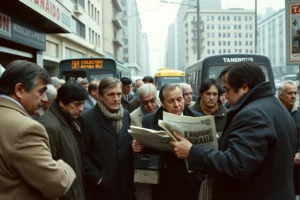
Parisian newspapers—Le Petit Parisien, Le Matin, Le Figaro, Le Temps, and L’Humanité—gave extensive coverage to the peace conference, the treaty terms, and the victory celebrations. Front pages carried communiqués from the Quai d’Orsay, reports on Wilson and Clemenceau, and speculation about German reparations. The attack on Clemenceau in February was reported in dramatic detail, as was the signing of the treaty in June. Newspapers also covered bread prices, strikes, and the influenza epidemic.
“This is not a peace,” wrote John Maynard Keynes in The Economic Consequences of the Peace (1919). He called the treaty a “Carthaginian Peace,” warning that it would reduce Germany to servitude and damage the whole civilised life of Europe.
Not all Parisians agreed with Keynes. Many French commentators thought the treaty too lenient, and newspapers reflected a public mood that was by turns triumphant, suspicious, and anxious about the future.
What People Were Talking About
Conversations in cafés, queues, and workshops turned on the peace terms. Would Germany pay? Was the League of Nations a real guarantor of security? What had become of the promises made to colonial peoples and small nations? The Bolshevik Revolution and the threat of revolutionary unrest also haunted public debate, especially after strikes and mutinies in Europe. Parisians discussed demobilisation, the return of Alsace-Lorraine, and the fate of the war dead.
Private letters and diaries from the period reveal more intimate concerns: the cost of coal, a son’s return, a husband’s wounds, the fear of influenza, and the difficulty of finding housing. Rumours about secret diplomacy and German intentions circulated widely. The victory parade was a moment of shared emotion, but it did not erase grief or uncertainty.
Historical Photographs
A rich visual record survives. The Agence Rol and Agence Meurisse collections at the Bibliothèque nationale de France, along with press photographs and postcards, show the Big Four at the Quai d’Orsay, crowds outside Versailles, the signing of the treaty in the Hall of Mirrors, and the victory parade on 14 July. Other images capture street scenes, returning soldiers, newspaper kiosks, and the wounded Clemenceau after the assassination attempt.
These photographs are significant because they show both the official theatre of peacemaking and the ordinary life of the city. They also reveal the limits of the visual record: the influenza pandemic, domestic interiors, and the poor are less well documented than ceremonies and statesmen.
Documents & Primary Sources
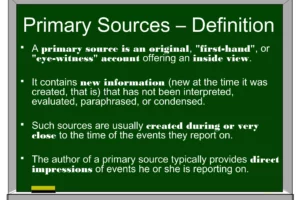
Historians of Paris in 1919 rely on a wide range of primary sources:
- Diplomatic records and minutes of the Paris Peace Conference, including the Council of Four and the treaty drafts, held in French, British, and American archives.
- French government and prefectoral papers in the Archives nationales and the Archives de Paris, including police reports on strikes, demonstrations, and public order.
- Newspapers such as Le Petit Parisien, Le Figaro, Le Matin, and L’Humanité, available in the Bibliothèque nationale de France.
- Personal letters, diaries, and memoirs held in the Bibliothèque historique de la Ville de Paris and private collections.
- Photographs, posters, maps, and postcards in the BnF and other visual archives.
1919 Timeline
| Date | Event |
|---|---|
| 18 January | Paris Peace Conference opens at the Quai d’Orsay. |
| 19 February | Émile Cottin shoots and wounds Georges Clemenceau. |
| April | League of Nations Covenant adopted; Italy withdraws over Fiume. |
| 7 May | Treaty terms presented to the German delegation. |
| 28 June | Treaty of Versailles signed in the Hall of Mirrors. |
| 14 July | Allied victory parade through Paris. |
| 10 September | Treaty of Saint-Germain with Austria signed. |
| 16 November | French legislative elections produce a conservative majority. |
| 27 November | Treaty of Neuilly with Bulgaria signed. |
What Changed Next
The Paris settlement of 1919 did not produce a stable world order. The United States Senate rejected the Treaty of Versailles in 1920, weakening the League of Nations and American engagement in Europe. Reparations disputes, French occupation of the Ruhr in 1923, and German hyperinflation poisoned international relations. In Paris, the early 1920s brought the “années folles,” tourism, and cultural experimentation, but also inflation, strikes, and political polarisation.
Within two decades the settlement collapsed into another world war. The peace conference’s promises to colonial peoples and small nations remained largely unfulfilled, while the treaty’s harsh terms and enforcement problems became a warning lesson for later statesmen. Paris in 1919 thus stands as a moment of hope, victory, and unresolved danger.
Sources
- David Reynolds, “Polychronicon 175: Paris 1919 – a century on,” Historical Association, 2019.
- Laurence Badel, Eckart Conze, and Axel Dröber, eds., The Paris Peace Conference of 1919: The Challenge of a New World Order (De Gruyter, 2024).
- John Maynard Keynes, The Economic Consequences of the Peace (London: Macmillan, 1919).
- U.S. Department of State, Papers Relating to the Foreign Relations of the United States, The Paris Peace Conference, 1919 (Washington: GPO, 1942–47).
- Margaret MacMillan, Paris 1919: Six Months That Changed the World (New York: Random House, 2001).
FAQ
What was the population of Paris in 1919?
The city of Paris had roughly 2.9 million inhabitants in 1919; the 1921 census recorded 2,906,472. The wider Seine department was substantially larger.
What major events happened in Paris in 1919?
The Paris Peace Conference opened in January, Clemenceau survived an assassination attempt in February, the Treaty of Versailles was signed in June, and a great victory parade took place on 14 July. Later in the year came the Treaty of Saint-Germain, the Treaty of Neuilly, and national elections.
What primary sources are available for studying Paris in 1919?
Key sources include diplomatic conference records, French prefectoral and police archives, newspapers such as Le Petit Parisien and Le Figaro, personal letters and diaries, photographs from the Agence Rol and Agence Meurisse collections, posters, maps, and treaty drafts held in national archives.
How did daily life in Paris in 1919 differ from today?
Daily life was shaped by postwar shortages, inflation, rent control, coal scarcity, mourning, and the Spanish influenza pandemic. Transport relied on the métro, trams, buses, and railways rather than private cars, and news travelled through newspapers and word of mouth rather than radio and the internet.



Leave a Reply